
An Evolving Science
Cloud classification serves multiple purposes. It provides meteorologists with a common language, allowing consistent observation across regions and time.
It allows scientists to infer atmospheric processes from visual patterns and physical properties. Modern classification also underpins weather prediction, climate modelling, and aviation safety.
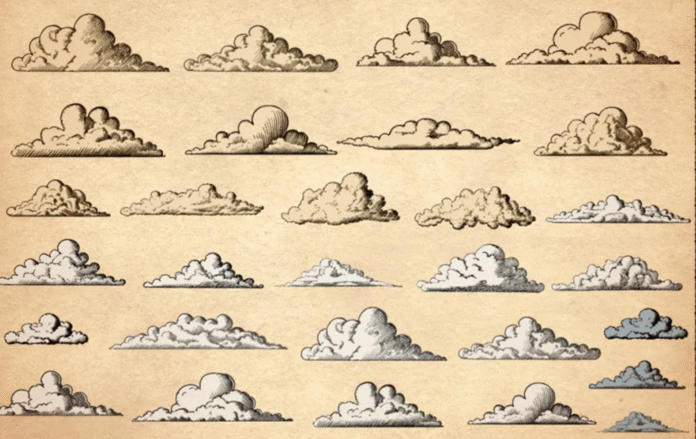
The evolution from early observational systems, such as Luke Howard’s 1803 cloud classification, to the modern World Meteorological Organization (WMO) framework illustrates the integration of empirical observation, physics, and technology.
Today, clouds are classified by height, structure, composition, and developmental behaviour, providing a comprehensive understanding of atmospheric dynamics.
Historical Context and Evolution
The foundation of modern cloud classification lies in the work of Luke Howard. In 1803, Howard introduced four primary cloud types: cirrus, cumulus, stratus, and nimbus, based on appearance and form.
His system provided a descriptive vocabulary that allowed observers to record and compare clouds consistently.
Later refinements introduced compound types, such as cirrostratus, stratocumulus, and cumulonimbus, reflecting transitions and variations within the basic forms.
Howard’s morphological approach, while insightful, did not consider altitude, thermodynamic processes, or composition, which became central to the 20th-century scientific understanding of clouds.
The International Meteorological Committee, under the auspices of the WMO, formalised a more structured classification in the late 19th and early 20th centuries.
The International Cloud Atlas (1896, revised multiple times) established ten main cloud genera, later expanded with species and varieties, based on both height and morphological characteristics.
Modern cloud classification integrates Howard’s morphological approach with quantitative criteria.
Technological advances, including radar, satellite imagery, and lidar, allow meteorologists to observe clouds globally, determine altitudes, thickness, and water content, and detect clouds that are invisible to the naked eye.
These tools have extended the practical and scientific applications of cloud classification far beyond Howard’s initial framework.
Core Principles of Modern Cloud Classification
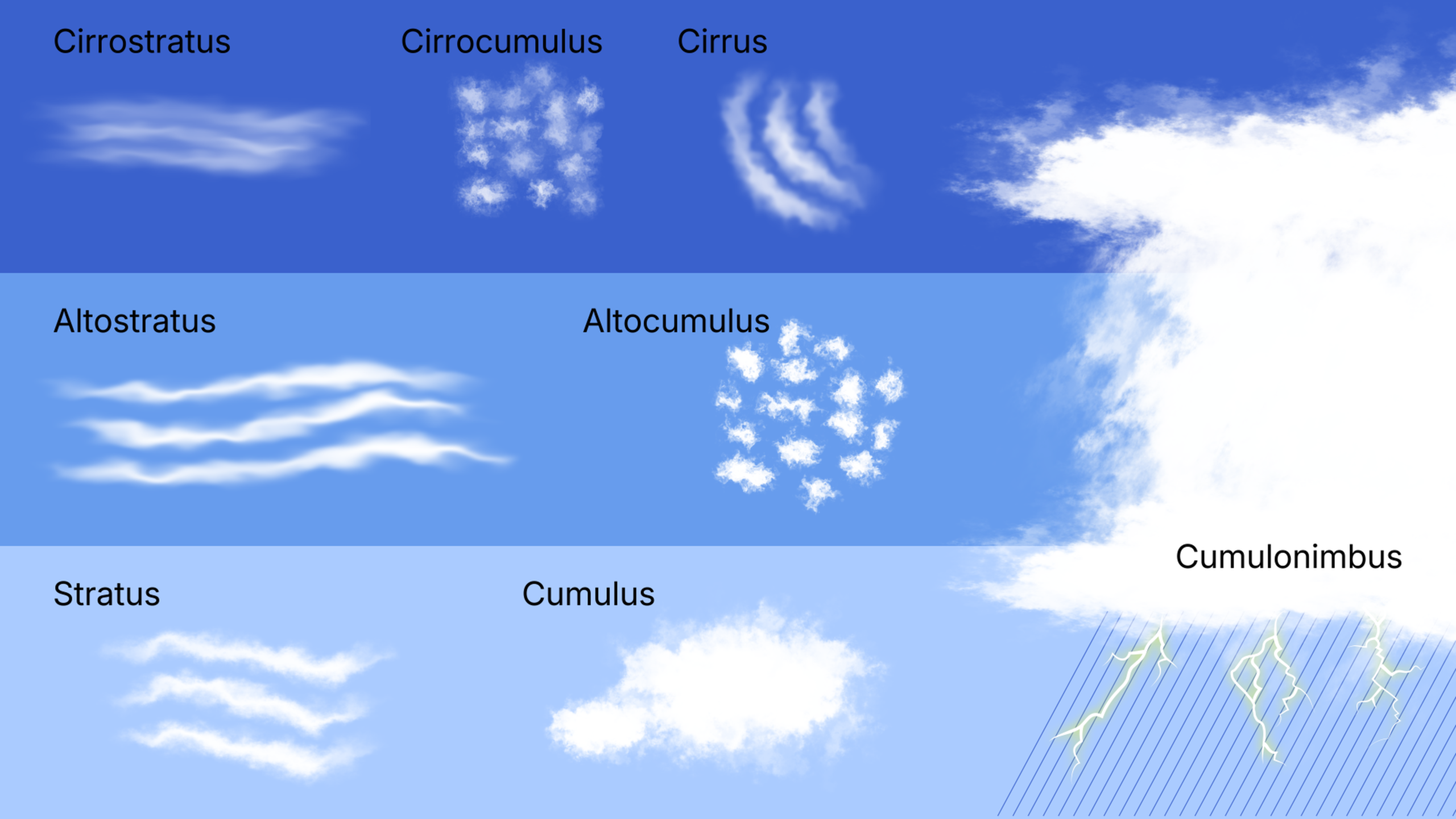
The modern system classifies clouds based on four main principles: altitude, form, composition, and development.
Each principle provides insight into the atmospheric processes that govern cloud formation, evolution, and precipitation.
Altitude-Based Classification
Clouds are first categorised by height, reflecting the vertical structure of the atmosphere:
- High-Level Clouds (Above 6,000 m)
These clouds form in the upper troposphere, where temperatures are low and air is thin. They are composed primarily of ice crystals. Typical genera include:- Cirrus (Ci)
- Cirrostratus (Cs)
- Cirrocumulus (Cc)
- Mid-Level Clouds (2,000–6,000 m)
Found in the middle troposphere, these clouds often contain supercooled water droplets, with some ice crystals at higher levels. Genera include:- Altostratus (As)
- Altocumulus (Ac)
- Low-Level Clouds (Surface–2,000 m)
These clouds exist in the lowest layers of the atmosphere, primarily composed of liquid water droplets, except in cold conditions. Genera include:- Stratus (St)
- Stratocumulus (Sc)
- Nimbostratus (Ns)
- Clouds with Vertical Development
These clouds span multiple atmospheric layers and exhibit significant vertical motion, often associated with convection. Genera include:- Cumulus (Cu)
- Cumulonimbus (Cb)
Morphology and Form
The shape and structure of clouds provide insight into the underlying dynamics of air movement. Morphological descriptors include:
- Cumuliform: Heaped, dense, and vertically developed clouds, indicating convection.
- Stratiform: Layered clouds with horizontal extent, formed in stable air masses.
- Cirriform: Fibrous or wispy clouds in high, thin layers.
- Lenticular: Lens-shaped clouds forming over topographic features or wave motions.
Form-based classification allows observers to distinguish similar altitude clouds that may behave differently in terms of weather outcomes. For example, altocumulus and cirrocumulus may appear similar in texture but indicate different atmospheric conditions due to altitude and droplet composition.
Development and Dynamics
Modern classification recognises dynamic processes that create clouds:
- Convective clouds: Vertical growth due to buoyant ascent, typically cumulus and cumulonimbus.
- Frontal clouds: Associated with the lifting of air along warm or cold fronts, producing layered stratiform clouds.
- Orographic clouds: Generated by airflow over mountains, creating lenticular or cap clouds.
- Wave clouds: Formed by atmospheric gravity waves, including undulatus and Kelvin-Helmholtz clouds.
By integrating development, meteorologists can forecast weather changes and identify potential hazards such as thunderstorms, turbulence, or heavy precipitation.
The Ten Principal Cloud Genera
The modern WMO classification recognises ten main cloud genera, derived from Howard’s original four types but refined by height, composition, and structure:
- Cirrus (Ci): High-level, fibrous, ice crystal clouds.
- Cirrostratus (Cs): High, thin veil clouds often producing halos.
- Cirrocumulus (Cc): Small, rippled cloudlets forming high-level “mackerel sky” patterns.
- Altostratus (As): Mid-level, uniform grey clouds often preceding precipitation.
- Altocumulus (Ac): Mid-level, patchy clouds, sometimes forming wave or ripple patterns.
- Stratus (St): Low, featureless layers producing overcast conditions.
- Stratocumulus (Sc): Low, lumpy clouds with minimal vertical development.
- Nimbostratus (Ns): Thick, low clouds producing prolonged precipitation.
- Cumulus (Cu): Low-level, heaped clouds formed by convection.
- Cumulonimbus (Cb): Vertically extensive storm clouds capable of producing severe weather.
Each genus may be subdivided into species and varieties reflecting shape, transparency, and internal structure.
For example, altocumulus can appear in sheets (stratiformis), patches (translucidus), or ripples (undulatus).
These subdivisions allow precise communication of cloud type and behaviour.
Technological Advances in Cloud Observation
Modern cloud classification relies on visual observation, but is greatly enhanced by technology:
- Satellite Imagery: Geostationary and polar-orbiting satellites provide continuous global coverage, allowing identification of cloud cover, altitude, and structure. Satellite sensors detect infrared, visible, and water vapour channels, distinguishing cloud phases and thickness.
- Radar: Weather radar detects hydrometeors, mapping precipitation within clouds. It is particularly useful for identifying nimbostratus and cumulonimbus and for estimating rainfall rates.
- Lidar: Light detection and ranging instruments measure cloud base heights and aerosol content. Lidar can resolve thin cirrus layers and subvisible clouds that are difficult to see with the naked eye.
- Numerical Models: Cloud classification is integrated into weather prediction and climate models, where clouds are parameterised by altitude, fraction, and optical properties.
These technologies allow meteorologists to classify clouds in real time, understand microphysical properties, and analyse climatic trends that were inaccessible in Howard’s era.
Cloud Classification and Weather Forecasting
Clouds are indicators of atmospheric stability, moisture content, and vertical motion. Recognising cloud types allows meteorologists to anticipate weather changes:
- High cirrus clouds can signal approaching warm fronts or jet stream disturbances.
- Altostratus or altocumulus often precede moderate precipitation within 12–24 hours.
- Stratus or stratocumulus indicate stable air with limited vertical development.
- Cumulonimbus clouds mark potential thunderstorms, severe convection, and hazards such as hail or tornadoes.
Modern forecasting uses cloud classification in combination with pressure, temperature, and humidity profiles to produce reliable short-term predictions and longer-term climate assessments.
Cloud Classification and Climate Science
Beyond immediate weather forecasting, cloud classification is essential in climate research.
Clouds affect both incoming solar radiation and outgoing infrared radiation, with different types contributing to net warming or cooling. For example:
- High-level cirrus allow sunlight to pass but trap infrared radiation, producing a warming effect.
- Low-level stratocumulus reflect sunlight, producing a cooling effect.
Global climate models rely on accurate cloud fraction, type, and optical properties to simulate energy budgets.
Misrepresentation of clouds remains one of the largest sources of uncertainty in climate projections, highlighting the continuing relevance of detailed cloud classification.
The Future of Cloud Classification
Cloud classification continues to evolve with new technologies and scientific understanding:
- Subvisible clouds: Ultra-thin clouds detected by lidar and satellite, influencing stratospheric radiation budgets.
- Microphysical classification: Differentiating droplet sizes, ice crystal habits, and mixed-phase processes for precipitation prediction.
- Machine learning: Automated cloud recognition from satellite imagery and ground-based cameras, improving consistency and coverage.
- Climate monitoring: Long-term cloud observations are central to detecting changes in cloud cover, type distribution, and altitude linked to climate change.
Despite technological advances, visual observation remains critical. Many meteorologists and pilots rely on human cloud recognition for situational awareness and immediate decision-making.
Modern cloud classification builds upon the foundation laid by Luke Howard, expanding it with scientific rigour and technological precision.
By integrating height, morphology, composition, and development, it allows meteorologists to interpret the atmosphere’s visible structures and link them to physical processes.
Cloud classification serves multiple purposes: it provides a common language for observation, a tool for weather forecasting, a framework for climate study, and a way to connect human experience with atmospheric science.
rom cirrus streaks high in the upper troposphere to cumulonimbus towers of thunder, clouds remain both objects of beauty and vital indicators of the dynamic atmosphere.
As technology advances, our understanding of clouds continues to deepen, but the essential principles remain unchanged: careful observation, systematic classification, and interpretation based on physical processes.