How physicist David Grimes’s equation shows why vast conspiracies collapse
In 2016, physicist and science communicator Dr David Robert Grimes published a striking paper in PLOS ONE titled “On the Viability of Conspiratorial Beliefs.” Here, we apply this paper to Chemtrails.
His research offered a mathematical lens through which to examine the longevity of secret plots. Grimes’s formula, deceptively simple, quantified what intuition long suggested: large conspiracies are almost certain to fail because people talk, accidents happen, and truth leaks out.
He calculated that a conspiracy involving more than a few hundred people would likely be exposed within just a few years. Specifically, for secrecy to last five years, the operation could involve no more than 2,521 individuals. Beyond that, the probability of exposure rises steeply over time.
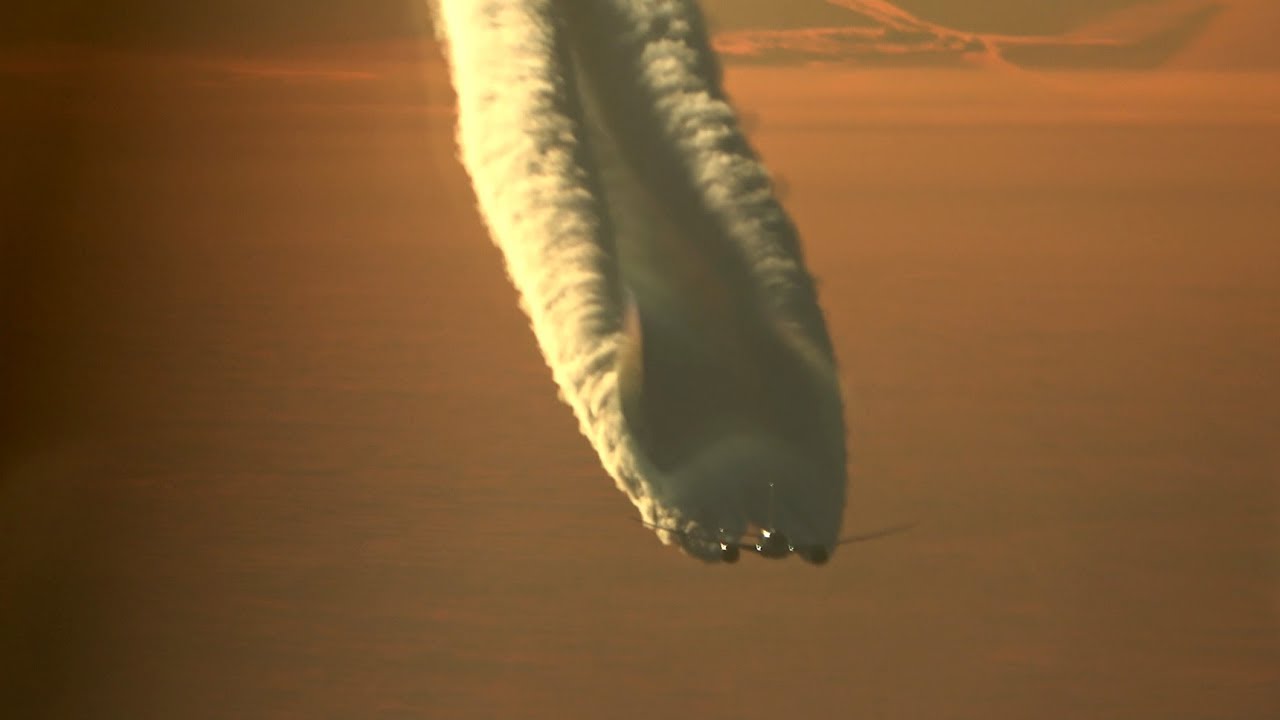
This analysis becomes particularly relevant when applied to one of the most persistent modern myths, the chemtrail conspiracy theory, which claims that aircraft are secretly spraying chemicals into the atmosphere for sinister purposes such as population control, weather modification, or climate manipulation.
Could such a vast and long-running programme really remain hidden for nearly three decades? Grimes’s mathematics provides a rigorous way to find out.
Grimes’s Mathematical Model of Secrecy
The structure of the model
Grimes’s model begins with a simple assumption: every conspirator has a small, constant probability (p) of exposing the secret, whether intentionally (whistle-blowing) or accidentally (error, death, disclosure). For N conspirators, the collective probability of a leak grows with N.
If each individual has a failure probability p per year, then the probability that the conspiracy remains secret for time t is approximately

and the probability that it has leaked by that time is

This means that even when p is very small, increasing N or t drastically reduces secrecy survival.
Estimating p
To ground his formula, Grimes examined real-world examples of exposed conspiracies, including the NSA’s PRISM surveillance programme, the Tuskegee Syphilis study, and the FBI forensic fraud case.
By analysing how long these operations remained secret before leaking, he estimated an individual failure rate of around 4.09 × 10⁻⁶ per person per year, a remarkably conservative figure.
The implications
Plugging that number into the model shows that a conspiracy involving a thousand people would have a 95 % probability of exposure within a few decades. For secrecy to last a century, it would require fewer than 125 people.
Grimes’s insight is straightforward: the more people who know, and the longer they must keep silent, the greater the certainty of discovery.
Applying Grimes’s Model to the Chemtrail Theory
Estimating the number of conspirators
To understand the chemtrail claim through Grimes’s mathematics, we must first estimate how many individuals would realistically need to participate in such a programme.
Even a conservative scenario within the continental United States would require significant manpower.
The resources required are estimated in this article.
Suppose 150 aircraft are allegedly assigned to spraying duties, each flying one sortie per day. That equals around 54,750 flights per year.
Each flight would need at least a pilot and co-pilot, ground crew for loading and fuelling, maintenance staff, schedulers, and logistics coordinators — perhaps eight to ten personnel per aircraft.
Across rotations, training, supply chains, and oversight, this would involve at least 10,000 people, likely many more once manufacturers, chemical suppliers, regulators, and administrative layers are included.
Therefore, for a national programme:
- Low-case: 2,000 conspirators (an implausibly small and tightly controlled operation)
- Mid-case: 20,000 conspirators (a realistic national-scale network)
- High-case: 100,000 or more (multi-agency or multinational scale)
Estimating the duration
Chemtrail believers generally claim the programme began in the mid-1990s, meaning it has operated for roughly 25 to 30 years. This provides the time frame t for our analysis.
Running the numbers
Using Grimes’s leak probability p = 4.09 × 10⁻⁶ per person per year, we can calculate the expected exposure rate (φ = p × N) and resulting leak probability over time.
- Low-case (N = 2,000):
After 5 years, 4% chance of exposure; after 10 years, 8%; after 30 years, about 22 %. - Mid-case (N = 20,000):
After 5 years, 33% chance of exposure; after 10 years, 56%; after 30 years, 95 %. - High-case (N = 100,000):
After 1 year, 33%; after 2 years, 56 %; after 5 years, 86%; after 10 years, >99 %.
Even with cautious assumptions, the model shows that the probability of a chemtrail operation remaining secret for three decades is vanishingly small — approaching statistical impossibility.
Why Exposure Would Be Inevitable
A real programme on this scale would leave an extensive trail of evidence: procurement contracts for chemicals, flight manifests, engine modification records, maintenance logs, waste disposal data, and inconsistent fuel analyses.
Thousands of staff in aviation and chemical industries would observe irregularities. Satellite data, atmospheric sampling, and public flight-tracking networks would reveal anomalies within months.
In the era of smartphones, social media, and open government, it would take only one technician with a conscience to destroy the illusion of secrecy.
Grimes’s Threshold Applied
Grimes’s benchmark, 2,521 participants for five years of secrecy, is a valuable metric. The chemtrail hypothesis exceeds that threshold by more than an order of magnitude in both personnel and duration.
Even if the risk per individual were ten times smaller, an operation with 10,000 participants over 25 years would still have a 90 % chance of exposure. No human system of that size can maintain silence indefinitely.
Caveats and Clarifications
Grimes’s model simplifies reality, but it errs on the side of generosity. It assumes a constant risk rate, independent actors, and instantaneous exposure after the first leak.
Real conspiracies are even more fragile. Information spreads faster now than ever before, and small breaches multiply through digital media.
Historically, the Manhattan Project employed about 130,000 people, and yet its essential details became public within a year of the first atomic bomb.
If the world’s most secret wartime project could not remain hidden, how could a supposed aerial spraying operation survive thirty years of scrutiny?
Reflecting on the Chemtrail Theory through Grimes’s Lens
The scale problem
The chemtrail narrative imagines a vast alliance of government agencies, airlines, and scientists acting in perfect coordination and silence. But Grimes’s mathematics shows that once thousands of people are involved, silence becomes statistically impossible.
The missing whistle-blowers
Despite decades of accusations, there has never been a verified whistle-blower, authentic document, or physical evidence confirming deliberate chemical dispersal.
According to Grimes’s equation, the absence of leaks after 30 years is not mysterious, it is decisive evidence that no such conspiracy exists.
The psychology of persistence
People are drawn to grand conspiracies because they offer simple villains and moral clarity. Long, persistent contrails are misread as “chemical trails” because they look unusual, not because they are unnatural.
Cognitive biases such as confirmation bias and motivated reasoning reinforce belief, while distrust of institutions ensures that counter-evidence is dismissed.
Mathematics provides an antidote: not through ridicule but through clarity. Grimes’s equation quantifies the intuitive truth that large secrets cannot last.
Summing it up
Grimes’s model transforms scepticism into science. It allows us to measure the fragility of secrecy rather than merely assert it.
When applied to the chemtrail hypothesis, the conclusion is unambiguous: a nationwide or global spraying operation involving 150 aircraft flying daily for 30 years and tens of thousands of people could not remain hidden.
The probability of exposure is effectively 100%. To believe otherwise is to assume that human behaviour, probability, and information dynamics have somehow ceased to operate.
Mathematics, in this sense, is not the enemy of imagination but its boundary. It tells us which stories the real world can sustain, and which must dissolve under the weight of their own improbability.
Editor’s Note
David Robert Grimes, a physicist at the University of Oxford, is known for his research bridging physics, oncology, and misinformation studies. His work on conspiracy viability is part of a wider movement to apply quantitative reasoning to social phenomena. By showing how secrets statistically decay, Grimes demonstrates that the language of mathematics can illuminate belief itself — revealing why some ideas collapse not through argument, but through arithmetic.