Why is Cyclone Engineering Impossible
Even if every nuclear weapon on Earth were detonated at once, the total energy released would still be less than the energy flux through a single large hurricane. Cyclones are products of planetary-scale thermodynamics, not the work of transmitters or laboratories.

Cyclones are enormous heat engines
A single mature storm releases ~2 × 10²¹ joules, three to four times more energy than humanity uses in a year.

Energy scales are astronomical
HAARP, EMF arrays, and nuclear devices are trillions of times too weak to influence storm formation or steering.

Moisture is critical
Cyclones contain 10¹⁴–10¹⁵ kg of water vapour. Humans cannot evaporate or supply that amount artificially.

Weather modification is limited
Cloud seeding can only slightly enhance rainfall in existing clouds, not create cyclones or direct them.
The true scale of cyclones
Cyclones, hurricanes and typhoons are among the most powerful natural forces on Earth. Each one releases more energy in a few days than humanity consumes in years.
Yet online theories sometimes claim that human technology, such as the High-frequency Active Auroral Research Program (HAARP) or directed electromagnetic fields (EMF), could somehow create or steer these vast systems.
The evidence from atmospheric physics shows otherwise. Cyclones draw their strength from enormous amounts of heat and moisture stored in the oceans. The energy involved is so immense that no man-made system could possibly replicate or control it.
- Natural events explain extreme floods: Dubai 2024, Texas 2017 (Harvey), and Hurricane Helene 2024 were caused by natural meteorology, not human intervention.
- Physics sets the limits: Evaporation, condensation, and atmospheric dynamics are governed by planetary-scale energy flows. No technology exists to replicate or control them.
A tropical cyclone forms over warm ocean water when surface temperatures exceed about 26.5 °C across a depth of at least 50 metres. This warmth allows a continuous stream of water vapour to rise, condense, and release latent heat high in the troposphere. That release of heat is what powers the storm’s rotating core.
The average mature cyclone contains around 10¹⁴ to 10¹⁵ kilograms of water vapour. When that vapour condenses into cloud droplets, the process releases roughly 2 × 10²¹ joules of latent heat energy. To put that in context, global human civilisation uses about 6 × 10²⁰ joules of energy per year in all forms—oil, gas, coal, electricity and nuclear combined. A single cyclone therefore processes three to four times more energy than humanity consumes annually.
Energy required for evaporation

To create a cyclone artificially, one would have to evaporate that enormous mass of seawater. The latent heat of vaporisation of water is about 2.45 × 10⁶ J/kg at 25 °C. Multiplying by 10¹⁵ kilograms gives roughly 2.45 × 10²¹ joules.
If that energy came from electricity, it would require over 680 billion terawatt-hours (TWh)—about 30,000 times the annual output of the world’s power stations. Even if you could focus every watt of global energy production on the ocean for a week, it would barely warm a small part of the sea surface by a fraction of a degree. The sheer thermodynamic scale makes deliberate cyclone generation impossible.
How nature does it
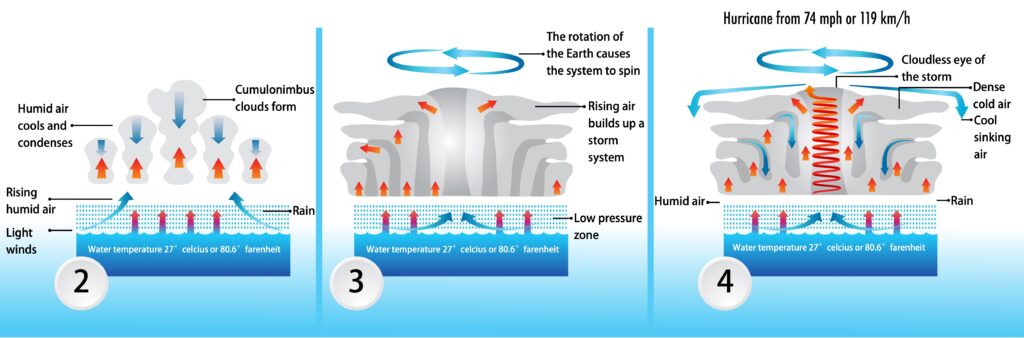
The tropical ocean is an immense solar collector. About 70% of incoming solar radiation falls over water. Each square metre of tropical sea absorbs roughly 250 watts of solar energy on average. Over a region of 500 kilometres in diameter, that adds up to around 5 × 10¹⁷ joules per day—a value that easily sustains evaporation and convection when conditions are right.
Cyclones are therefore a byproduct of natural energy transfer. They release the stored heat of the ocean into the atmosphere, redistributing it toward the poles. The system depends on planetary-scale thermodynamics, not localised manipulation.
Why HAARP and EMF systems cannot create or steer Cyclones
The HAARP facility in Alaska was built for ionospheric research. It transmits 3.6 megawatts of radio power into the upper atmosphere at frequencies between 2.8 and 10 MHz. Even if every bit of that energy were somehow directed into the lower troposphere (which it is not), it would be dwarfed by the power involved in a cyclone.
Let’s compare:
- Cyclone latent heat release: 2 × 10²¹ joules over several days
- HAARP total energy output per day: 3.6 × 10⁶ watts × 86,400 seconds = 3.1 × 10¹¹ joules
- The difference: a factor of ten trillion (10¹⁰) or more
No electromagnetic array could inject anywhere near the heat or mechanical energy required to alter a developing cyclone. Furthermore, the radio frequencies used by HAARP interact with charged particles in the ionosphere 80–300 kilometres above the Earth—far above the weather systems that exist within the troposphere (0–12 kilometres). The energy density is simply too small to have any measurable effect on clouds or rain.
Even the world’s most powerful radar systems or microwave transmitters generate energy fluxes that are minuscule compared with natural convective processes. The energy required to heat one cubic kilometre of moist air by even 1 °C is about 1 × 10¹⁵ joules, many millions of times beyond what any human technology can supply.
The moisture problem

Water vapour is the fuel of a cyclone. To sustain one artificially, you would need to keep evaporating seawater faster than it condenses. Evaporating 1 × 10¹⁵ kilograms of water would also require removing that same mass from the sea surface—roughly 1 trillion tonnes.
That would cool the surface ocean by several degrees, halting evaporation altogether. Nature prevents runaways like this through energy balance: the evaporation rate depends on solar input, not human intervention.
The key is that a cyclone does not “create” moisture; it concentrates and recycles it. Without vast stores of warm, humid air already present in the lower atmosphere, no amount of technology could form a storm of that magnitude.
Why floods and cyclones are natural extremes, not engineered events
The Dubai floods
In April 2024, record rainfall struck the United Arab Emirates, leading to widespread speculation about cloud seeding or artificial weather control. While the UAE does perform limited cloud seeding operations, these involve small aircraft dispersing silver iodide or salt particles into existing cumulus clouds. The process can enhance rainfall locally by a few percent under the right conditions, but it cannot create major storms.
Analyses from the European Centre for Medium-Range Weather Forecasts (ECMWF) showed that the Dubai rainfall resulted from a strong upper-level trough drawing moist air from the Arabian Sea. The moisture plume contained tens of millions of tonnes of water—orders of magnitude beyond anything influenced by seeding.
The Texas floods
Texas experiences recurrent severe flooding due to its subtropical climate and variable jet stream patterns. The 2017 Hurricane Harvey event produced about 125 billion tonnes of rainfall over five days.
Meteorological reanalysis confirmed that the rainfall matched predictions based on sea surface temperatures and atmospheric moisture content. No external electromagnetic or aerosol forcing could inject that much water into the atmosphere.
Hurricane Helene (2024)
Hurricane Helene, which struck the southeastern United States in late September 2024, intensified rapidly as it passed over waters around 30 °C in the Gulf of Mexico. The warm ocean and high humidity provided all the necessary ingredients for explosive deep convection.
Satellite radiances showed a clear pattern of natural intensification driven by latent heat release, not external interference. The energy flux through the eyewall exceeded 1 × 10¹⁸ watts, entirely consistent with thermodynamic models of tropical cyclone heat engines.
The physics of control: why steering cyclones is impossible
Diverting a storm even slightly would mean altering the pressure gradients that drive the trade winds and subtropical jet. That would take on the order of 10¹⁸ joules just to produce a small deviation—a task beyond all known human capability. Weather systems are chaotic and non-linear; tiny perturbations cannot be targeted with precision.
Even if one could somehow energise or weaken a cyclone locally, steering it would require changing the flow of the surrounding atmosphere over millions of square kilometres. The steering layer for most tropical cyclones lies between 700 and 300 millibars (about 3–9 km altitude). The momentum of air masses at that scale is astronomical.
Comparing human and natural energy systems
| Source | Power Output | Total Energy (1 day) | Ratio to Cyclone |
|---|---|---|---|
| Cyclone latent heat | ~5 × 10¹⁹ W | 4 × 10²¹ J | 1× |
| Global electrical grid | 2.5 × 10¹² W | 2 × 10¹⁷ J | 1 / 20,000 |
| HAARP facility | 3.6 × 10⁶ W | 3 × 10¹¹ J | 1 / 10¹⁰ |
| Large nuclear explosion | 4 × 10¹⁵ J | — | 1 / 500,000 |
Cloud seeding: what is actually possible
True weather modification is limited to small-scale attempts to enhance rainfall or suppress hail. Cloud seeding releases condensation nuclei—particles that help water vapour condense—but it only works within pre-existing clouds containing supercooled droplets.
The technique cannot create clouds from clear air, cannot generate water vapour, and cannot influence global circulation patterns.
The energy supplied by a typical seeding operation is negligible. A twin-prop aircraft might disperse a few tens of kilograms of salt or silver iodide per sortie. Compare that with the hundreds of billions of tonnes of water involved in a cyclone, and the scale difference becomes self-evident.
Cyclones: A question of scale, not conspiracy
Physics leaves no room for the idea that humans can engineer cyclones. The energy, moisture, and spatial scales involved are simply too vast. The Sun warms the oceans, evaporation fuels convection, and the Earth’s rotation organises the result into a vortex.
Human activities may influence the climate gradually through greenhouse gas emissions, but the direct generation or control of storms by EMF, HAARP, or any similar technology is beyond our reach.
Extreme weather events such as the Dubai floods, Texas floods, and Hurricane Helene are best understood through meteorology, not through the lens of hidden control systems. The numbers themselves tell the story: the energy of a cyclone is measured in zetta-joules, the domain of the planet, not of people.
References and Data Sources
- Emanuel, K. A. (2005). Divine Wind: The History and Science of Hurricanes. Oxford University Press.
- Trenberth, K. E., Fasullo, J., & Shepherd, T. G. (2015). “Attribution of climate extremes.” Nature Climate Change, 5, 725–730.
- NASA Earth Observatory (2024). Energy of Hurricanes [https://earthobservatory.nasa.gov]
- National Oceanic and Atmospheric Administration (NOAA). Hurricane Research Division Data Archive and National Hurricane Center Reports, 2017–2024.
- European Centre for Medium-Range Weather Forecasts (ECMWF). ERA5 Reanalysis Dataset, April 2024 UAE Rainfall Event.
- World Meteorological Organization (WMO, 2023). Tropical Cyclone Operational Plan for the World Weather Watch.
- U.S. Air Force & University of Alaska Fairbanks (2022). HAARP Technical Fact Sheet.
- IPCC (2021). Sixth Assessment Report: The Physical Science Basis.