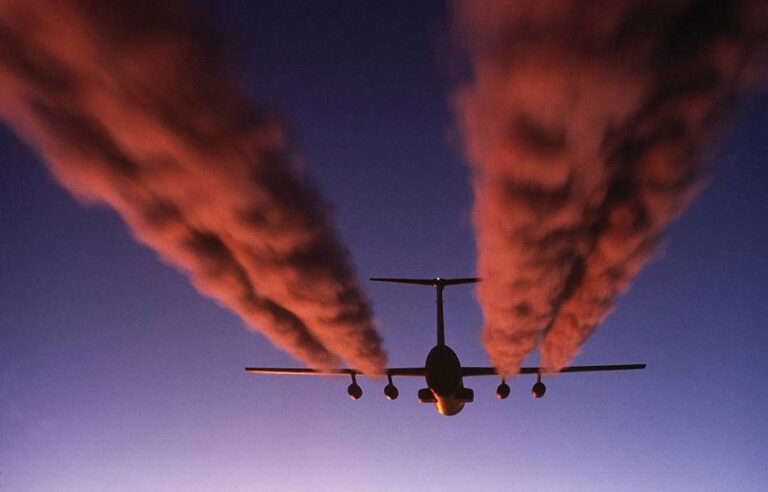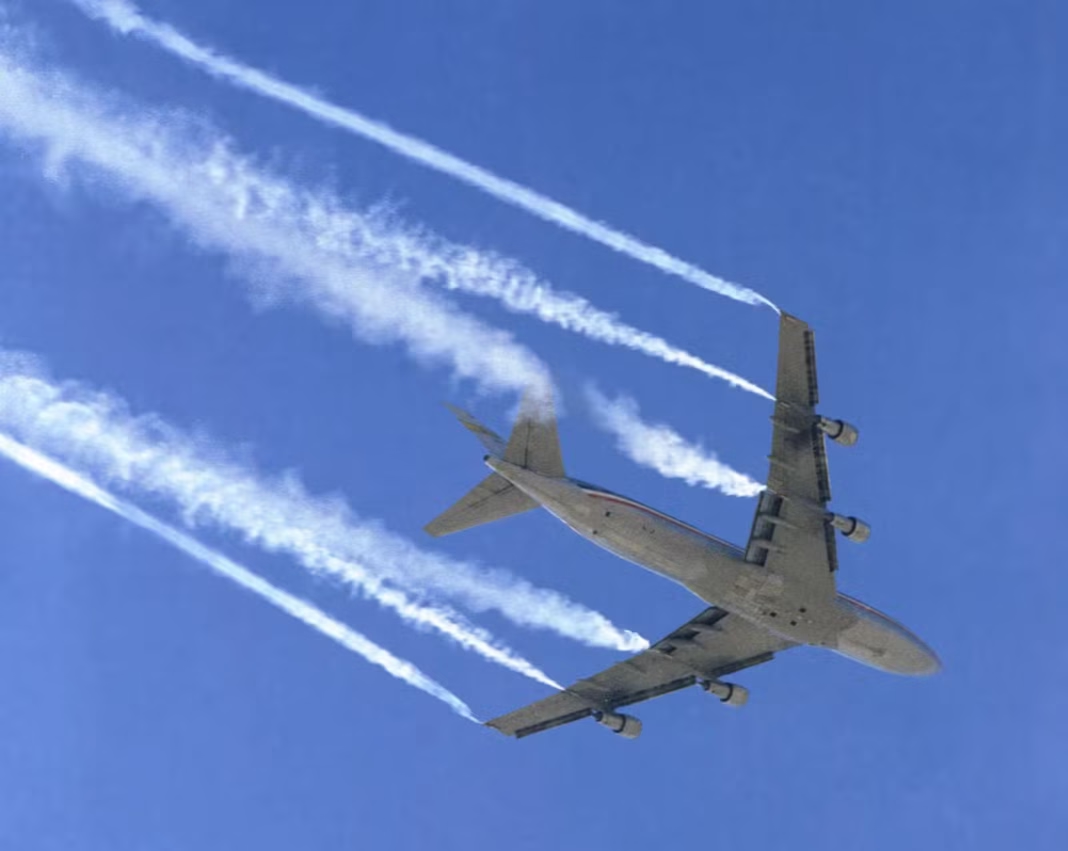

High above us, vapour trails often mark the passing of aircraft. Most of are familiar exhaust contrails, caused by hot engine emissions meeting cold, moist air. Yet not all conttrails come from engines. Aerodynamic wake contrails originate from the wings, tailplanes or even the fuselage; an effect that has confused observers for decades.
These are aerodynamic wake contrails, the product of pressure and temperature changes caused by the aircraft’s shape and motion through humid air.
To atmospheric scientists, they are a well-understood manifestation of fluid dynamics and phase change. To those unfamiliar with aerodynamics, they can appear puzzling, even suspicious.
Misinterpretations of these trails have fed one of the internet’s most persistent modern myths; the chemtrail conspiracy theory.
To grasp why these trails form, and why they have been so widely misunderstood, one must begin with the physics of condensation itself.
The Thermodynamics of a Contrail
All contrails, whether exhaust or aerodynamic, are manifestations of the same principle: when moist air cools below its saturation temperature, water vapour condenses into liquid droplets or ice crystals.
The Clausius–Clapeyron relation describes this behaviour quantitatively, showing that the saturation vapour pressure of water decreases exponentially with falling temperature.
At cruising altitudes, where temperatures often sit near −50 °C, the air holds almost no moisture. When a jet engine expels exhaust gases laden with water vapour, the sudden mixing with frigid ambient air pushes the mixture beyond saturation. Microscopic droplets form, freeze, and reflect sunlight, creating the familiar white line.
Aerodynamic Wake Contrails, however, arise not from combustion but from the pressure field surrounding the aircraft. Air flowing over a curved wing or around a flap accelerates, causing its pressure to drop.
According to the ideal-gas law and the adiabatic process equation, this pressure drop cools the air by several degrees Celsius. If the humidity is high enough, that cooling is sufficient to reach saturation, and water vapour condenses into a fine mist or ice crystals.
The resulting trail marks the aircraft’s path through a pocket of temporarily supersaturated air; a visible record of fluid dynamics in motion.
Conditions for Aerodynamic Contrail Formation
The formation of an aerodynamic wake contrails depends on a delicate combination of meteorological and flight parameters. The three main requirements are:
- High ambient humidity: typically greater than 70 %. The closer the air is to saturation, the smaller the temperature drop required to trigger condensation.
- Sufficient pressure reduction: as occurs over wings, flaps, or tail surfaces during high lift or rapid manoeuvres.
- Low enough temperature: often below 0 °C, but the exact threshold depends on local pressure and humidity.
Such conditions frequently occur during take-off and landing phases in humid air masses, or during high-altitude flight through ice-supersaturated regions.
In wind-tunnel experiments at the German Aerospace Center (DLR), scientists have replicated this process. When air with 85 % relative humidity was accelerated over a scaled wing profile, a pressure drop of only 200 hPa caused visible condensation within milliseconds. Once the flow decelerated, the temperature rose, and the droplets evaporated, demonstrating how quickly these features can form and vanish.
Where They Form on the Aircraft
Aerodynamic wake contrails appear in specific zones where pressure changes are strongest:
- Wing trailing edges: where high-speed flow from the upper surface meets slower flow from below.
- Flap and slat edges: during take-off and landing, when lift devices create complex vortices and localised cooling.
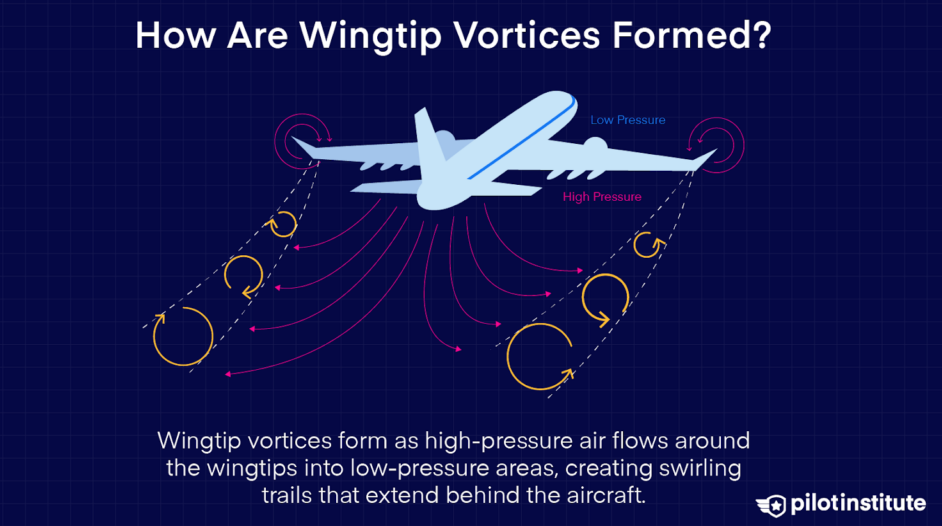
- Wingtip vortices: swirling tubes of rotating air that can carry condensed moisture for tens of metres behind the aircraft.
- Tailplane and fuselage junctions: where interference between aerodynamic surfaces produces small pressure pockets.
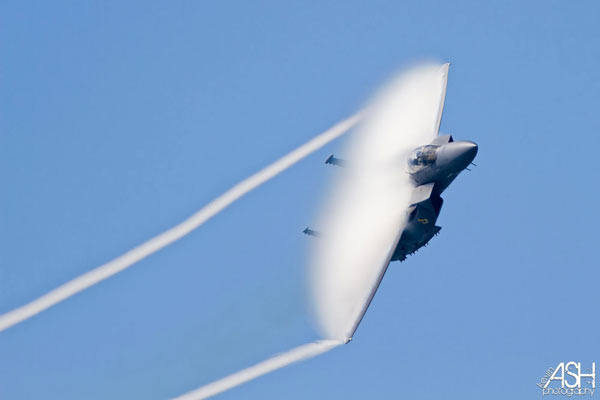
In some cases, the entire upper wing surface may be enveloped in a milky haze as air cools to the dew point.
Fighter jets performing high-G turns frequently display this phenomenon, creating dramatic cloud sheaths that appear to wrap the aircraft.
Commercial airliners exhibit a subtler version. When descending through moist air, thin streaks or ribbons may form along the wing trailing edge or flap track fairings. These may persist for for some time, depending on ambient humidity.
Optical Properties and Appearance
Aerodynamic wake contrails differ visually from exhaust contrails in several key ways. They may be broader but shorter-lived, with a soft, cottony texture rather than a sharply defined line.
Because the condensed droplets are initially larger than those in exhaust contrails, they scatter light differently, producing a more translucent effect. The droplets can freeze into small hexagonal ice crystals if the ambient temperature is below -40 °C.
To the observer on the ground, these trails may appear detached from the engines or even emerging from the aircraft’s body. Telephoto photography exaggerates this illusion by compressing perspective. The true origin points, the wingtips, flap edges, or tailplane, can appear coincident with other parts of the airframe.
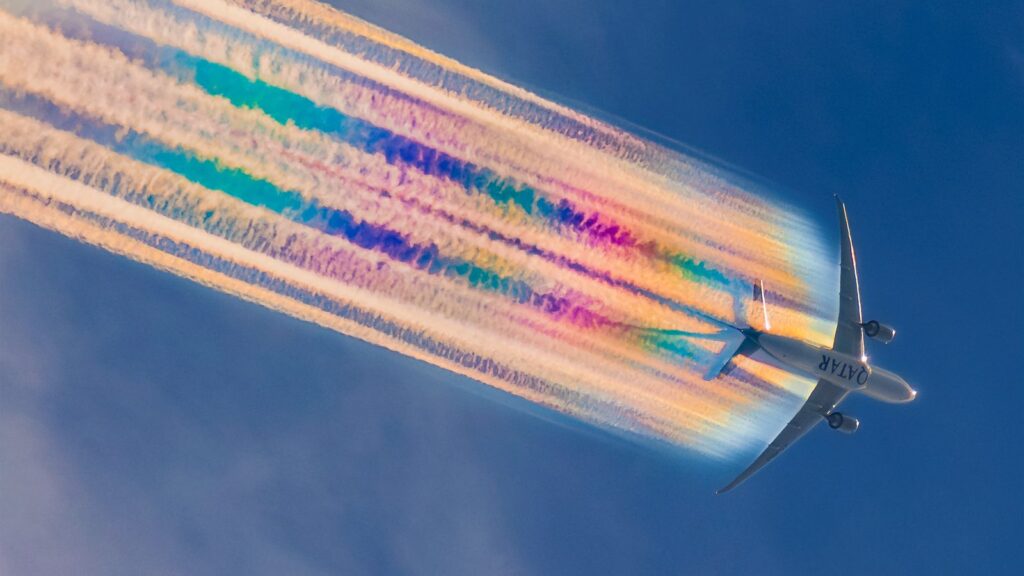
Under certain lighting conditions they may appear tinged with blue or grey, or even iridescent.
The Physics in Equations
The cooling of air in aerodynamic flow can be approximated by the adiabatic relation:
T2=T1(p1/p2)R/cp
where T1 and T2 are the upstream and downstream temperatures, p1 and p2 are the pressures, R is the specific gas constant, and cp is the specific heat at constant pressure.
For air, R/cp≈0.286. A pressure drop from 1000 hPa to 800 hPa thus produces a temperature decrease of roughly 17 °C which is more than enough to push near-saturated air below its dew point.
Once the pressure returns to ambient, the air warms and the condensed moisture re-evaporates. This reversible process explains the transient nature of aerodynamic wake contrails.
Historical Observations
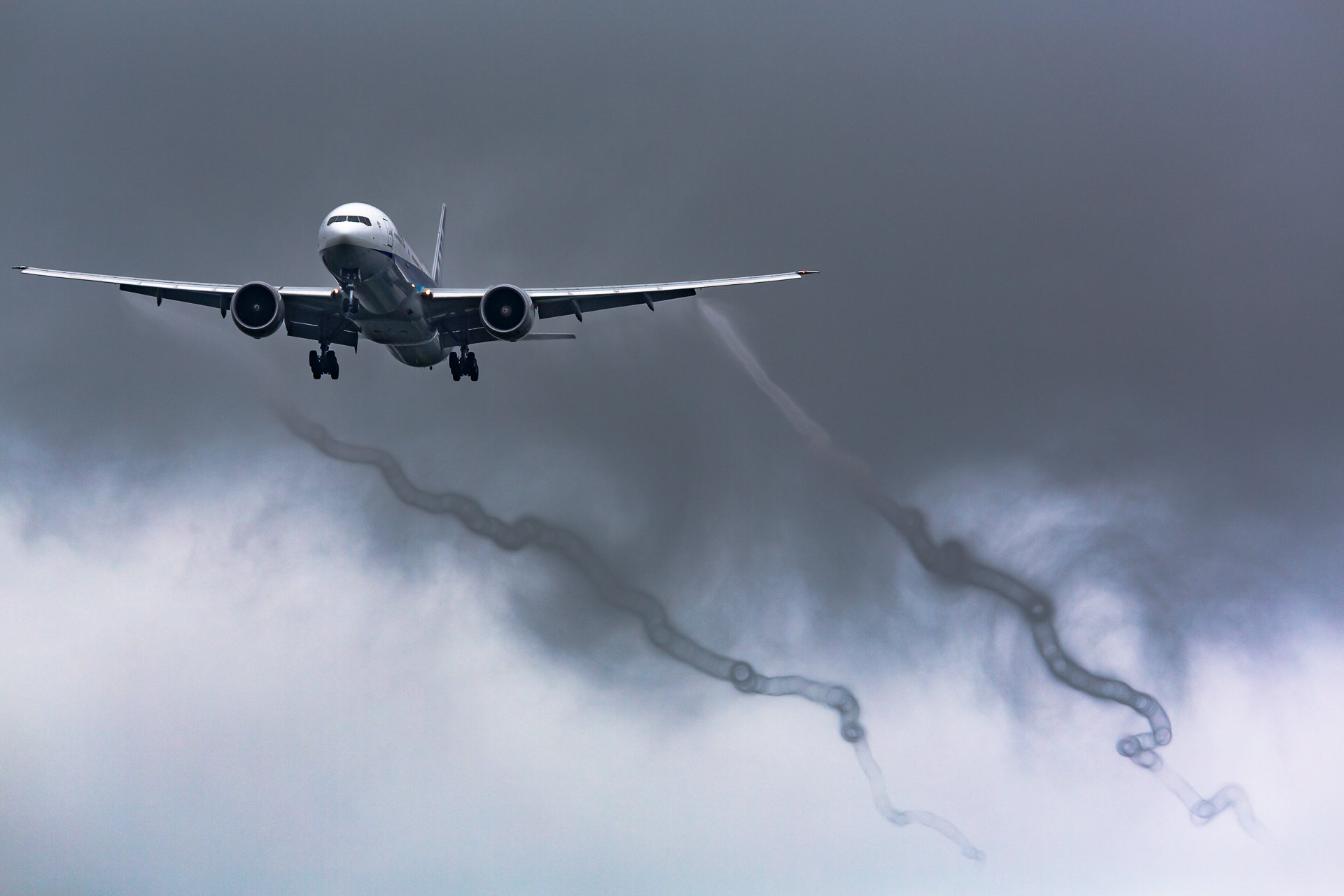
Aerodynamic condensation has been observed since the dawn of powered flight. Early aviators noticed mist forming over wings in humid air. During World War II, pilots reported opaque sheets enveloping aircraft during tight turns.
These were initially thought to be fuel vapour or coolant leaks, until wind-tunnel tests in the 1950s confirmed their aerodynamic origin.
Photographic documentation increased with jet travel. During the 1970s, NASA and the US Air Force captured numerous examples of wingtip condensation and vortex trails.
A 1986 NASA Technical Note by Knollenberg and colleagues formally described aerodynamic condensation trails as a distinct subclass of contrails unrelated to combustion.
Comparison with Engine Exhaust Contrails
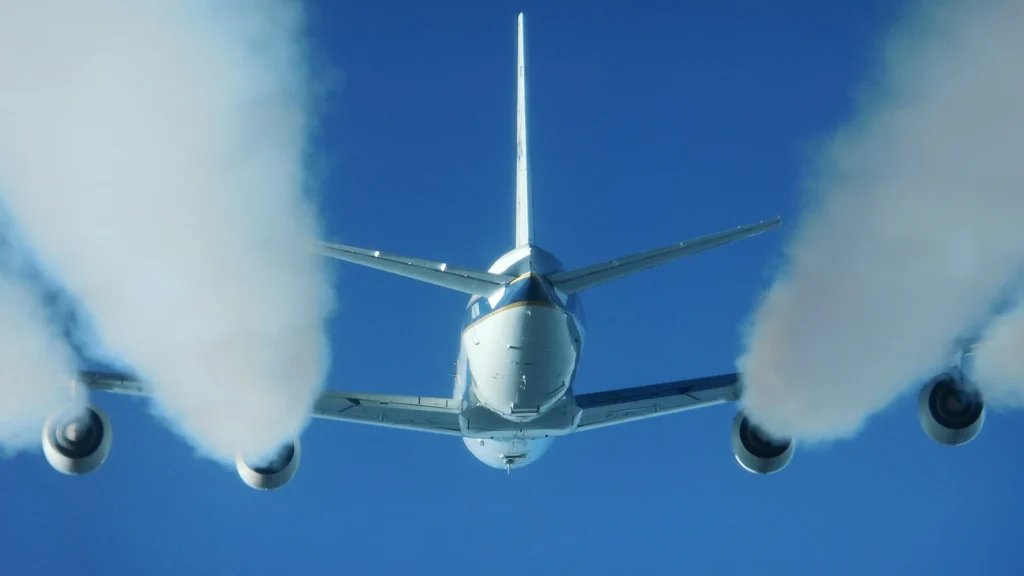
Although both phenomena involve water vapour condensation, their thermodynamic triggers differ fundamentally.
| Feature | Exhaust Contrail | Aerodynamic Contrail |
|---|---|---|
| Source of moisture | Jet exhaust gases | Ambient atmospheric vapour |
| Primary mechanism | Mixing of hot exhaust with cold air | Pressure-induced cooling over aircraft surfaces |
| Altitude range | Typically above 8 km | Can form from near ground to high altitude |
| Persistence | Often long-lived if air is ice-supersaturated | Usually brief, evaporating within seconds |
| Visual origin | Behind engines | Wings, wingtips, or tailplane |
| Physical composition | Ice crystals formed from exhaust water | Condensed or frozen ambient water vapour |
Both contribute to aircraft-induced cloudiness, which has minor but measurable effects on local radiative forcing. However, aerodynamic contrails are generally too transient to influence climate significantly.
Satellite and Remote-Sensing Evidence
Modern satellite instruments such as MODIS and VIIRS can detect contrails from space, but aerodynamic wake contrails are often too small or short-lived to register.
High-resolution cameras aboard research aircraft have confirmed that the optical depth of such trails rarely exceeds 0.05, compared with 0.3-0.5 for persistent exhaust contrails.
Lidar observations show that aerodynamic wake contrails consist mainly of droplets or ice crystals between 5 µm and 20 µm in diameter, evaporating within tens of seconds. Their limited scale and duration make them scientifically interesting but climatologically insignificant.
Why Misinterpretations Arise
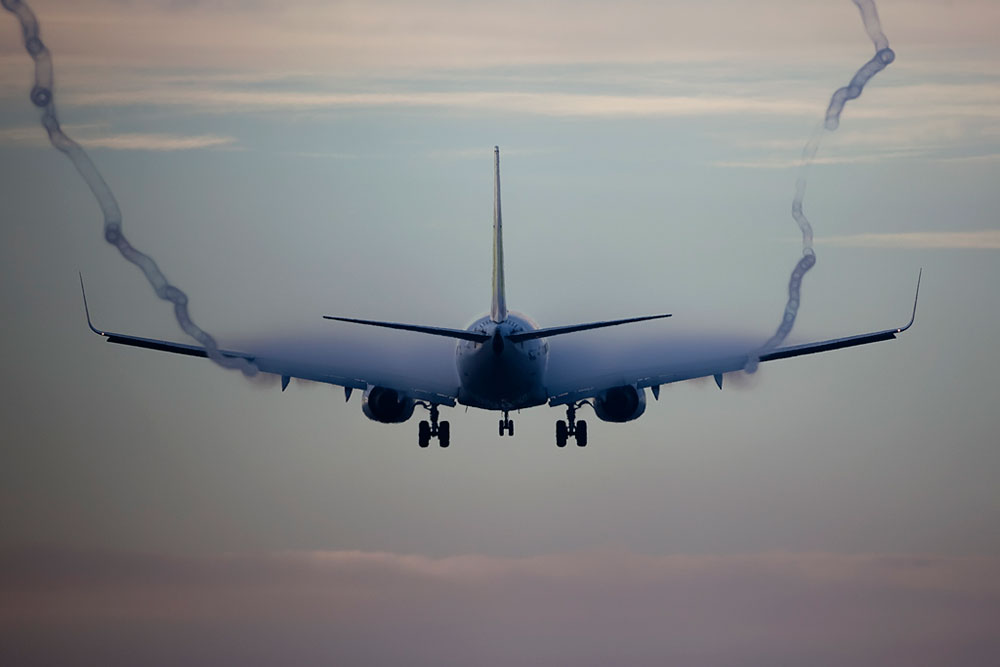
Despite clear physical explanations, aerodynamic wake contrails often become the focus of public misinterpretation. Videos showing plumes from wingtips or tails are shared online as evidence of “spray nozzles” or “chemical releases”.
The misunderstanding stems from two main factors: perceptual illusion and cognitive bias.
Perceptual Illusion
The human visual system is not well adapted for judging distances or spatial origins at ten kilometres’ range. When a high-zoom lens compresses depth, the apparent point of origin of a trail can shift dramatically. Heat haze, optical diffraction, and atmospheric refraction further distort the view.
As a result, aerodynamic wake contrails seem to emanate from unusual locations, such as between engines or from undercarriage or wingtips. In truth, these correspond to pressure minima along aerodynamic surfaces.
Cognitive Bias and Agency Detection
People interpret ambiguous stimuli according to existing beliefs. If someone already suspects aircraft of releasing chemicals, any unusual trail will confirm that suspicion. This is confirmation bias in action; a cognitive shortcut that privileges supporting evidence and disregards contradiction.
A second bias, known as agency detection, encourages humans to attribute deliberate intent to complex natural events. From an evolutionary perspective, it is safer to assume agency where none exists than the reverse. In the sky, this translates to seeing deliberate spraying where only physics operates.
Psychological Factors in Persistent Belief
The endurance of the “chemtrail” idea, despite decades of scientific refutation, can be understood through psychological research on conspiracy thinking.
Studies by Karen Douglas and colleagues (University of Kent) show that conspiracy beliefs fulfill emotional and social needs rather than evidential ones. They offer certainty in uncertain times and confer belonging to a group that perceives itself as enlightened.
In this framework, aerodynamic wake contrails function as visual anchors for an existing worldview. Their unfamiliar appearance supports the narrative that ordinary explanations conceal deeper truths.
Social media amplifies this process by creating echo chambers where like-minded individuals reinforce one another’s interpretations.
Neuroscientific studies suggest that pattern-recognition circuits in the brain, particularly within the temporal and parietal cortices, are hyper-active in individuals prone to conspiratorial or paranormal thinking. They detect connections, even illusory ones, between unrelated phenomena. A trail emerging from a wing thus becomes evidence of a hidden mechanism.
Communicating the Science
For scientists and educators, the challenge is to convey complex aerodynamic processes in ways accessible to non-specialists. Merely asserting that “it’s just water vapour” fails to satisfy curiosity and may appear dismissive.
Effective communication begins with visual analogy. Demonstrating condensation on a cold bottle or the mist forming around car spoilers in humid air helps illustrate the same principle.
Flight-test videos showing pressure sensors alongside visual footage reveal the precise relationship between pressure drop and condensation.
Transparency is also crucial. When research institutions such as NASA, DLR, or the UK Met Office publish open data and imagery explaining contrail physics, public trust increases.
The tone matters as much as the content: clear, respectful explanations can diffuse suspicion more effectively than ridicule.
Atmospheric Implications
Although transient, aerodynamic contrails provide valuable insight into microphysical processes in the upper troposphere. Their rapid formation and dissipation make them natural laboratories for studying phase transitions and turbulence.
Recent work at the University of Reading used high-speed photography and computational fluid dynamics to map the three-dimensional structure of these trails. The studies revealed oscillating wave patterns that influence droplet growth rates; knowledge that helps refine climate models of cirrus formation.
Understanding aerodynamic condensation also aids aircraft design. Engineers can predict and mitigate unwanted condensation effects that may obscure vision or signal icing conditions.
In future, active control of wing-surface temperature through laminar-flow technologies could reduce such visible trails altogether.
Case Studies from Research Flights
During a 2019 joint campaign by NASA and DLR known as CoMet, research aircraft observed multiple aerodynamic contrails forming in humid layers over the North Atlantic. Using onboard hygrometers, scientists recorded relative humidity values near 95 %, pressure drops of 180 hPa over wing surfaces, and instantaneous temperature declines of 14 °C.
High-speed cameras confirmed droplet formation within 0.02 seconds of entering the low-pressure zone. As the aircraft left the region, the droplets evaporated entirely within 15 seconds. No chemical residues were detected.
Such data underline that these features are transient condensation phenomena, indistinguishable in composition from natural clouds.
When Physics Meets Perception
The persistence of the chemtrail misconception offers a case study in how human perception interacts with physical science. Even when the mechanisms are measurable, visible phenomena can acquire social meanings far removed from their physics.
This divergence is not unique to contrails. Similar patterns appear in other domains: ball lightning, auroras, or unusual cloud formations have all attracted pseudoscientific explanations before proper understanding emerged.
The lesson is twofold. First, complex natural processes can appear purposeful or artificial when viewed without context. Second, explanations grounded in evidence must compete with narratives that are emotionally satisfying.
Towards a Clearer Sky, Scientifically and Socially
From an engineering perspective, aerodynamic wake contrails are unavoidable by-products of fluid motion in moist air. They testify to the precision with which aircraft sculpt the atmosphere. Each visible filament records the interplay of thermodynamics, humidity, and pressure, lasting only until equilibrium is restored.
From a psychological perspective, they remind us that observation is filtered through expectation. In the age of instant video and social media, rare atmospheric events are easily misread. Scientists must therefore engage not only with equations but with human cognition.
A society that understands how and why condensation occurs is less likely to see malevolence in ordinary physics. That understanding requires sustained public education, not dismissal. The task is as much sociological as it is meteorological.
The Wrap-Up on Aerodynamic Wake Contrails
The formation of aerodynamic wake contrails depends on humidity, pressure, and temperature; not hidden tanks or nozzles.
They are are an elegant demonstration of basic physics: when air expands and cools over an aircraft wing, water vapour condenses into a transient mist.
Yet their unusual visual nature continues to provoke misunderstanding. Recognising the psychological mechanisms behind that misunderstanding is essential to countering it. Science alone explains how the trails form; psychology explains why some people resist that explanation.
In combining both perspectives, we see not a case of secrecy but of perception; a reminder that the natural world, seen through imperfect human eyes, can still surprise, confuse, and inspire awe.