The High-Frequency Active Auroral Research Program (HAARP) has been the subject of various conspiracy theories alleging its involvement in weather manipulation, including the creation of floods and cyclones.
These claims often surface following significant weather events, such as the severe flooding in Spain and New Mexico. However, a thorough examination of HAARP’s capabilities and the science of weather formation reveals that these allegations are unfounded.
Understanding HAARP, it’s Purpose and Functionality
HAARP is a scientific research facility located in Gakona, Alaska, operated by the University of Alaska Fairbanks. Its primary objective is to study the ionosphere—the layer of Earth’s atmosphere situated between 30 and 600 miles above the surface.
The facility employs high-frequency radio waves to temporarily heat small, localized regions of the ionosphere, allowing scientists to observe and analyze its behavior under controlled conditions.
The ionosphere is distinct from the troposphere, the atmospheric layer where weather phenomena such as clouds, precipitation, and storms occur. The energy levels involved in HAARP’s operations are minuscule compared to the vast amounts of energy required to influence weather systems.
For instance, a typical thunderstorm can release energy equivalent to 10 atomic bombs, while HAARP’s peak power output is around 3.6 megawatts—insignificant in comparison.
The Science of Weather Formation
Weather systems, including cyclones and heavy rainfall events, are driven by complex interactions within the troposphere. These interactions involve the exchange of heat and moisture between the Earth’s surface and the atmosphere, influenced by factors such as solar radiation, ocean temperatures, and atmospheric pressure systems.
The energy required to initiate and sustain these processes far exceeds the capabilities of any current human-made technology.
Addressing Specific Claims of HAARP Induced Flooding
For example, the formation of a tropical cyclone involves the evaporation of vast amounts of seawater, which releases latent heat into the atmosphere, fueling the storm’s development. This process requires an immense energy input that is orders of magnitude greater than what HAARP can produce.
The idea that HAARP can control weather patterns, such as generating cyclones or influencing cloud formations, is a misconception. The energy levels involved in HAARP’s operations are minuscule compared to the vast amounts of energy required to alter weather systems.
Recent claims have surfaced alleging that HAARP was responsible for the severe flooding events worldwide. These assertions have been thoroughly investigated and debunked by experts.
The flooding in these regions was the result of natural weather patterns, including intense rainfall associated with atmospheric disturbances, not artificial manipulation.
Meteorological agencies and climate scientists have consistently found no evidence linking HAARP to any weather events.
The facility’s operations are confined to the ionosphere, far above the troposphere where weather occurs, and its energy output is insufficient to influence atmospheric conditions at ground level.
For instance, a typical thunderstorm can release energy equivalent to 10 atomic bombs, while HAARP’s peak power output is around 3.6 megawatts, insignificant in comparison.

How a cyclone forms
Understanding Undulating Cloud Patterns

Undulating cloud formations, such as cirrus undulatus or altocumulus undulatus, are often cited as evidence of weather manipulation. These clouds exhibit a wavy, rippling appearance, resembling fish scales, and are typically associated with atmospheric gravity waves.
These waves occur when air is displaced vertically, such as by mountains or weather fronts, and then oscillates back due to gravity.
The International Cloud Atlas, a comprehensive guide to cloud classification, attributes these undulating patterns to natural atmospheric processes. These clouds are not indicative of artificial weather modification but are a common meteorological phenomenon which have been documented for decades.
The Role of Climate Change in Extreme Weather Events
While HAARP cannot influence weather patterns, human activities, particularly the emission of greenhouse gases, have been shown to affect the climate.
Climate change leads to alterations in atmospheric conditions, such as increased temperatures and changes in precipitation patterns, which can exacerbate the severity of weather events.
For instance, warmer temperatures can lead to increased evaporation rates, providing more moisture for storms and potentially intensifying rainfall events. These changes are well-documented and supported by extensive scientific research, including studies from the Intergovernmental Panel on Climate Change (IPCC) and national meteorological organisations.
Climate models show that, across most of the world, the most severe weather events are likely to become even more severe as the world warms2 (Figure 2).
Another study found that every additional 1°C increase in temperature nearly doubles the likelihood of weather corresponding to today’s most severe precipitation events.
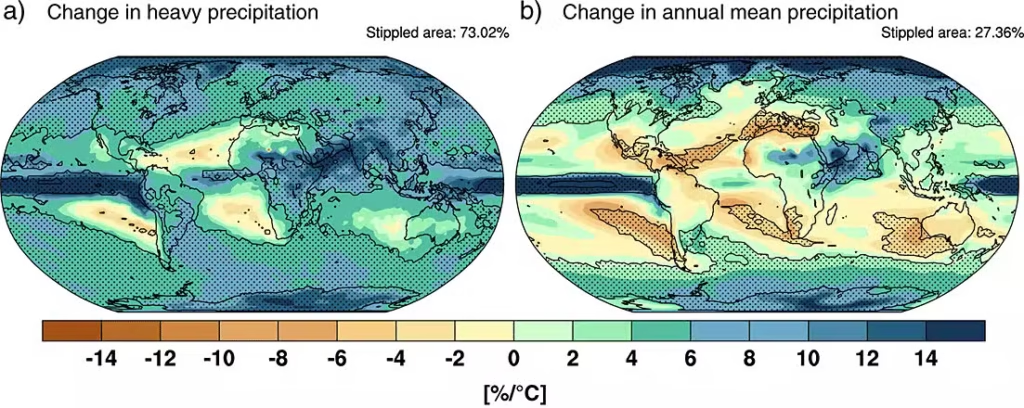
Changes per 1°C of warming over pre-industrial levels in the amount of precipitation for (a) the heaviest-precipitation day of the year (b) and the annual mean. While other effects of climate change like aridification mean that annual mean precipitation decreases in some regions of a warming world, we do see that the most severe weather events will dump more precipitation across almost all the world’s land.
Heavy rainfall events observed in the past several years have tracked with predictions made by past climate models. We also have evidence that climate change has increased the destructive power of modern-day floods.
A study of U.S. floods between 1988 and 2017 attributed 36% of all flood-related damages to “historical precipitation changes”, which models have linked to climate change.
5G Technology and Its Impact on Weather Patterns
5G wireless technology operates at higher frequencies than its predecessors, enabling faster data transmission and increased connectivity. However, concerns have been raised about potential interference with weather forecasting instruments.
Specifically, the electromagnetic signals from 5G networks could potentially interfere with satellite-based sensors that measure water vapor in the atmosphere, a critical component for accurate weather predictions.
Despite these concerns, there is no scientific evidence to suggest that 5G technology can directly influence weather patterns or cloud formations. The electromagnetic radiation used by 5G networks does not interact with water molecules or atmospheric particles in a way that could cause cloud formation or dissipation.
To Summarise
In summary, the claims that HAARP can create floods or influence weather patterns are not supported by scientific evidence. HAARP’s operations are limited to ionospheric research and do not extend to weather modification.
The severe weather events observed in regions like Spain and New Mexico are the result of natural atmospheric processes and, in some cases, the impacts of climate change.
Understanding the science behind weather formation and the limitations of technologies like HAARP is crucial in dispelling myths and misconceptions.
By relying on credible scientific research and expert analyses, we can foster a more informed and accurate understanding of the complex systems that govern our environment.
References
- Tabari H. (2020) Climate change impact on flood and extreme precipitation increases with water availability. Scientific Reports.
- Fischer et al. (2014) Models agree on forced response pattern of precipitation and temperature extremes. Geophysical Research Letters.
- Myhre et al. (2019) Frequency of extreme precipitation increases extensively with event rareness under global warming. Scientific Reports.
- Fischer and Knutti. (2016) Observed heavy precipitation increase confirms theory and early models. Nature Climate Change.
- Davenport et al. (2020) Contribution of historical precipitation change to US flood damages. PNAS.