
The mystery of the broken white line
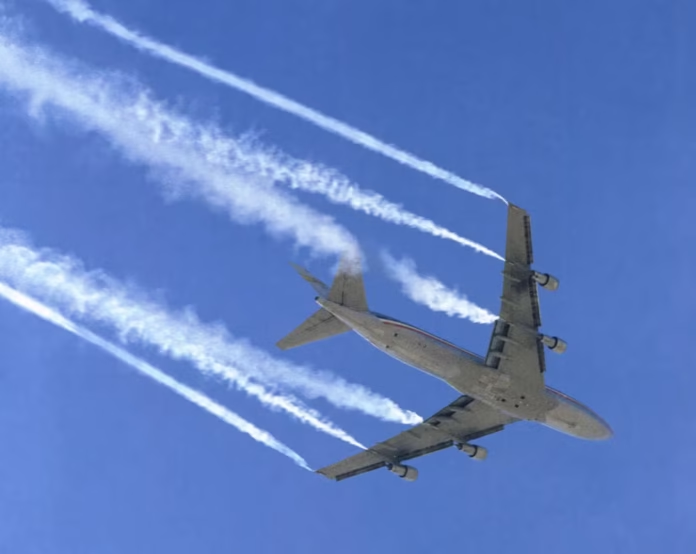
Most people have seen a plane crerating a bright white line, then the line seems to stop, then it starts again. From the ground it can look deliberate, as if a pilot has toggled something on and off.
The more mundane explanation is also the correct one. Contrails are not sprayed trails in the sense implied by chemtrail claims. They are a kind of cloud, and clouds appear and disappear when air parcels cross thresholds of temperature and humidity.
Aviation adds water vapour and particles to seed the process, but the atmosphere decides whether the trail becomes visible, how long it lasts, and whether it breaks into gaps.

What a contrail actually is
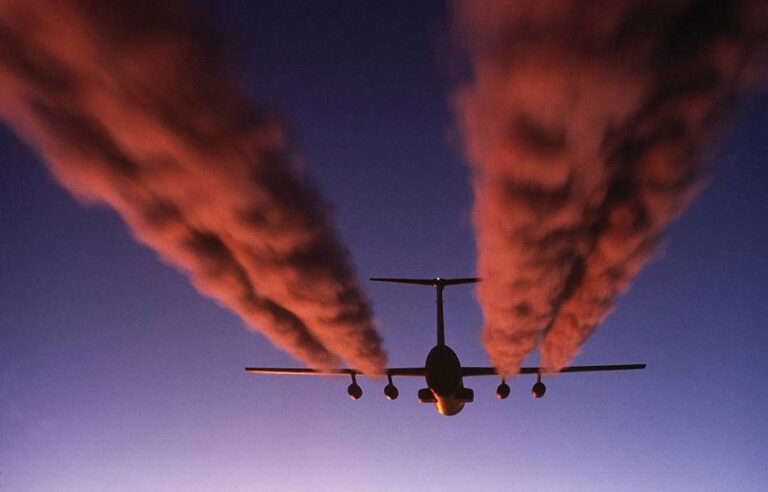
A modern jet engine burns hydrocarbon fuel. A major by-product is water vapour, plus tiny particles (including soot) that can act as condensation nuclei.
When that hot, moist exhaust mixes with very cold air at cruising altitude, the mixture can briefly become saturated, allowing droplets to form and then freeze into tiny ice crystals. That ice crystal cloud is the contrail.
This is why contrails are most common at typical jet cruise heights, where temperatures are well below freezing, often at or above about 20,000 feet, and commonly much higher.
Two stages: forming a contrail, then keeping it
The start and stop effect makes far more sense when you separate contrails into two stages.

Stage 1: Can a contrail form at all?
The core physics is captured by the Schmidt–Appleman criterion: whether mixing between exhaust and ambient air reaches water saturation at the relevant temperature, which depends on ambient temperature, pressure, humidity, and aircraft and engine parameters. In plain terms, it is easier to form contrails when it is colder, and harder when it is warmer or much drier.
Stage 2: If it forms, will it persist?
After the initial flash of ice crystals, the trail either grows or shrinks depending on ambient humidity with respect to ice (often written RH_ice or RHi). If the surrounding air is ice-supersaturated (roughly, RHi at or above 100%), ice crystals can persist and grow. If the air is ice-subsaturated (RHi below 100%), the ice crystals sublimate back into invisible water vapour and the contrail fades, sometimes in seconds.
This view explains a common observation: many contrails form briefly but do not last. Others persist for hours and can spread into broader cirrus-like cloud.
The key misconception: The sky is not a uniform thing
From the ground, the blue sky looks like a single smooth backdrop. At 8-12 km altitude, it is nothing of the sort.
The upper troposphere is structured into layers and filaments shaped by jet streams, gravity waves, fronts, and turbulence. Temperature and humidity can vary sharply across boundaries that are invisible to the eye.
That is why contrails can appear to start and stop when an aircraft enters or leaves pockets of extra moisture, including ice supersaturation regions (ISSRs).

The same idea explains a familiar feature of everyday weather: clouds are often discrete. We routinely see scattered cumulus clouds with clear blue gaps between them because the atmosphere is made of parcels of air with different properties.
Some parcels are moist and unstable enough to cool to saturation as they rise, so cloud droplets form. Other parcels are drier, warmer, or more stable, so rising air does not reach saturation and clouds do not form.
The sky can therefore look patchy even on a calm day, because the ingredients for cloud formation are patchy.

Contrails behave in the same threshold-driven way. The aircraft provides hot, moist exhaust, but the atmosphere still has to co-operate. When a jet crosses an invisible boundary into air that is cold and ice-supersaturated, the contrail persists and brightens.
Cross back into air that is too dry with respect to ice, and the ice crystals sublimate and the contrail rapidly fades. What looks like a deliberate on/off action is often the aircraft moving through a naturally mottled atmosphere.
Why it looks like a cockpit switch from the ground
Several visual and geometric effects combine to create the illusion of a clean on/off toggle.

Distance compresses the scene
A jet at cruise height is often tens of kilometres away. The visible contrail behind it can be many kilometres long, and winds aloft can shear and displace it. Persistent contrails can drift with upper winds so that the trail you see may not sit neatly behind the aircraft you think made it.
You are seeing different air along the same flight path
When the aircraft crosses an invisible boundary into drier (ice-subsaturated) air, new contrail stops forming or begins to vanish quickly. But the older segment behind the aircraft may be sitting in slightly moister air and can remain visible. Result: a sharp-looking gap appears, even though nothing mechanical has changed.
Human perception loves straight lines
Contrails are pencil-straight, high-contrast features against a plain background. The eye naturally interprets abrupt changes in that line as intentional, because intentional marks are usually the only straight marks humans make. Nature, however, makes sharp boundaries all the time when thresholds are involved. In other words, we are used to seeing deliberate dashed or dotted lines on roads, in writing and even product packaging.
The most common reasons a contrail breaks, stops, or restarts
Here are the leading real-world mechanisms that produce start/stop contrails, without any need for a mythical “spray switch”.
1) Crossing the edge of an ice-supersaturated region
This is the classic case. Inside an ISSR, contrails can persist and spread. Outside it, they can fade rapidly. The boundary can be surprisingly sharp on the scales you see from the ground.
2) Small changes in altitude, big changes in outcome
Temperature generally decreases with height through the troposphere, but the atmosphere has layered structure near the tropopause (the crucial boundary layer in Earth’s atmosphere separating the turbulent, weather-producing troposphere below from the stable, stratified stratosphere above). A small climb or descent can move the aircraft into air that is warmer or drier enough to fail the formation threshold, or to make persistence unlikely. Research literature on contrail conditions routinely uses the Schmidt–Appleman framework for this sensitivity.
3) The contrail Forms but dies when the air is too dry
The Met Office describes the next step plainly: in very dry air, contrail ice crystals sublimate and become invisible; in more humid air they persist and can spread. That drying can occur over short distances.
4) Different aircraft, different contrails
Even in similar air, aircraft do not behave identically. Engine technology, fuel chemistry, soot output, and exhaust heat all affect contrail formation and evolution. The FAA highlights that contrail formation and persistence depend on exhaust composition as well as atmospheric conditions.
5) You are not always looking at engine contrails
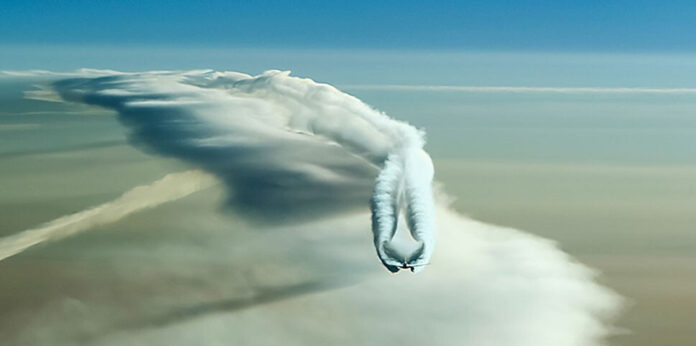
Some white lines are not cruise contrails at all. The Met Office notes related phenomena such as wingtip vortices (usually low altitude in humid air), and distrails where an aircraft passing through an existing cloud layer can leave a clear slot rather than a white line. These are also known as Fallstreak or Hole-Punch Clouds, and can confuse the story when people try to interpret every line as one single process.
So could pilots turn chemtrails on and off?
There is no credible operational basis for the idea that commercial pilots are toggling a secret system to spray chemicals to make lines appear and disappear.
More importantly, the contrail physics already predicts exactly the pattern people are trying to explain. If the atmosphere supplies cold, moist, ice-supersaturated air, you get persistent white lines. If it does not, you do not. The switch is the threshold behaviour of water, not a cockpit control.
A brief note on climate, because contrails matter
None of this requires conspiracy to be consequential. Persistent contrails can reflect sunlight and trap outgoing infrared radiation, and they can evolve into broader contrail cirrus under the right conditions.
Temperature and humidity strongly control contrail lifetime, with satellites observing long-lived clusters lasting many hours in humid air.
Research and regulators are actively studying prediction and avoidance of persistent contrail regions, including ISSRs, precisely because they can affect climate.
References
- Resources for the Future (2025), overview of contrails and Schmidt–Appleman framing for formation conditions.
- UK Met Office, “Contrails or condensation trails”.
- US Federal Aviation Administration, “Contrails” (public interest section on patterns, ISSRs, and start/stop behaviour).
- NASA Earth Observatory, “The Evolution of a Contrail” (humidity controls lifetime; contrails can persist for hours in humid air).
- NSW Environment Protection Authority, “Condensation trails” (contrails as a physical phenomenon from hot exhaust mixing with very cold air).
- Wolf et al., Atmospheric Chemistry and Physics (2023), discussion of the Schmidt–Appleman criterion and critical thresholds.
- Benetatos et al., Scientific Reports (2024), on the commonness of ice-supersaturated regions and their role in long-lasting contrails.
- Petzold et al., (2025), summary statement on persistence when RH_ice ≥ 100% and dissipation when RH_ice < 100%.