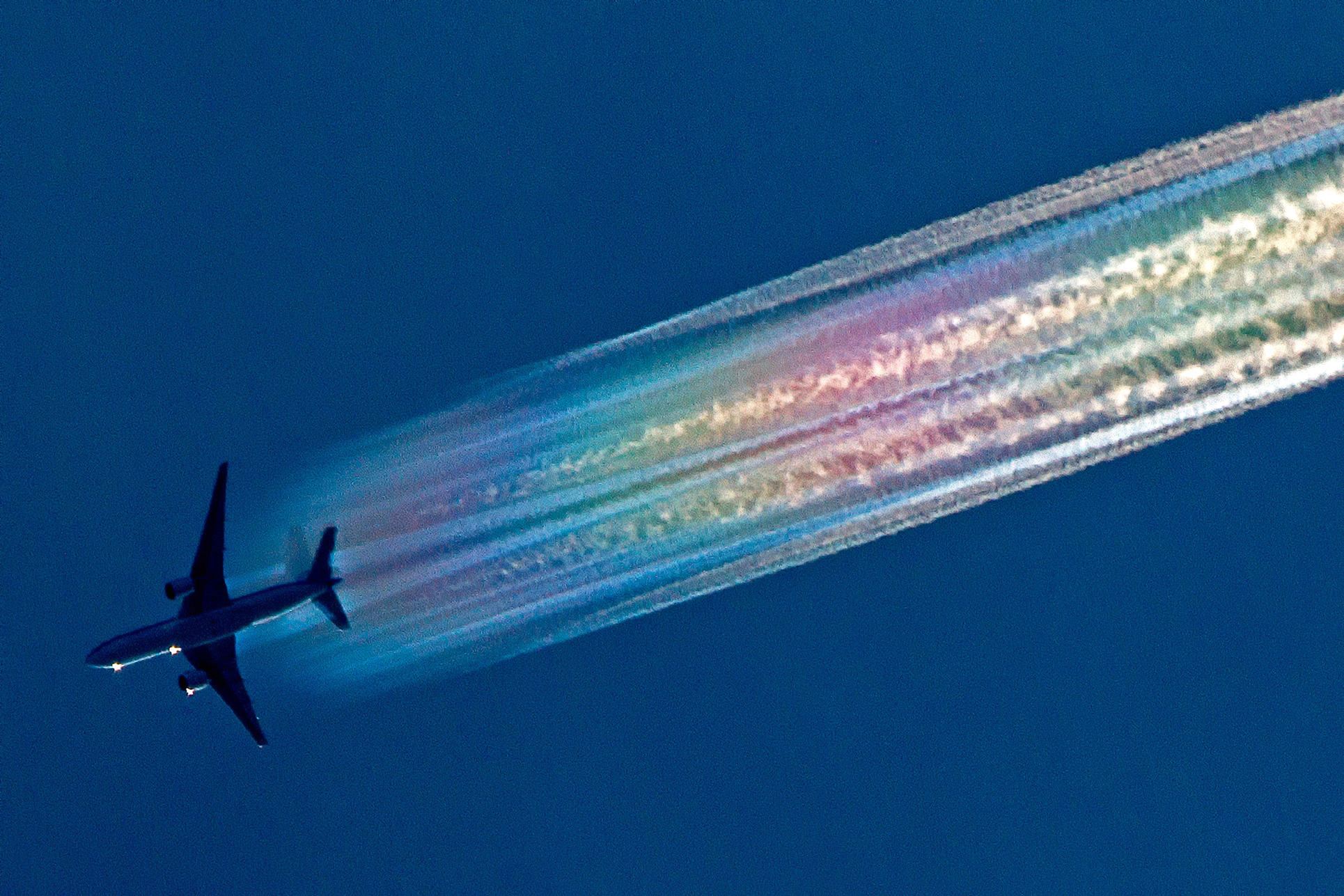

What you are Actually Seeing is Incandescent Whole-Wake Contrails.
Most people are familiar with thin white lines, or contrails, that follow aircraft at high altitudes: contrails formed from the water vapour in engine exhaust. Less familiar, but often far more striking, are whole-wake contrails, condensation trails generated not from the engines but from the aircraft’s entire aerodynamic wake, especially its wingtips and fuselage vortices. These phenomena, sometimes referred to as “wingtip condensation trails” or “wake-vortex trails,” can produce fleeting ribbons, spirals, and sheets of cloud that glow with shifting colours under certain conditions.
These are, in essence, contrails which appear as rainbows which form off the back of an aeroplane’s wings under certain conditions. The plane must be flying heavy, such as full of fuel before a trans-Atlantic flight. This causes extremely low pressure above the wings due to very high lift, causing water vapour in the air to freeze.
To the casual observer, these vivid displays can seem almost supernatural. Iridescent wake trails have been photographed over Europe, Asia, and the Americas, sparking speculation about “chemtrails” or exotic aerosols. In reality, their appearance is fully explained by physics, meteorology, and optics. This article investigates the science of incandescent and iridescent whole-wake contrails, exploring how they form, when they appear, and why they sometimes glow with rainbow hues.
What Are Whole-Wake Contrails?
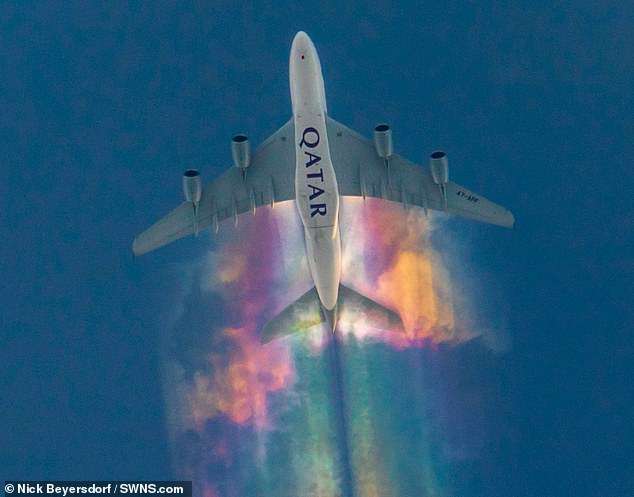
Whole-wake contrails are condensation trails produced by the pressure and temperature changes caused by an aircraft’s aerodynamic surfaces, not by its engine exhaust. Whereas engine contrails are formed from water vapour in the exhaust plume, whole-wake contrails arise when the low-pressure regions around wings and other surfaces cause moist air to cool and condense.
This phenomenon is most noticeable in:
- Wingtip vortices: spiralling currents of air shed from wingtips.
- Flap edges and control surfaces: where strong local pressure drops occur.
- The fuselage wake: where the air is disturbed behind the entire aircraft.
At high humidity and the right temperatures, these vortices can trail long, coherent tubes of condensation that may twist together or sink slowly after the aircraft passes.
Formation Physics: Pressure, Temperature, and Humidity
Aerodynamic Cooling
Bernoulli’s principle explains that as air accelerates over a wing or control surface, its static pressure decreases. In sufficiently humid air, the temperature drop associated with this pressure decrease can cause the water vapour to reach saturation. When this happens, microscopic droplets or ice crystals form, producing a visible condensation pattern.
Typical conditions:
- Altitude: 1–10 km (3,000–33,000 ft). Whole-wake contrails are seen at both lower and higher altitudes than engine contrails.
- Temperature: Below 0°C, especially below –10°C for persistent trails.
- Relative humidity: >70% with respect to liquid water (or >100% for ice saturation).
Vortex Structure
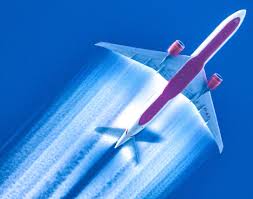
An aircraft generates lift by creating a pressure difference between the upper and lower wing surfaces. This leads to wingtip vortices — counter-rotating tubes of air shed from the wingtips. These vortices induce vertical and horizontal motion in the surrounding air, which can concentrate humidity and maintain the condensation trail long after initial formation.
NASA wind-tunnel studies have shown that wingtip vortices can persist for several minutes and extend hundreds of metres behind large aircraft, particularly at cruising speeds.
Iridescence: The Physics of Colour in Whole-Wake Contrails
Light Scattering and Diffraction
The shimmering, rainbow-like hues sometimes seen in whole-wake contrails are caused by diffraction of sunlight around water droplets or small ice crystals. This is the same phenomenon that produces colourful coronae around the sun or moon. The colours are most vivid when the droplets are:
- Small and uniform in size (2–20 micrometres).
- Freshly formed and not yet coalesced into larger droplets.
- Seen at a specific viewing angle relative to the sun.
As droplet size changes, so does the interference pattern, creating shifting pinks, greens, blues, and violets. Photographs of Airbus A380 and Boeing 747 wakes during descent often show brilliant iridescence on their trailing vortices or wingtip-generated condensation sheets.
Perceived “Incandescence”
Observers sometimes describe these trails as “incandescent” — glowing as if lit from within. In reality, this is sunlight refracted, diffracted, and scattered in such a way that the wake appears to emit light. Under low-angle sunlight (sunrise or sunset), the effect is magnified, with droplets catching and scattering warm hues of orange and red.
Conditions Favouring Iridescent Whole-Wake Contrails
The most striking displays occur when several factors coincide:
- High Ambient Humidity: Enough moisture for rapid condensation.
- Cold Temperatures: Especially below –10°C to allow ice crystal formation.
- Strong Wing Loading: Large aircraft, steep banking turns, or high lift configurations produce stronger vortices.
- Low Sun Angles: Morning or evening sunlight enhances iridescence.
Such conditions are often found:
- Plane is flying “heavy” creating high lift.
- During takeoff and landing in humid, cool air.
- At cruise altitudes over oceanic regions with high humidity.
- In the wake of thunderstorms, where moisture and turbulence are abundant.
Distinguishing Whole-Wake Contrails from Engine Contrails
| Feature | Engine Contrail | Whole-Wake Contrail |
|---|---|---|
| Origin | Exhaust water vapour | Aerodynamic pressure drop |
| Position | Directly behind engines | At wingtips, flaps, or full aircraft wake |
| Composition | Ice crystals from exhaust water | Ambient water vapour condensing |
| Altitude Range | Typically above 8 km (26,000 ft) | Can form from 1–10 km |
| Persistence | Dependent on ambient humidity | Dependent on vortex strength and ambient humidity |
| Appearance | Linear streaks | Spirals, tubes, sheets, sometimes coloured |
Quantitative Data
- Vortex strength: For a Boeing 747 at cruise, wingtip vortex circulation can exceed 300 m²/s.
- Droplet sizes: 2–20 micrometres produce visible iridescence.
- Lifespan: Vortex trails can persist for minutes before dissipating or descending.
- Altitude span: Documented from 3,000 ft (humid coastal airports) to 35,000 ft (humid cruise layers).
In 2018, the German Aerospace Center (DLR) used lidar to measure whole-wake contrails behind an Airbus A320. They found wake trails persisting for 90 seconds and descending 200 m below flight level, with droplet densities of 10³–10⁴ per cubic centimetre — similar to natural cloud microphysics.
Historical Observations
Whole-wake condensation has been noted since the early days of powered flight. Photographs from the 1940s show wingtip condensation sheets on propeller aircraft in humid conditions. During WWII, pilots reported “rainbow vapours” off wingtips during dives or sharp turns. Modern high-resolution cameras and smartphones simply make these effects easier to capture.
Why Whole-Wake Contrails Sometimes Resemble Clouds
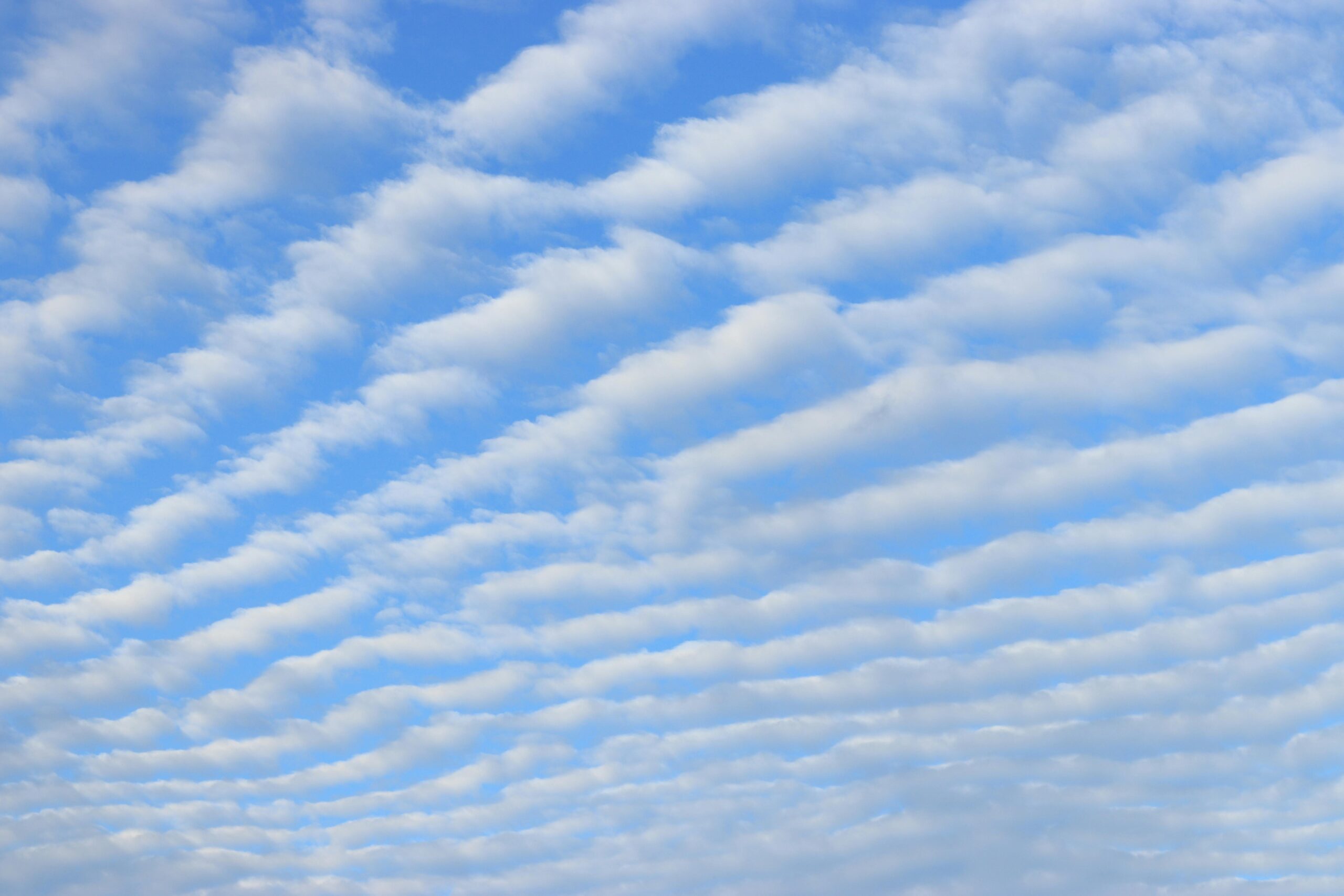
Because the droplets or ice crystals are essentially the same as those in natural clouds, whole-wake contrails can resemble thin cirrus or altocumulus filaments. Under certain conditions, the spiralling vortices can stretch into long tubes, creating patterns mistaken for “sprays” or “chemtrails” by uninformed observers. However, all scientific evidence shows these are transient aerodynamic phenomena, not deliberate releases.
Case Studies
Case Study 1: Airbus A380 at Zurich Airport (2019)
Photos show rainbow-hued spirals trailing from wingtips during final approach. Meteorological data: 4°C, 92% humidity, light crosswind. Droplet sizes estimated at 5–8 μm based on colour bands.
Case Study 2: Boeing 777 Over the Atlantic (2021)
Satellite imagery captured a pair of iridescent wake trails descending slowly from cruise altitude. Radiosonde data indicated –37°C and ice supersaturation at 250 hPa.
Public Perception and Misinterpretation
Iridescent whole-wake contrails are visually spectacular and can look artificial. Combined with the rise of social media, these images often circulate in conspiracy forums as “evidence” of spraying operations. In reality, no chemicals are being dispersed. The patterns are transient, self-dissipating, and entirely explained by physics.
Conclusion
Incandescent and iridescent whole-wake contrails are a natural consequence of aerodynamics, humidity, and sunlight. They form when low-pressure regions around aircraft surfaces cause ambient water vapour to condense, creating spiralling vortices and sheets of droplets or ice crystals. The vivid colours are produced by diffraction and scattering of sunlight through small, uniform particles.
Unlike persistent engine contrails, these whole-wake phenomena are short-lived, localised, and visually dramatic but entirely natural. Understanding the physics behind them helps demystify their appearance and counters misconceptions about deliberate aerosol spraying.
References
- NASA Glenn Research Center. Contrails and Aerodynamic Condensation. 2022.
- DLR (German Aerospace Center). Wake Vortex and Aerodynamic Contrails Measurements. 2018.
- ICAO. Aerodynamics of Lift and Vortex Generation. 2015.
- Gedzelman, Stanley. Atmospheric Optics: Diffraction and Iridescence. 2020.
- Wallace, J. M. & Hobbs, P. V. Atmospheric Science: An Introductory Survey. 3rd Edition, 2006.
- McIntyre, M. E. Wingtip Vortices and Atmospheric Mixing. Journal of Fluid Mechanics, 1981.
- Pruppacher, H. R. & Klett, J. D. Microphysics of Clouds and Precipitation. Springer, 2010.