
Understanding Star-Shaped Bursts and the Stories Built Around Them
Weather radar is one of the most sophisticated tools in modern meteorology. It scans the sky every day, tracing storms, tracking rainfall, and helping to protect communities from severe weather.
A growing number of online communities have become fixated on anomalous star-shaped patterns, circular pulses, and sudden bursts that appear on weather radar displays.
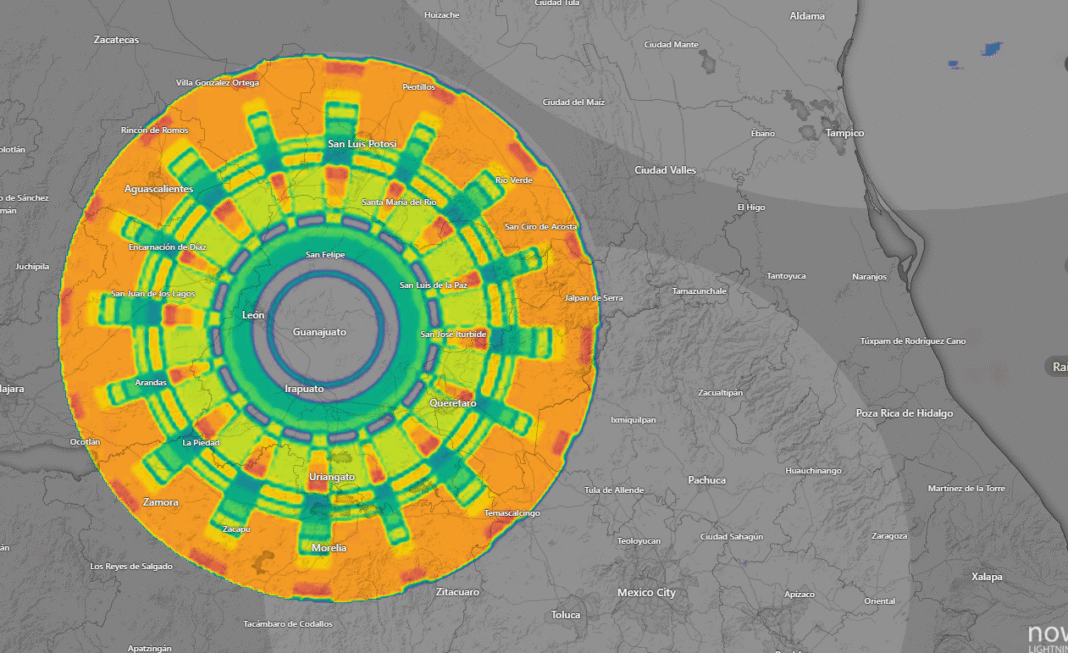
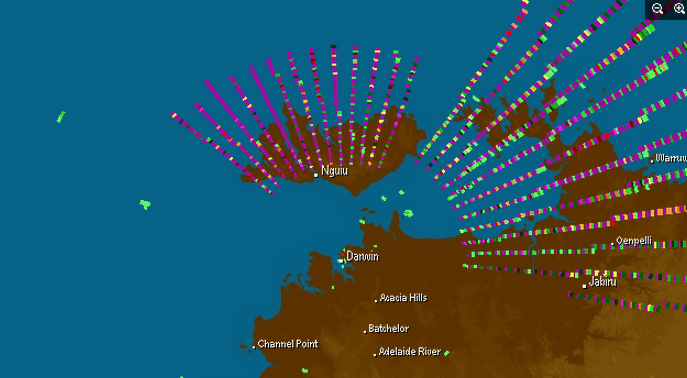
These shapes often resemble petals, spokes, or radiant suns. To atmospheric scientists they are familiar technical artefacts, produced by the radar equipment itself under certain conditions.
To conspiracy theorists, however, they are something far more sinister. Some believe these patterns reveal an unseen programme of weather manipulation, usually tied to ideas about electromagnetic control, chemtrail spraying, or HAARP-like technologies reshaping the climate.
The differences between scientific explanation and conspiratorial imagination tells us as much about human psychology as it does about the physics of weather radar.
What Weather Radar Actually Measures
Weather radar detects energy reflected back from objects in the atmosphere. The system emits pulses of microwave radiation, typically in the S-band or C-band frequencies, and listens for the tiny portion of that energy which bounces off raindrops, snowflakes, hail, insects, dust, or even airborne refractive layers.
The reflected energy reveals not only the presence of targets but also their movement, allowing meteorologists to identify rotation in thunderstorms or the advance of cold fronts.
The beam travels in a narrow cone shape. As it moves further from the radar dish, that cone broadens. A point 50 kilometres away is sampled by a beam several hundred metres wide.
Radar does not produce a photographic image of clouds. Instead, the system samples a three-dimensional volume of atmosphere and translates that data into colour shaded maps. In doing so, it sometimes creates patterns that do not correspond to real physical shapes in the sky.
Understanding the beam geometry is critical because many anomalies arise when the beam interacts with something unexpected, or when the post-processing software attempts to fill gaps in the data.
Star-bursts, concentric rings, wedges, or sudden spokes are not traces of artificial energy pulses being fired into the sky, nor of electrical interference generated by clandestine machinery.
Rather, they are signatures of the weather radar’s own limitations, combined with the atmosphere’s ability to bend or scatter microwaves in unusual ways.
Why Star-Shaped Bursts Appear
These star shapes are by-products of how weather radar works. The atmosphere constantly bends, scatters, and distorts electromagnetic energy.
The radar processing software attempts to correct for these effects but cannot eliminate them entirely. The result is a map that sometimes looks artistic or symbolic rather than purely meteorological.
Scientists have documented these artefacts for decades. Technical reports from the 1960s and 1970s discuss identical patterns, long before the internet and long before today’s conspiracy frameworks emerged.
If radar operators from that era saw today’s online theories, they would likely be baffled to learn that simple clutter spikes are interpreted as evidence of global manipulation.
The star shapes that attract so much online attention can result from several different processes.
Ground Clutter
Radar beams can strike buildings, terrain, wind farms, or other stationary objects, producing distinct lines radiating outwards from the weather radar site.
If the radar makes only a partial sweep at a specific elevation angle, these returns can form the appearance of evenly spaced spikes.
Radial Spokes
Radial spokes caused by software filters. When the weather radar detects transient interference or noise along a narrow azimuth, the system blocks that slice of data, leaving a spoke pattern behind. To the human eye, this can look like a sunburst or geometric symbol.
External Radio Transmissions
Radar systems can pick up signals from sources other than precipitation, including Wi-Fi, mobile phone towers, and other radar systems. These foreign radio signals show up on the map as straight, radiating lines.
Beam Ducting (Anomalous Propagation Events)
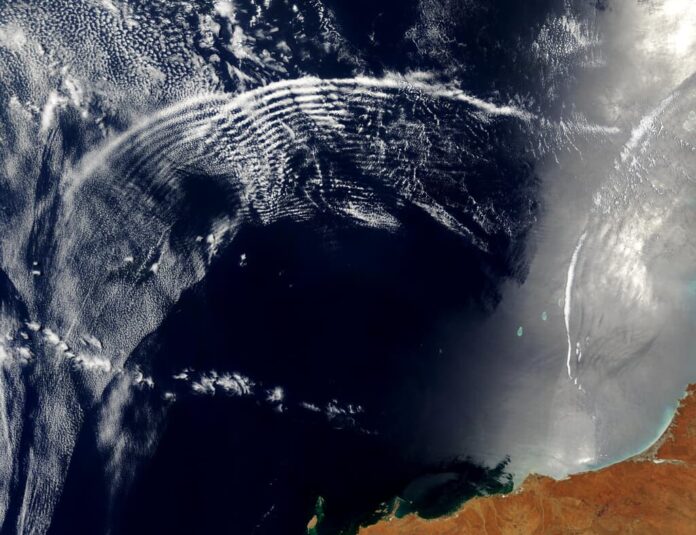
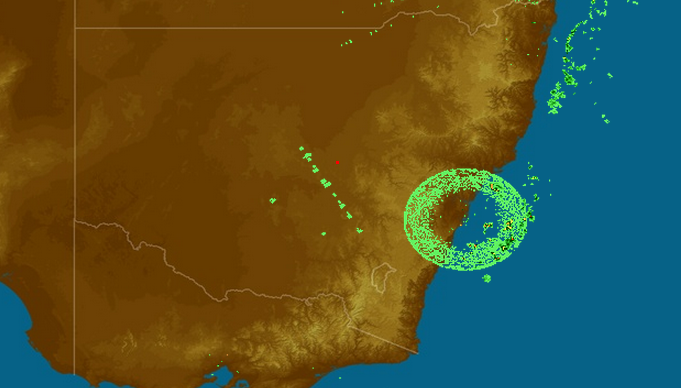
Beam ducting is a phenomenon where layers of warm and cool air create a refractive environment that traps the weather radar beam close to the ground. Under these conditions, the beam travels unusually far, skimming across the surface and producing false echoes. These appear as bright rings or radial patterns on the map. They are sometimes called anomalous propagation events.
Solar Interference
Near sunrise and sunset, a radar beam can momentarily scan the sun. This can produce a bright line radiating from the center of the image in the direction of the sun.
Radar Maintenance and Service
Sometimes, starbursts can appear on the radar display when the system is undergoing repairs or routine maintenance.
Chaff
Military aircraft sometimes deploy radar countermeasures called “chaff,” which consists of fine, metallic strips. These can create large, cloud-like echoes on radar displays to obscure the aircraft.
The Physics Behind the Patterns
To appreciate why these geometric shapes occur, it helps to understand the specific behaviour of microwaves in the lower atmosphere.
Radar beams at common weather radar frequencies propagate horizontally from the antenna, rising gently due to Earth’s curvature and the refractive index of air.
Under normal conditions, the beam spreads and weakens with distance. However, when there is a temperature inversion, with warm air lying above cooler air near the surface, the refractive index gradient changes. The beam bends downward, sometimes to the point that it becomes trapped in a duct, bouncing along the surface for hundreds of kilometres.
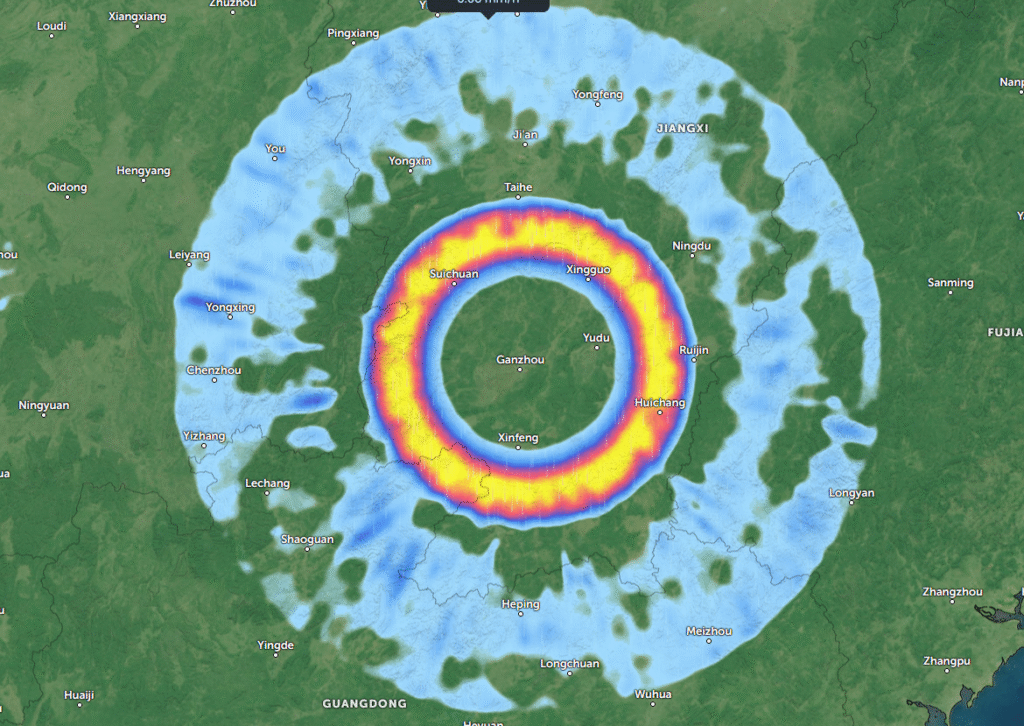
This creates illusions of intense rainfall or storms where they don’t exist. It also generates elegant geometric symmetry. Because the radar sweeps in a circular motion, any anomaly caused by ducting will appear as concentric circles centred on the radar site.
These circles are not real weather events. They are interference patterns, similar in principle to optical halos or lens flares in photography. They occur because the atmosphere has temporarily turned itself into a waveguide for microwave energy.
Spoke patterns often come from the digital signal processor. Modern radars sample thousands of pulses per second, checking for noise, interference, or radio sources that might contaminate the data.
When contamination is detected along a particular bearing, the processor flags or removes that azimuth, producing a blank spoke that radiates outward.
Some enthusiasts argue that these spokes resemble energy bursts or controlled beams. In reality, the only energy involved is the radar’s own output, which is constant and non-directional within its rotating scan.
Weather radars are not beam weapons. They emit low-power microwave pulses, typically between 250 kilowatts and 1 megawatt peak power, but at a rate that yields a time-averaged power far lower.
The peak power is comparable to microwave communication systems, not military directed-energy devices. The energy dissipates rapidly with distance and cannot induce weather changes.
Why Conspiracy Theorists Find These Shapes Compelling
The rise of social media has turned radar maps into a form of visual entertainment. People who would never previously have studied meteorological data now spend hours watching overwatch radar loops.
With greater exposure comes greater opportunity for misinterpretation. When a radar display suddenly erupts in petal-like bursts or geometric pulses, the human brain seeks patterns and meaning.
For conspiracy theorists already primed to believe in weather modification programmes, these shapes offer tantalising visual confirmation.
Psychologists studying belief formation note that vivid imagery can strengthen a narrative. A numerical chart showing atmospheric refractivity carries little emotional weight. A radar image that looks like a starburst, on the other hand, feels symbolic. It appears intentional, even if it is merely technical noise.
This tendency to ascribe meaning to unintelligent processes is deeply human. It is the same impulse that leads people to see shapes in clouds or faces in rocks. The radar map becomes a canvas for projection.
Radar artefacts have also been adopted into broader frameworks of electromagnetic conspiracy theories, especially those involving HAARP.
Although HAARP is simply an ionospheric research facility in Alaska, it has been folded into claims that governments possess secret weather control abilities. When viewers see dramatic radar shapes, they interpret them as the signature of such hidden technologies.
Online communities create feedback loops. Someone posts an image of a starburst radar anomaly. Others reinforce the interpretation. Soon, the anomaly becomes evidence of a coordinated global plot.
The original scientific explanation is rarely considered. Even when it is, it is dismissed as a cover story. The conspiracy becomes self-sealing. Lack of evidence is reinterpreted as proof of secrecy.
The HAARP Connection: Why the Theory Persists
HAARP’s publicised purpose is the study of ionospheric physics. The facility transmits high-frequency radio waves upward to stimulate small regions of the upper atmosphere, allowing researchers to examine propagation effects, auroral processes, and plasma physics.
It does not transmit in the microwave bands used by weather radar. Nor can it influence tropospheric weather systems. The energy it transmits into the atmosphere is tiny compared with natural inputs such as sunlight, thunderstorms, convection, and jet streams.
Yet the idea that HAARP can control weather has become one of the most enduring modern myths. It is attractive because it offers a simple explanation for complex events. Storms, heatwaves, droughts, and unusual radar patterns are interpreted as signs of a hidden technology shaping the climate.
Star-shaped bursts on radar maps fit neatly into this narrative because they look artificial. A shape that resembles a geometric symbol evokes imagery that supports the conspiracy.
Conspiracy theorists often argue that the radar images show intentional pulses. They point to the symmetry as evidence of control.
Scientists know that the symmetry is exactly what one would expect from a rotating antenna producing artefacts.
If an energy weapon or weather control device existed, it would not produce decorative shapes on civilian weather radar displays.
The persistence of the HAARP narrative is partly due to the difficulty of understanding atmospheric science.
Weather is dynamic, sensitive to small changes, and full of nonlinear behaviour. Radar artefacts, refractive anomalies, and interference patterns are unintuitive.
Conspiracy theories offer simpler stories. They also provide a sense of empowerment. Believers feel they possess secret knowledge that others lack.
Radar Anomalies and the Limits of Interpretation
Many radar anomalies occur during clear skies. When viewers see intense bursts or large coloured blobs despite no storm activity, they assume something unnatural has happened.
In reality, clear skies are often the perfect conditions for ducting events. Strong inversions, which produce tranquil weather, create the refractive gradients that cause beam bending.
As a result, the radar sees distant ground clutter or sea clutter and interprets it as precipitation. The data appears on the map but does not reflect real weather.
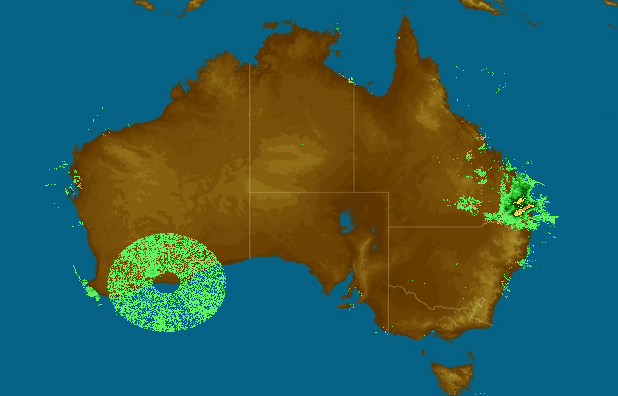
Another common pattern is the sudden appearance or disappearance of radar returns in circular discs around the radar site. This can occur when the radar switches modes or when maintenance occurs.
Sometimes, precipitation near the radar is so heavy that it attenuates the beam, preventing detection of distant targets. This creates gaps or circular voids which can be misread as evidence of deliberate suppression.
When radars perform calibration sweeps or quality control routines, the resulting images can look even stranger. They may show temporary uniform coverage or segment patterns.
These technical processes have been part of radar operation for decades, but they only became widely visible to the public once radar images were freely accessible online.
Wind turbines also create characteristic artefacts. Their rotating blades reflect microwave energy strongly, causing spikes or bursts in the direction of the turbines. In regions with large wind farms, these spikes may appear repeatedly, creating patterns that amateurs mistake for electromagnetic pulses.
The Appeal of Geometric Imagery
The starburst images that fascinate conspiracy theorists fit within an ancient human pattern of seeking symbols. When something looks purposeful, we assume a purpose.
Humans have always interpreted geometric shapes in nature as signs of intention. From Stone Age constellations to medieval omens, people have long sought meaning in the sky. In the digital era, radar displays have become a new kind of celestial canvas.
Meteorologists, on the other hand, see these shapes as manifestations of the equipment. They understand that the radar system is prone to artefacts whenever the atmosphere behaves in certain ways.
They also know that the symmetry is a direct consequence of the circular sweep of the antenna. The petals or spikes always centre on the radar site because that is where the beam originates.
The contrast between these interpretations illustrates how framing shapes belief. The same image can be a marvel of physics to one viewer and a clue to a hidden plot to another.
Without a grounding in electromagnetic theory or radar engineering, the simplest explanation can seem implausible. Complexity often fosters suspicion.
Why Weather Cannot Be Controlled by Radar or HAARP-Like Technology
The idea that weather can be controlled by small inputs of electromagnetic energy is a misconception of scale.
Weather systems involve colossal quantities of energy. A single thunderstorm releases the equivalent of several nuclear bombs worth of power as latent heat.
A large cyclone contains energy comparable to many years of global electrical production. Human technology cannot meaningfully alter these phenomena using microwave or radio waves.
Weather modification efforts such as cloud seeding operate on a very different principle. They attempt to influence microphysical processes on local scales by introducing particles around which water droplets can form. Even then, the effects are modest and subject to strict limitations.
The notion that directed energy can sculpt storm systems or create droughts is incompatible with the known physics of the atmosphere.
Weather radar is a passive observer. It does not inject energy into the atmosphere. Its pulses are extremely brief and disperse rapidly.
If radar could influence weather, the widespread deployment of radars around the world would have produced measurable effects. Decades of operation show no such influence.
How Misinformation Spreads and Evolves
Radar anomalies have become popular in conspiracy circles partly because they are easy to share. A single screenshot of a dramatic starburst can circulate widely, divorced from context. Without understanding the underlying engineering, many assume that the visual impact reflects physical impact.
Online platforms reward dramatic narratives. A video claiming weather manipulation receives more engagement than a quiet explanation of beam attenuation. Influencers amplify the conspiratorial interpretation because it attracts viewers.
Over time, these interpretations become entrenched. They are woven into broader narratives about climate control, government secrecy, and atmospheric manipulation.
Even well-meaning viewers may misinterpret what they see. A person might encounter a radar map showing a large circular pulse and assume it indicates an explosion of some sort. Once they ask questions in a conspiracy group, the community reinforces the dramatic interpretation. The technical explanation is rarely sought.
Communicating the Real Science
To counter misinformation, scientists must explain radar artefacts clearly and patiently. They need to show how the shapes arise from identifiable, repeatable processes.
Comparisons with optical phenomena can help. Just as a photograph can show lens flares or reflections that do not exist in the real scene, radar maps can show patterns produced by the sensor, not the atmosphere.
It also helps to acknowledge that the images are visually striking. People are drawn to them for good reason. They offer a glimpse of the hidden workings of technology. They can be appreciated aesthetically even when understood scientifically.
By demystifying the images, scientists can reduce the space in which conspiracy theories grow. Education does not eliminate belief, but it offers an alternative pathway for curiosity.
Most people who ask about radar anomalies are not acting in bad faith. They are trying to make sense of something unfamiliar.
Reading the Sky Through Machines
Weather radar is one of the triumphs of twentieth-century science. It has saved countless lives by providing early warning of storms. It is a tool of measurement, not manipulation.
The star-shaped bursts that appear on radar screens are phenomena of engineering and atmosphere, not evidence of clandestine operations.
Yet the human imagination is powerful. Where scientists see interference patterns, others see coded messages. Where meteorologists see ducting events, others see pulses of artificial energy. This gap will always exist to some extent because it stems from human psychology.
The solution is not to dismiss the curiosity that drives people to examine radar maps. Instead, it is to provide clear explanations, grounded in physics, that illuminate rather than ridicule.
When people understand the tools we use to observe the world, the shapes on the screen become part of the story of science, not the fuel of suspicion.
If things looks strange on a weather radar, it is not a sign that someone is controlling the atmosphere. It is a reminder that the atmosphere is far more complex, dynamic, and beautiful than we often realise, and that the machines we use to study it occasionally reveal both their own limitations and their own inadvertent artistry.
Many images used are from Australian Radar Anomalies