A century of white lines: how we learned to read the sky
Contrails have been part of human flight for as long as aircraft have routinely ventured into the cold, dry air of the upper troposphere.
Contrails are a predictable outcome of combustion and cloud microphysics, and their story runs in parallel with the story of aviation itself, from the first high-altitude sorties in the Great War to today’s densely trafficked sky.
This article traces when contrails were first noticed, how scientists worked out the physics that govern them, and why we see more of them now. Along the way we will draw on early eyewitness accounts, wartime photographs, and the scientific milestones that formalised our understanding.
First sightings: World War I and the 1919 record climbs
The earliest published observations of contrails date to the closing months of the First World War, when aircraft finally reached altitudes cold enough for exhaust water vapour to freeze into ice crystals.
Contemporary accounts from late 1918 describe transient white streaks forming behind aircraft during high-level operations, a phenomenon intriguing enough to spark discussion among pilots and observers at the time.
A short history compiled for NASA education materials summarises this early period and highlights a decisive sequence of post-war flights by the German pilot Franz Zeno Diemer in 1919, who climbed to about 30,500 feet above Munich and reported visible condensation effects in the wake.
Those first high climbs mark a practical threshold. At lower levels, the ambient air is usually too warm or too moist in the wrong way to permit a visible trail.
At around nine to eleven kilometres, temperatures often sit below minus 35 degrees Celsius and relative humidity with respect to ice can be high, so the mixing of hot, moist exhaust with that frigid air can briefly push conditions to water saturation, then to ice supersaturation, and finally to a trail of ice crystals.
The phenomenon was noticed first because aircraft finally spent time in the necessary environment.
From curiosity to operational problem: the Second World War
By the late 1930s and early 1940s, contrails had ceased to be a mere curiosity. They had become a tactical problem.
Both Axis and Allied air forces learned that white lines in the sky could betray altitude, position and heading.
Forecasting contrail formation became a practical military need. A widely used educational summary notes that contrail forecasting emerged as a specific skill during the war because persistent trails made formations easier to spot, regardless of other camouflage or radio silence.
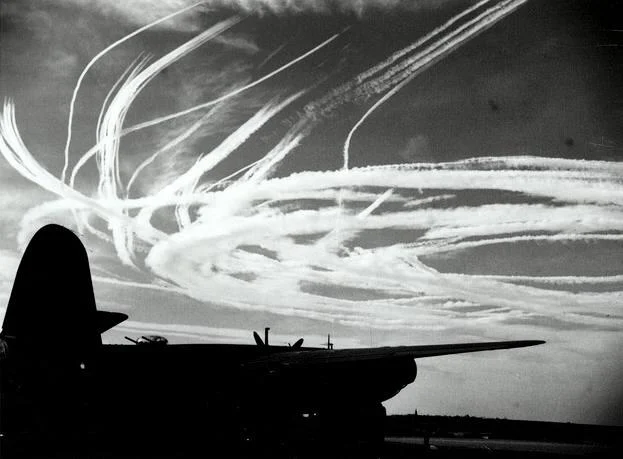
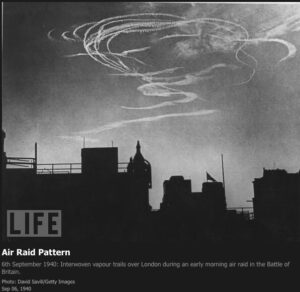
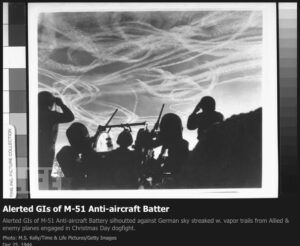
The historical record is unusually visual. Photographs from 1943 and 1944 show bomber streams over Germany with dense, braided plumes that spread into cirrus sheets. These images are abundant in public archives.

The U.S. Army Signal Corps captured B-17 formations leaving striking fans of trails during missions over Brunswick and elsewhere.
A wartime RAF caption from February 1945 over Berlin even remarked upon “fantastic vapour trails”, an unguarded acknowledgement that the visual spectacle was as unavoidable as it was conspicuous.
Historians of air power have documented how crews and planners adapted. If the forecast suggested persistent contrails along a planned route or at a target altitude, commanders might adjust levels or times to reduce the risk of telegraphing the mission.
This practical impetus fed directly into more rigorous science after the war.
Pinning down the physics: from Schmidt to Appleman
Two contributions are now canonical in contrail science.
In 1941, the German physicist Schmidt presented a thermodynamic framework for when a jet exhaust would produce a visible trail.
He treated contrails as a mixing problem: hot, moist exhaust dilutes into colder ambient air until the mixed parcel briefly reaches water saturation, at which point droplets form and promptly freeze.
In 1953, the American meteorologist Herbert Appleman formalised this into a practical diagram used by forecasters, now known as the Appleman chart.
It relates ambient temperature and pressure to the likelihood of contrail formation given typical exhaust properties. Together, the Schmidt–Appleman criterion remains the standard reference.
The physics is compact. First, a visible contrail requires that the mixed exhaust–ambient plume reach saturation with respect to water. Second, to persist beyond a few seconds, the surrounding air must be supersaturated with respect to ice so that the new ice crystals do not sublimate away.
These conditions are common in patches in the upper troposphere, which explains why aircraft can move in and out of trail-forming layers within minutes on a single flight.
Measurements and field checks have repeatedly validated the Schmidt–Appleman criterion in the decades since.
Photographs, paintings and eyewitness lines

Contrails entered public consciousness through images long before they entered school textbooks.
Wartime photographs show contrails as hard evidence of high-altitude traffic.
Civilian photographers later captured persistent networks of trails over European and North American cities during busy traffic flows from the 1950s onward.
Curated collections of historical images document that the characteristic ribbed and spreading patterns seen today are nothing new. Some of the most reproduced frames include bomber formations with tangled wakes and post-war frames where contrails spread into extensive cirrus decks.
Even captions can be revealing primary sources. The 1945 RAF caption from Berlin, for example, draws attention to “fantastic vapour trails”, choosing wonder rather than jargon to name the white lines.
Select museum and archive postings showcase similar period language. These fragments help anchor contrails in the ordinary narrative of aviation rather than in modern folklore.
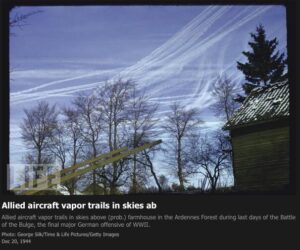
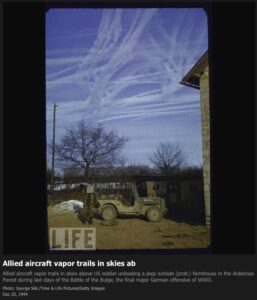
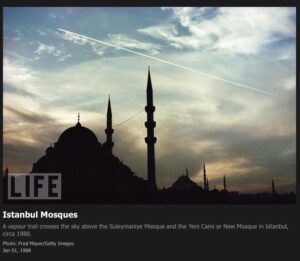
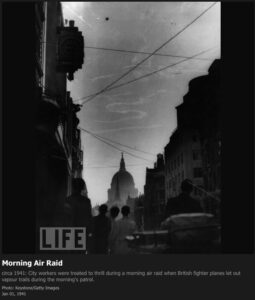
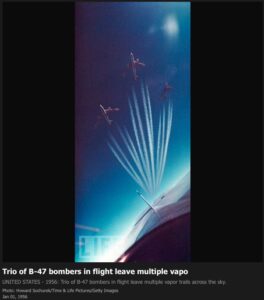
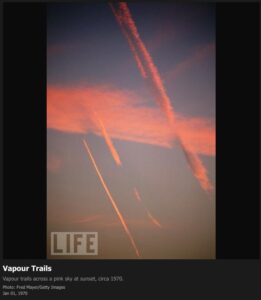
Life Magazine Contrail Photos
The following old images of contrails were originally found on the Life Magazine web site.


Why there are more contrails today
There are three straightforward reasons the twenty-first-century sky often shows more contrails than the sky your grandparents saw.
There are more flights.

The most important factor is sheer traffic volume. The number of daily tracked flights is routinely in the hundreds of thousands worldwide across all categories, with commercial movements alone commonly exceeding one hundred thousand per day outside holiday troughs.
Real-time statistics from flight-tracking services show the scale clearly. Passenger demand has also set records in recent years, reflecting recovered and expanded networks after the pandemic shock. More aircraft in the layers that support contrails means more opportunities for trails.
Modern cruise profiles spend time where contrails form.
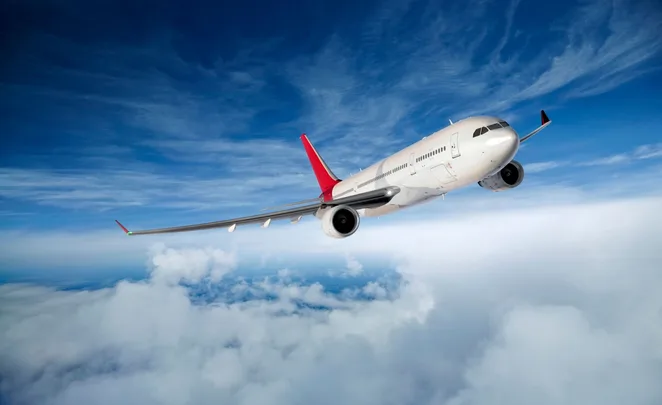
Jet airliners cruise in the upper troposphere where temperatures are typically well below freezing.
Global assessments have long noted that contrails are, physically speaking, a form of human-induced cirrus and that their occurrence is dictated by the thermodynamic environment encountered along routes.
As the volume of long-haul and high-altitude short-haul flying has grown, the exposure to contrail-friendly layers has grown with it.
High-bypass turbofan engines make contrails at least as readily as older engines.

A persistent internet claim is that modern high-bypass engines are “almost incapable” of forming contrails. The physics and the literature show the opposite.
High-bypass turbofans are very efficient. They add large amounts of water to the wake per unit of heat released and have cooler exhaust cores than older turbojets, which affects the mixing trajectory of the plume.
The result is that, for the same ambient conditions, the “contrail factor” is often higher, not lower, for high-bypass engines, making contrail formation more likely when the atmosphere is near the threshold.
Studies and technical theses examining bypass ratio and contrail likelihood support this qualitative conclusion.
Taken together, traffic growth, cruise altitudes and engine evolution explain why persistent white lines may appear more often above busy corridors today than they did decades ago.
From short-lived streaks to long-lived cirrus
Not all contrails are alike. Some vanish within seconds because the surrounding air is ice-subsaturated, so the newborn crystals sublimate away. Others persist and spread when the air is ice-supersaturated.
In the latter case, ice crystals can grow by deposition and the trail can shear into broad sheets that resemble natural cirrus.
The Intergovernmental Panel on Climate Change long ago described persistent contrails as artificially induced cirrus because, microphysically, that is exactly what they are.
Contrails interact with radiation in much the same way as thin, cold natural cirrus, with complex net effects that depend on time of day, season and background cloudiness.
The link between persistent contrails and radiative effects was studied opportunistically during the shutdown of U.S. airspace in September 2001 and has been explored using historical events such as massed bomber raids in the 1940s.
One popular-science write-up, based on journal work, pointed out that those wartime missions provided an inadvertent field experiment on how large populations of contrails can modulate local cloudiness and surface temperatures.
The direction and magnitude of those effects vary, as you would expect for high, thin cloud.
Forecasting contrails: from wall charts to models
For years, forecasters used Appleman charts to predict whether contrails would form at a given altitude from a forecast temperature and moisture profile.
Military weather units integrated contrail forecasts into flight planning because a persistent trail could undo other stealth measures by advertising an aircraft’s path.
Even today, simplified Appleman-style logic sits behind many educational tools, while research weather models incorporate more detailed microphysics to simulate where persistent contrails are likely.
The challenge remains upper-tropospheric humidity, which is notoriously difficult to measure and model with precision. This is why any simple forecast of “contrails guaranteed” should always be treated as probabilistic.
Aerodynamic contrails: not all trails are from exhaust
Most contrails arise from exhaust water vapour. A distinct class, aerodynamic contrails, forms when the pressure drop over a wing or propeller disc cools the air locally to saturation, creating clouds of tiny droplets that freeze within milliseconds in the ambient cold.
They can occur during steep turns or at high load factor and sometimes at lower altitudes. The physics and appearance differ but the outcome is the same. You are still looking at a cloud of ice crystals.
Misconceptions and the value of the historical record
The historical record is a powerful corrective to common misconceptions. High-resolution photographs from the 1940s through the 1980s show persistent, spreading contrails in skies far less trafficked than today’s.
These images demonstrate that the basic behaviour of trails has not changed. What has changed is traffic density, route structure and engine technology. Curated galleries that compile dated, verifiable pre-internet photographs make this plain.
The same record helps debunk the notion that modern engines “should not” produce contrails. The literature on bypass ratio and plume thermodynamics shows why the opposite is expected.
A common sense check helps too. Any hydrocarbon combustion produces water. If the ambient air is cold enough and close enough to saturation, that water will join the atmosphere’s hydrological cycle exactly as you see in your breath on a winter day. The only difference at 10 kilometres is the speed of freezing and the persistence of ice.
1980 NBC – Contrails can change the weather
Below is a news-clip from 1980, long before Chemtrails were first talked about.
Counting the lines: traffic growth over a century
In the 1950s the world flew a fraction of today’s schedules. In the 1990s, traffic was already a step up, yet still well below current volumes.
Recent years have set new records for passenger demand and flight numbers, with daily tracked flights often running into the high hundreds of thousands across all categories, and commercial flights alone exceeding one hundred thousand per day on many dates.
Real-time dashboards from independent trackers show the trend; airline trade bodies report matching records in passenger-kilometres flown.
When you knit this growth to the physics covered above, the outcome is inevitable. More flights plus contrail-friendly layers equals more contrails seen.
Seeing like a scientist: what to look for in the sky
If you want to read the sky with a scientist’s eye, three clues matter.
First, watch the lifespan of a trail. If it appears and then vanishes within a minute, the air is likely ice-subsaturated. If it persists for 15 minutes and spreads into streamers, the air is probably ice-supersaturated in that layer. That distinction is both a microphysics lesson and a weather clue.
Second, look for altitude contrasts. Aircraft sometimes change level to find smoother air or better winds. A jet leaving no trail at one level may start producing one after a small climb. That is an Appleman lesson in real time.
Third, watch for the network effect. In busy corridors, successive trails can overlap and merge into a broader veil.
Historical photos and modern satellite images both show this. It is not a new behaviour. It is a scaling effect of traffic volume.
Milestones in contrail science
Late 1910s. First reports of condensation trails during World War I, culminating in 1919 high-altitude climbs over Munich by Franz Zeno Diemer.
1941. Schmidt outlines the thermodynamic conditions for contrail formation.
1943–45. The tactical importance of contrails becomes obvious during massed high-altitude raids. Forecasting trails enters routine planning. Photographic evidence abounds, with captions that explicitly note the trails.
1953. Appleman publishes his now famous chart to predict contrail formation using pressure–temperature diagrams and typical exhaust properties. The chart becomes a staple for military forecasters and later a teaching tool.
1999 onwards. The IPCC’s special report on aviation codifies our understanding of contrails as human-induced cirrus, connecting them to radiative forcing discussions. Subsequent work refines how we detect, model and manage contrail climate effects.
2000s–2020s. Studies re-examine how modern high-bypass turbofans alter plume microphysics and contrail probability, generally finding equal or higher likelihood of trail formation for the same ambient conditions compared with older turbojets.
More Contrail images throughout time
The photographic record is rich. Several representative images include:
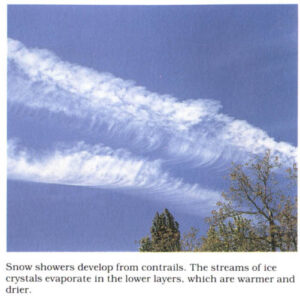
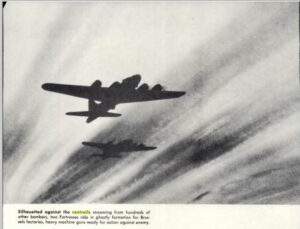
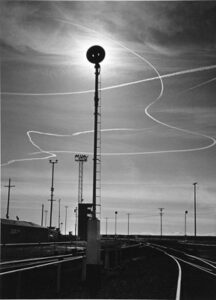
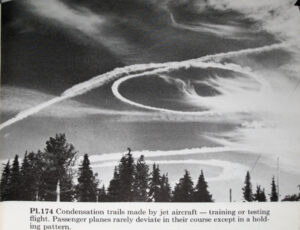
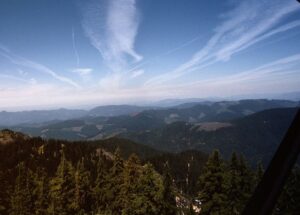

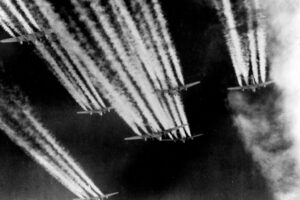
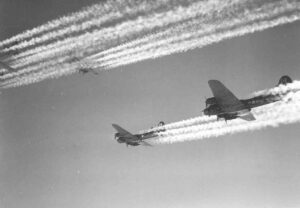
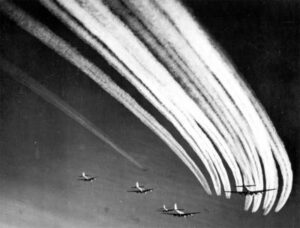
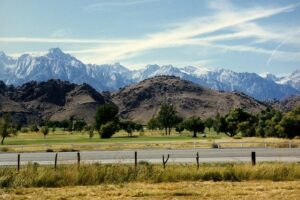

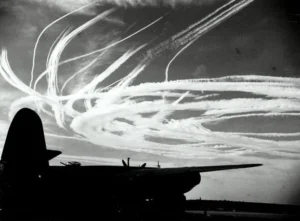
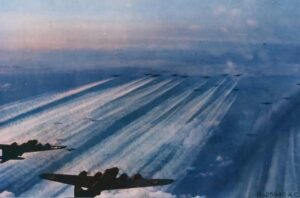
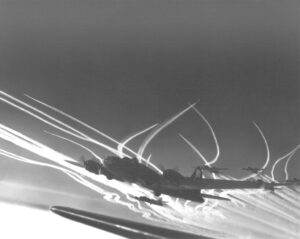
These stand not as curiosities but as evidence that contrails have long behaved as modern observers report.
The modern problem: climate and operations
As contrails spread and mix into cirrus, they can increase high-cloud cover. The climatic effect is nuanced, varying by region and diurnal cycle, but contrails are one of the non-CO₂ climate impacts of aviation that airlines and regulators now watch.
This has led to the idea of contrail management, where minor route or altitude adjustments avoid layers forecast to be ice-supersaturated.
The concept is actively explored and, if operationally feasible, could reduce the small fraction of flights responsible for most contrail radiative forcing, without large time penalties. Historical context matters here.
The same operational logic that led wartime planners to dodge persistent contrail layers for tactical reasons may someday be used to dodge them for climate reasons.
Why history matters
Recording when contrails were first seen, how they were explained and when they mattered operationally keeps the discussion anchored in evidence. The story shows cumulative science at work:
Observers described the phenomenon. Physicists derived the threshold conditions. Forecasters built tools. Photographs and captions documented what the sky looked like in specific places and times. Later, climate scientists assessed the aggregate effect of many such trails on regional cloudiness and radiation.
This is also why historical images and primary lines are so valuable. They prove that the behaviours people notice today, such as spreading into veils or forming broad grids over hubs, are not artefacts of the internet age. They were visible as soon as flight frequencies and routes created the opportunity.
Looking ahead: contrails in an evolving fleet
The next chapter in contrail history will be shaped by three trends.
First, fleet changes
Ultra-high bypass geared turbofans, open-rotor concepts and sustainable aviation fuels will shift exhaust composition and plume microphysics. Some changes may increase the ice-nucleating particle count while others may reduce it, with net effects still a subject of research.
Second, operations
Airlines already optimise for winds and turbulence. Adding a contrail-avoidance objective may be feasible on a subset of flights if forecast skill for ice-supersaturated layers improves and if the climate benefit justifies the extra planning. The wartime precedent shows that operational contrail forecasts are not a novelty.
Third, observation
Satellites, ground-based lidars and citizen science will keep improving our ability to detect and classify contrails versus natural cirrus, which matters for both attribution and management. The underlying thermodynamics are settled. The challenge is scale and variability.
Some closing thoughts
Contrails are a textbook case of how physics and engineering intersect in the open air. They begin with stoichiometry and thermodynamics inside an engine and end as sunlight scattered by ice at ten kilometres.
Their history shows how quickly a new technological capability can create a new class of atmospheric phenomena, how operational needs can drive basic research, and how images and brief, matter-of-fact lines in wartime captions can end up as valuable scientific artefacts.
We see more contrails today because we fly more, higher and with engines that mix exhaust and ambient air in ways that favour ice crystal formation when the layer is primed.
The white lines may be familiar, but the science behind them remains a living subject, and the archive they have left across a century of flight is rich and clear.