
The Artificial Sun Conspiracy Theory
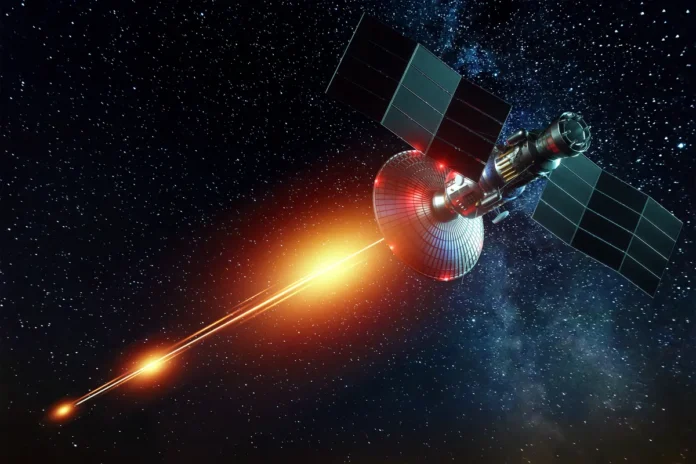
Among the more unusual claims circulating within online conspiracy communities is the idea that an artificial sun has been launched into Earth orbit.
According to these theories, governments or private parties have deployed a luminous object capable of mimicking the real sun in order to deceive the public or to manipulate the environment.
The claim often appears alongside discussions of weather modification, secret geoengineering programmes, and large-scale atmospheric manipulation.
As with most conspiracy theories, the argument rests on a combination of misunderstandings, selective interpretation of images, and a fundamental lack of technical knowledge.
Let’s examine the concept of an artificial sun within a scientific framework, drawing on established physics, engineering constraints, and basic geometry. The goal is to show clearly why such a device cannot exist in the manner conspiracy theorists imagine, while also exploring the real technologies that sometimes inspire these misinterpretations.
Why It Is Not Physically Possible to Launch an Artificial Sun
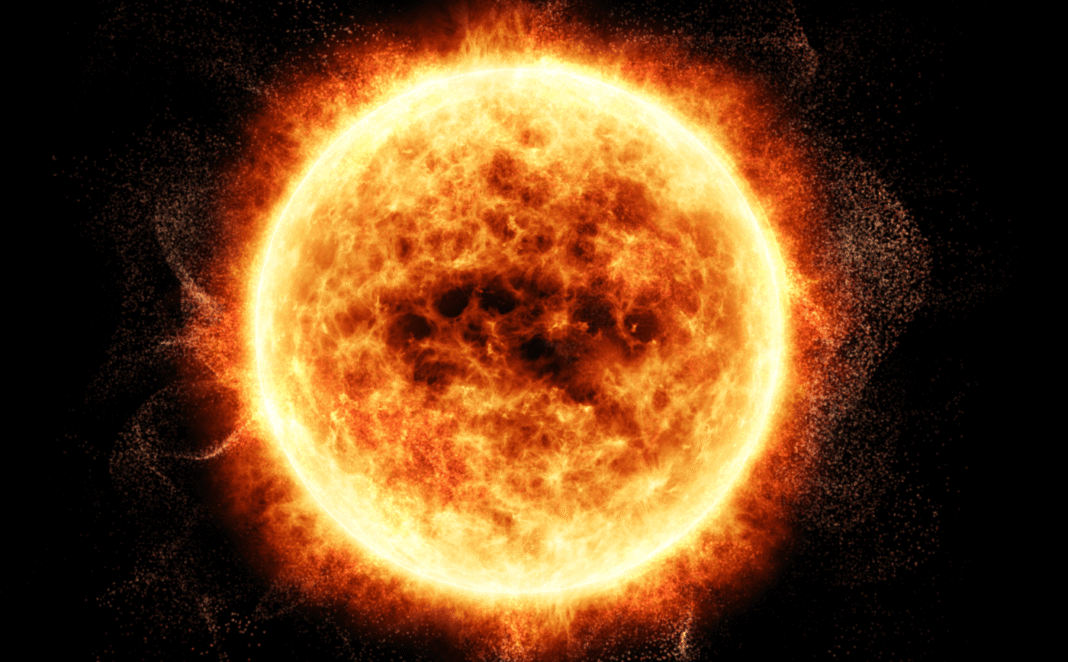
The simplest reason an artificial Sun in orbit is impossible is that the real Sun is extraordinarily bright and extraordinarily large.
The Sun delivers roughly 1,360 watts of solar power per square metre at the top of Earth’s atmosphere. Across the full disc of the sky, the human eye perceives this as an illumination of approximately 100 000 lux on a clear day. Reproducing this level of brightness across the entire visible hemisphere of Earth is not remotely feasible.
A functional Sun simulator in orbit would require two independent capabilities.
- It must physically obscure or replace the Sun in the observer’s line of sight.
- It must emit enough light to create the same illumination as the Sun.
Both requirements exceed any conceivable engineering capability.
The primary misunderstanding comes from a confusion between localised artificial light sources and a solar-scale light output.
A stadium floodlight produces at most tens of thousands of lumens. Even the most advanced industrial light sources produce millions of lumens.
The Sun emits roughly 3.8 × 1026 watts of power. To reproduce only the fraction that reaches Earth, a satellite would need to emit an irradiance matching that of the Sun across an angular diameter of roughly 0.53 degrees, the apparent size of the Sun in the sky.
No known material, fuel, or energy system can produce a coherent, Sun-like illumination at that scale, nor is there any way to disguise such an object from astronomical observation.
Observatories across the world monitor the sky continuously. Amateur astronomers track satellites down to a few centimetres across. The absence of any data suggesting an artificial sun is itself conclusive.
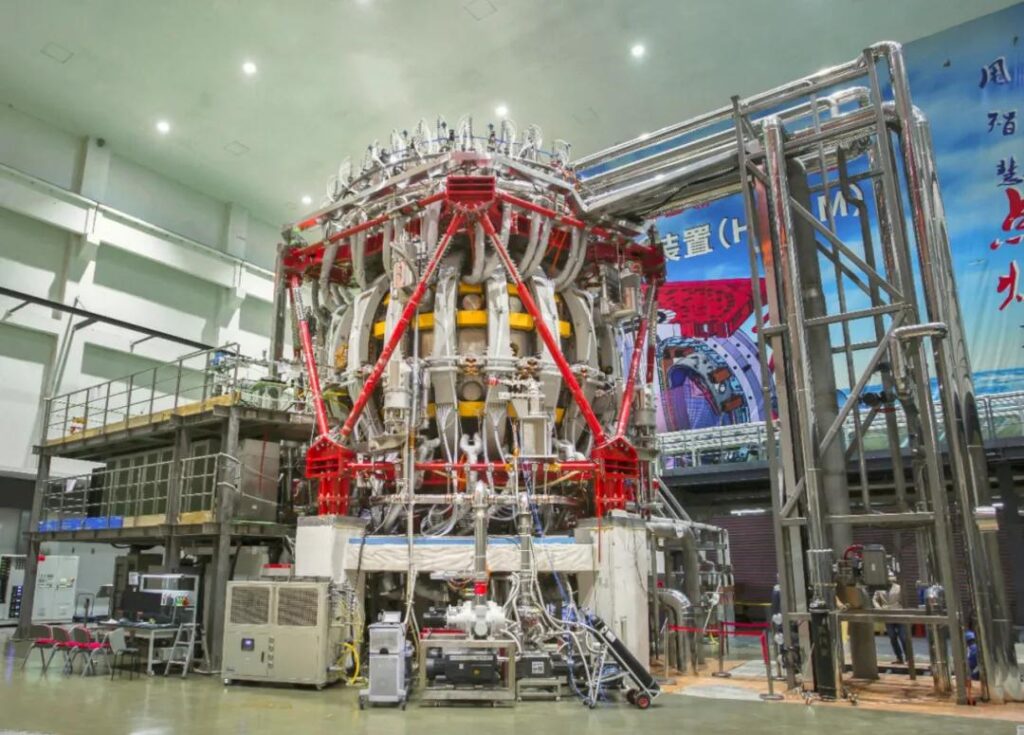
China’s Sun Simulator: Experimental Advanced Superconducting Tokamak (EAST)
A recurring point in conspiracy discussions is the claim that China has developed or launched a large orbital sun simulator.
The misunderstanding arises from two unrelated technologies.
The first is an experimental artificial light source used in research facilities within China. These devices are powerful indoor solar simulators designed for material testing, space environment studies, and renewable energy research.
They use xenon arc lamps or high intensity LEDs to reproduce the spectral characteristics of sunlight. Their output is confined to controlled laboratory conditions and is directed at small test areas that measure only a few square metres. They are not capable of illuminating the atmosphere or the landscape beyond the laboratory.
The second source of confusion is China’s long term interest in satellite based illumination. Several research groups have proposed the concept of placing reflective satellites in orbit to redirect sunlight to specific urban areas at night.
The idea is similar to historical proposals in Russia, where engineers once explored using large mirrors in orbit to illuminate regions during winter. These proposals remain theoretical. They rely on reflective surfaces rather than artificial light. The intention is to redirect existing sunlight rather than generate new light. No large reflective illumination satellite has ever been launched by China or any other nation.
Images and videos shared online to support the claim often show atmospheric optical effects such as sun dogs, reflections on clouds, or artefacts produced by digital cameras. Others show indoor laboratory lighting rigs that are misrepresented as space based devices. China has not launched an artificial Sun.
The technology referenced in these claims is either conventional laboratory equipment or an unbuilt conceptual study involving mirrors, neither of which resembles the planetary scale illumination system imagined in conspiracy theories.
Other Artificial Suns That Currently Exist
Although an orbital artificial Sun is impossible, there are several real technologies that have encouraged confusion. These include high-intensity arc lamps, fusion research devices, and concentrated solar simulation systems used in laboratories.
Solar simulators
Research institutions use powerful solar simulators to study solar panels, spacecraft materials, and high-temperature engineering. These are typically arrays of xenon arc lamps or specialised LEDs arranged to reproduce the spectral distribution of sunlight.
They are used indoors. Even the largest systems illuminate only a small area, often a few square metres. Their brightness does not approach the scale required to illuminate a planetary hemisphere.
Fusion experiments
Facilities such as the National Ignition Facility and the Joint European Torus produce extremely high temperatures comparable to the Sun’s interior. These devices are sometimes described colloquially as artificial suns.
In reality, they produce light and heat only within a confined plasma inside a reactor vessel. They do not emit significant visible light outside the containment. Their size and energy consumption make them entirely unsuitable for orbital deployment.
Industrial lighting
Very large industrial lamps, particularly those used for film production or metal halide illumination, can appear extremely bright. When photographed under specific settings, they sometimes resemble miniature suns. None exceed a few hundred thousand lumens, and none are physically large enough to create a solar disc.
These technologies demonstrate that artificial illumination can be extremely bright in controlled environments. However, their power demands, limited spectral qualities, and small scale highlight the gulf between laboratory devices and the concept of an orbital artificial Sun.
How Large an Artificial Sun Would Need to Be to Cover the real Sun
A key requirement of the conspiracy theory is that the artificial Sun must obscure the real Sun. This claim can be evaluated using elementary geometry.
Angular size of the Sun
The Sun has an angular diameter of around 0.53 degrees as viewed from Earth. Any object intended to obscure it must subtend an equal or larger angular diameter in the observer’s sky.
Case 1: Object in Low Earth Orbit
Low Earth orbit (LEO) is typically between 200 km and 2,000 km above Earth’s surface. For this calculation, let us assume a height of 500 km, a typical orbit for Earth observation satellites.
To cover the Sun, the artificial Sun must have a diameter equal to:
Diameter = 2 × (distance to object) × tan(angular radius)
The angular radius is approximately 0.265 degrees.
Converting 0.265 degrees into radians gives approximately 0.00463 radians.
Thus the required diameter is:
Diameter ≈ 2 × 500,000m × 0.00463
Diameter ≈ 4 630 m
In other words, an artificial object in LEO would need to be around 4.6 kilometres across to obscure the Sun from a single observer.
To cover the Sun for observers across an entire region or country, the disc would need to be considerably larger, possibly tens of kilometres across.
Case 2: Object in High Earth Orbit Orbit
High Earth orbit, at around 35 786 km above the surface, drastically changes the scale.
Using the same formula:
Diameter ≈ 2 × 35 786 000 m × 0.00463
Diameter ≈ 331 000 m
An artificial Sun placed in geostationary orbit would need to be over 330 kilometres in diameter merely to cover the Sun for a single observer at one location on Earth. To obscure the Sun for even a modest geographical region, it would need to be far larger.
There is no launch vehicle, no materials technology, and no orbital infrastructure that can create or support structures of this size. Even the International Space Station, one of the largest objects ever placed in orbit, is only around 109 metres wide.
Required Brightness: How Many Lumens Are Needed for an Artificial Sun
The human eye perceives sunlight at ground level as roughly 100,000 lux. Lux is lumens per square metre at the point of illumination.
To calculate how many lumens a light source must emit to produce equivalent illumination, one must consider distance, beam spread, and atmospheric scattering.
If an artificial Sun in LEO emitted light evenly in all directions, the total luminous flux required would be immense. However, even if it were engineered to focus light only toward Earth, which is itself not trivial, the power demands would far exceed any known technology.
The Earth’s surface area facing the Sun at any moment is roughly 1.27 × 10¹⁴ square metres.
The Sun delivers about 1,360 watts per square metre at the top of the atmosphere, corresponding to a visible-light luminous flux of roughly 100,000 lux.
An orbital device would have to match this illumination locally. Even if the artificial Sun were designed only to illuminate a small region, the total luminous output required would be in the order of trillions of lumens.
The brightest LED arrays currently achievable span the tens of millions of lumens at most. The gap between this and the solar requirement is not a matter of scale but a difference of many orders of magnitude.
Candidate Light Sources for a Hypothetical Artificial Sun
Conspiracy theorists often claim the artificial Sun is an LED, a plasma sphere, or a type of fusion device. Each proposal fails under scrutiny.
LED Arrays
LED technology is efficient and capable of high brightness, but nowhere near the level required to simulate sunlight across kilometres of atmosphere. The thermal management required to dissipate the heat produced by such an enormous LED panel would be prohibitive.
Xenon arc lamps
These produce intense broad-spectrum light and are used in solar simulators. The largest examples are stationary and consume tens of kilowatts. They are unsuitable for space due to their mass, fragility, and power requirements.
Laser-based systems
Lasers can focus energy into narrow beams but cannot illuminate broad areas. The concept of a laser shining light over Earth to mimic the Sun is incompatible with the principles of radiative geometry.
Fusion-based illumination
Fusion reactors produce energetic plasma but do not directly emit visible light at the scale required. They are extraordinarily massive and require extensive shielding, cooling systems, and magnetic confinement. None are close to being spaceflight compatible.
No known light source is capable of producing anything close to the solar constant within an orbital platform. Even if such a technology existed, it would be visible from Earth’s telescopes, radar networks, and amateur satellite trackers.
Energy Requirements and Power Sources for an Artificial Sun
If we assume, for the sake of argument, that an artificial Sun was intended to illuminate only one metropolitan area, such as a city of around 100 square kilometres, the numbers remain implausible.
At ground level, producing 100,000 lux across 100 square kilometres requires:
- 100,000 lumens per square metre
- One square kilometre equals one billion square metres
Thus 100 km² equals 100 billion square metres
The required luminous output would be:
100,000 lumens × 100,000,000,000
This equals 1 × 10¹⁶ lumens
This is a conservative estimate because atmospheric scattering significantly reduces light intensity before it reaches the ground.
The electrical power required to produce 1 × 10¹⁶ lumens, assuming extremely optimistic luminous efficacy values, would be in the order of tens of terawatts. Global electricity generation is roughly 30 terawatts from all sources.
Therefore, an orbital light source capable of illuminating a single city would need a power output comparable to the entirety of human civilisation’s electrical capacity.
Solar power feasibility
If the device attempted to power itself using solar panels, it would need to collect terawatts of solar energy. Solar satellite concepts for supplying power to Earth typically require arrays several kilometres in size to deliver even a few gigawatts.
A system requiring terawatts would need solar arrays spanning hundreds of square kilometres. No launcher can place such infrastructure in orbit. The mass, structural requirements, and deployment mechanisms exceed anything close to possible engineering.
Could Such an Artificial Sun Be Launched
No! Even if we ignore the luminous and energy requirements, the physical scale alone is completely beyond reach.
The largest payload capacities of current rockets can place perhaps 100 tonnes into low Earth orbit. Even ambitious next generation vehicles would not approach the ability to deploy multi kilometre structures.
Additionally, assembling structures on the scale of kilometres or tens of kilometres in orbit would require thousands of launches, extensive autonomous fabrication technology, and massive industrial presence in space. None of this exists.
Astronomers routinely track objects as small as discarded rocket bolts. A multi kilometre reflective or illuminated structure would be detectable instantly. It would cast shadows, reflect sunlight, and appear as a major orbital hazard. No such data exists.
Observational Geometry: Why No One Sees Two Suns
A fundamental flaw in the conspiracy theory is a misunderstanding of geometry. If an artificial Sun were placed between an observer and the real Sun, it would only obscure the real Sun for that single observer or for a very narrow region beneath the object. Observers located even a short distance away would see the real Sun and the artificial Sun in different parts of the sky.
Consider a hypothetical artificial Sun 500km above Earth. Two observers separated by 1,000km would view the object along significantly different lines of sight. This would place the object in different positions relative to the real Sun in the sky.
One observer might see the object directly in front of the Sun. The other observer, however, would see them separated by a measurable angular distance.
This is unavoidable due to parallax. The only reason the real Sun appears in the same position for all observers is that it is 150 million kilometres away.
If an artificial object existed in front of the Sun, two Suns would appear. One would be the real Sun, and the other would be the object. No such observations occur.
Photographs that claim to show two Suns are either lens artefacts, misinterpretations, or atmospheric optical effects.
Reports of Two Suns: Atmospheric Optical Phenomena
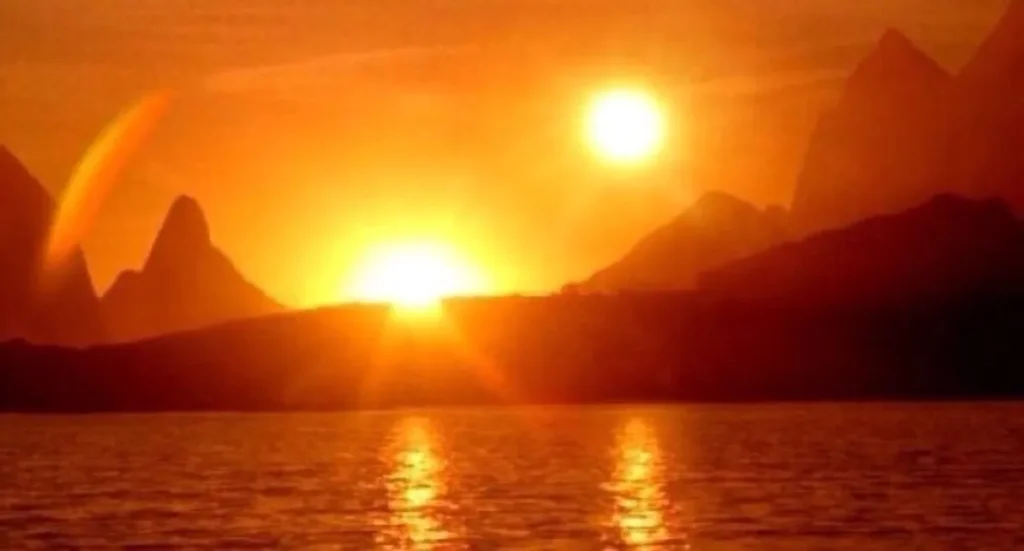
Many people who believe in an artificial Sun report seeing two bright discs in the sky. This phenomenon is real, but it is not caused by orbital technology.
Hunter’s Moon

During the period of the Hunter’s Moon, some observers report seeing what looks like a second Sun near the horizon. This effect is a combination of atmospheric refraction, low-angle scattering, and the strong contrast between the Moon’s bright disc and the surrounding twilight.
When the Moon rises or sets near the Sun’s position, temperature gradients in the lower atmosphere can bend and distort light, creating displaced or duplicated images. These mirage-like reflections can give the impression of two Suns, particularly when haze, thin clouds, or humidity increase the spread of light.
The phenomenon is entirely natural and follows predictable optical behaviour, with no need for any artificial object or technology.
Sun dogs
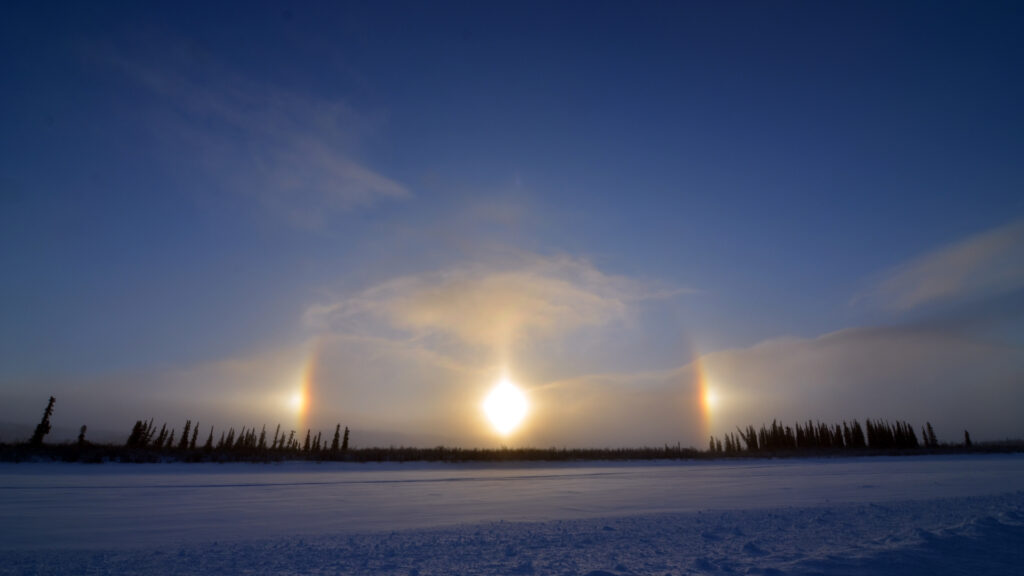
Sun dogs, also known as parhelia, are bright spots that appear on either side of the Sun when sunlight passes through ice crystals. They often resemble bright secondary Suns. They appear most commonly when thin cirrus clouds are present.
Halos
Circular halos around the Sun, often of radius 22 degrees, are caused by the refraction of sunlight through hexagonal ice crystals in the upper atmosphere. Halos can create bright arcs and points of light that may resemble additional Suns.
Atmospheric refraction
Temperature inversions and layers of air with differing densities can bend sunlight. This can create displaced images of the Sun, especially on the horizon.
Lens artefacts
Camera lenses often produce internal reflections, especially when pointed directly at the Sun. These can create ghost images that resemble a second Sun.
These effects are well understood, predictable, and thoroughly documented in meteorological and optical science. None require or imply the existence of an artificial Sun.
A Final Assessment of the Artificial Sun Theory
The claim that an artificial Sun has been launched into orbit collapses under even minimal scientific scrutiny. The physical scale required to obscure the real Sun, the luminous output needed to replicate sunlight, and the energy demands required to power such a device all exceed the limits of known physics, engineering, and materials science.
Real artificial light sources exist, but none operate at planetary scale. The brightest human-made lights illuminate only small controlled areas and require substantial energy inputs. Translation of these technologies into orbit is not plausible.
The geometry of observation demonstrates that if such an object existed, observers across Earth would see multiple Suns at different positions in the sky. This does not occur. Reports of two Suns are easily explained by well understood atmospheric optical effects such as sun dogs and halos.
There is no physical evidence, no astronomical data, and no engineering capability to support the idea of an artificial Sun in orbit. The persistence of the claim reflects misunderstandings of optics, spaceflight, and observational geometry rather than any technological reality.