
Assessing the Plausibility of Chemtrails Claims: An Engineering-Based Review
The notion that commercial or military aircraft are secretly dispersing chemicals into the atmosphere, often labelled the chemtrails conspiracy theory, has persisted for more than two decades.
Its central claim is that the visible condensation trails behind aircraft are not merely contrails formed from water vapour, but deliberate dispersals of undisclosed substances for undisclosed purposes.
Such proposals range from weather modification and psychological manipulation to covert geoengineering. Despite its popularity in some online communities, the hypothesis collapses when examined through the lens of aviation engineering, manufacturing practice, operational logistics, regulatory oversight, and observable evidence.
This article evaluates the feasibility of large-scale chemical dispersal using commercial jetliners or military aircraft, drawing particularly on the testimony of a veteran Boeing engineer with more than twenty years’ experience in aircraft design, inspection, and assembly.
His operational knowledge of the interiors of Boeing aircraft, coupled with a detailed understanding of quality control and regulatory oversight, offers an authoritative basis for assessing the chemtrail hypothesis.
The analysis is extended here into a comprehensive technical and logistical review showing why such a programme is effectively impossible.
The aim is not to ridicule those who hold these beliefs, but to examine the physical, engineering, and organisational requirements such a scheme would entail. When scrutinised empirically, the scenario demands levels of secrecy, mechanical modification, and operational complexity that contradict every known aspect of the modern aviation industry.
Aircraft Architecture and the Absence of Chemical Dispersal Hardware
A modern commercial aircraft is a highly space-optimised environment. Every cubic centimetre of internal volume is accounted for in the design process.
Structural members, fuel systems, electrical channels, avionics housing, passenger services, galleys, lavatories, and safety equipment follow rigorous placement standards to meet both engineering requirements and international certification rules.
Within this tightly constrained environment, there is no unused volume suitable for concealing large chemical tanks, pumps, and dispersal systems. Before the installation of interior wall panels, fuselage frames and systems are entirely exposed.
Engineers, inspectors, and maintenance teams have full visibility of every tank, reservoir, cable run, and pipe. The aircraft contains only the following liquid-storage systems, all of which are documented, regulated, and physically obvious:
- Jet-A fuel tanks integrated into the wings.
- Potable water tanks for the galley and lavatories.
- Wastewater tanks connected to lavatory and galley drainage.
- Halon-based fire-suppressant systems for engines and cargo compartments.
- Hydraulic reservoirs supporting control surfaces and landing gear.
- Nitrogen-generation systems in newer aircraft to reduce fuel-tank flammability risk.
No additional tankage exists. There are no sealed cavities large enough to house multi-ton chemical reservoirs, nor any unused structural spaces. The mass and distribution of liquids aboard a jetliner are tightly constrained because aircraft performance calculations depend on precise knowledge of weight and centre-of-gravity.
Any undisclosed liquid load of several tonnes would immediately affect take-off calculations, runway lengths, climb rates, stall margins, weight-and-balance sheets, and fuel planning. Pilots, ground engineers, and regulators would detect such anomalies instantly.
Emergency fuel-dump nozzles on wide-body aircraft are sometimes cited by conspiracy theorists as evidence of chemical dispensal equipment. Yet their function is well understood and essential: to reduce aircraft weight rapidly after take-off when an immediate landing is required. These nozzles emit only excess kerosene, and their installations are standardised, inspected frequently, and highly visible.
The fundamental point is unavoidable. There is no physical space within a commercial airliner to install the type of hidden chemical dispersal system required by chemtrail theorists. Every tank and pipe is known, logged, inspected, and certified. Any attempt to conceal an entirely new fluid-handling system would be noticed by engineers within minutes.
Manufacturing Transparency and the Impossibility of Concealed Factory Modifications
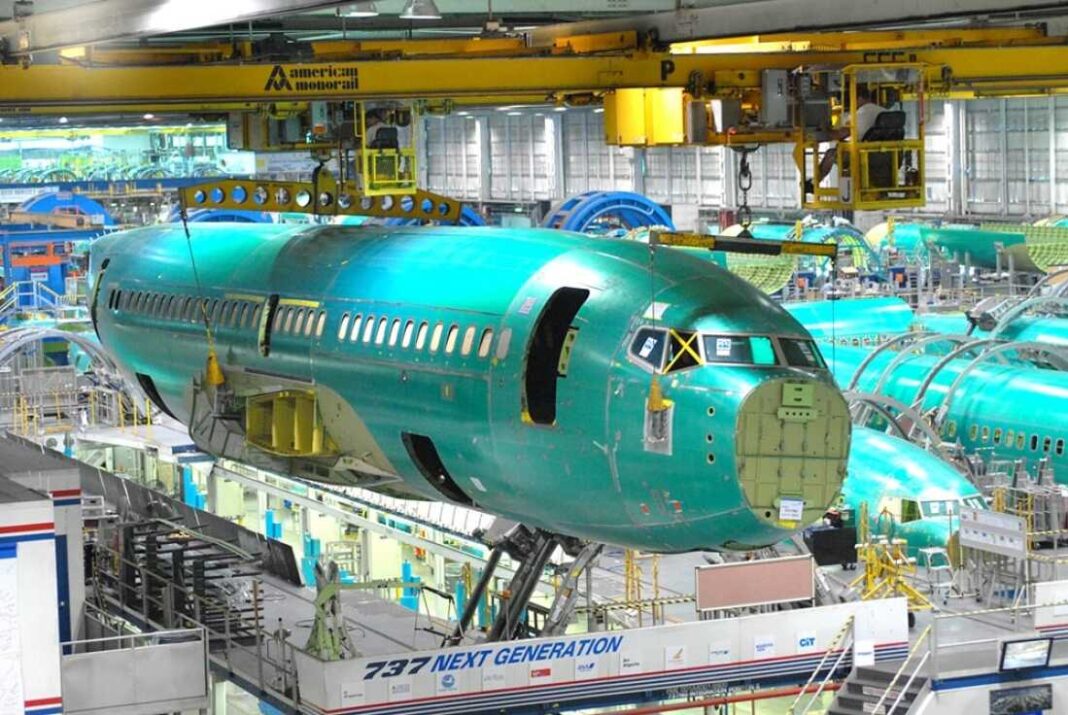
To maintain the integrity of the global aviation fleet, commercial aircraft manufacturers must adhere to strict transparency standards. Facilities such as Boeing’s Everett assembly plant operate under continuous oversight from domestic and international regulatory authorities. These include the Federal Aviation Administration (FAA), the European Union Aviation Safety Agency (EASA), and the national aviation regulators of every country whose carriers operate Boeing aircraft.
Assembly lines are open not only to regulators but to customers, VIP delegations, industry partners, and, in many cases, the general public. Boeing’s Everett plant offers guided tours that allow visitors to view the construction of aircraft at various stages of completion. Aircraft under assembly for different airlines stand side by side, allowing representatives from multiple countries to observe production simultaneously.
If any aircraft destined for domestic carriers were fitted with chemical dispersal equipment, such as internal tanks, sprayer booms, or chemical-handling pipes, these modifications would be plainly visible during construction.
A foreign airline executive, engineer, or regulator could simply walk to the adjacent assembly position and observe structural, mechanical, or systems differences between two ostensibly identical aircraft. Discrepancies would be detected immediately.
Furthermore, modern aircraft factories rely on thousands of employees, suppliers, inspectors, and subcontractors. Components arrive from hundreds of specialist companies. Integration teams assemble them under detailed work instructions. Quality-assurance personnel inspect every stage of assembly.
A modification of the scale required for a global chemtrail programme would involve not a handful of individuals but thousands across multiple facilities in several countries. The likelihood of such an operation remaining undisclosed is effectively zero.
Historical precedent reinforces this assessment. Aerospace manufacturers have never succeeded in keeping major classified projects invisible within the commercial domain. Even classified military stealth aircraft programmes have produced documented leaks from suppliers, test personnel, engineers, or flight crews.
A secret global chemical-dispersal programme involving commercial airliners, which are not protected by military secrecy protocols, would almost certainly be impossible to conceal.
Aftermarket Modifications: Another Implausible Scenario
Some proponents argue that even if aircraft are not modified at the factory, they might be outfitted with chemtrail hardware during aftermarket maintenance. This scenario is equally untenable.
Major aircraft modification centres operate with similar visibility and oversight to factory environments. Airlines contract modification and maintenance tasks to large, internationally recognised engineering organisations.
These firms employ hundreds or even thousands of engineers and technicians across open hangars. Their work is audited by aviation regulators through scheduled and unscheduled inspections.
A hidden modification requiring large tanks, pumps, nozzles, dispersal ducts, and control equipment would necessitate extensive structural alterations. Such changes require approved engineering drawings, certification, load analysis, electrical integration plans, weight-and-balance changes, and flight-test validation. All such documentation must be submitted to and approved by aviation authorities before an aircraft is permitted to fly.
The idea that maintenance hangars could secretly install large classified systems on dozens or hundreds of aircraft without detection contradicts the entire structure of the global aviation maintenance industry.
Every engineer, inspector, or subcontractor entering the hangar would have the opportunity to see the modifications first-hand. In addition, airlines frequently shift maintenance contracts between providers, meaning many different organisations would need to maintain secrecy.
Maintenance crews also conduct routine tasks in precisely the same interior spaces where chemtrail theorists claim hardware is installed. These include inspections of wing tanks, avionics bays, environmental control systems, cable runs, and structural joints. A concealed sprayer system would be impossible to avoid during this work.
Thus, whether at the factory or during aftermarket modification, any attempt to install large-scale dispersal equipment would be immediately visible, widely known by hundreds or thousands of personnel, and rapidly leaked.
Logistical Barriers: The Chemical Supply Chain Problem
Even if one entertains a hypothetical world in which clandestine aircraft modifications were somehow concealed, a more fundamental logistical barrier would remain: vast quantities of chemical fluid would need to be produced, transported, stored, and loaded onto aircraft daily.
Jetliners typically weigh between 70 and 350 tonnes depending on type and loading. To create persistent trails independent of engine exhaust, an aircraft would require several tonnes of chemical fluid per flight. A national fleet would therefore require thousands of tonnes per day.
This would necessitate:
- Specialised chemical manufacturing facilities.
- Dedicated storage and distribution centres.
- Special tanker trucks separate from conventional fuel distribution.
- Independent fill valves on aircraft distinct from standard fuel ports.
- Trained chemical-handling personnel.
- Continuous regulatory evasion despite thousands of truck movements per year.
Airports operate under tight security and safety protocols regulating all fuel and hazardous-material activities. Every tanker vehicle entering the airside area is logged, monitored, and inspected.
The proposal that secret tanker trucks could regularly fill hidden chemical tanks on hundreds of aircraft, in full view of pilots, fuel technicians, ramp crews, and ground-handling staff, is incompatible with modern airport operations.
Even if disguised as fuel trucks, the duplication of loading operations would be conspicuous. Aircraft typically receive only one fuel truck per turn. Two or three indistinguishable trucks approaching the same aircraft would be an immediate anomaly. Ramp staff record all fluid transfers, and weight calculations would produce inconsistencies if undisclosed fluids were added.
The theory also ignores environmental, hazardous-material, and safety regulations, which require detailed documentation of any chemical loaded onto an aircraft. Facilities handling hazardous liquids must maintain standard operating procedures, storage audits, spill-response protocols, Material Safety Data Sheets (MSDS), and licensing requirements. None of these can be bypassed without leaving an extensive regulatory trail.
Operational Barriers: Pilots, Dispatchers, and Air Traffic Control
Beyond mechanical and logistical barriers, operational considerations create further impossibilities. Every aircraft’s weight, fuel load, centre of gravity, and performance calculations must be certified by the flight crew before departure. These figures determine take-off speeds, climb rates, maximum landing weights, and required runway lengths.
If aircraft were secretly carrying additional multi-ton fluid loads, performance tables would not match real-world behaviour. Pilots would immediately detect discrepancies, as would airline dispatchers who calculate fuel requirements and weight-and-balance profiles for every flight. Such anomalies cannot be concealed because they affect controllability, safety margins, and legal compliance.
Further, chemtrail theories sometimes claim pilots activate or deactivate sprayers to create intermittent patterns. This is incompatible with the theory that chemicals are hidden in fuel, since all fuel aboard an aircraft is homogeneous. If contaminants were present, any trail produced would be continuous from take-off to landing, not intermittent.
The alternative proposal that military aircraft perform the spraying is equally flawed. Military jets operating covertly in civil airspace would appear on radar. Air traffic controllers coordinate every aircraft within controlled airspace. Hundreds or thousands of unregistered flights crossing commercial routes would be impossible to hide.
Thus, whether the hypothetical dispersal aircraft were commercial or military, the involvement of pilots, dispatchers, and controllers would expand the conspiracy to tens of thousands of people.
Regulatory Oversight and the Improbability of Mass Silence
The global aviation industry is one of the most intensively regulated sectors in existence. Regulators from dozens of countries conduct continuous oversight of aircraft design, manufacturing, maintenance, and operation. Inspectors from the FAA, EASA, Transport Canada, the Civil Aviation Administration of China, and many others enter factories and maintenance facilities unannounced.
For chemtrail operations to exist, all these regulatory bodies would need to be complicit. Given that many represent countries with divergent geopolitical interests, the notion that each would cooperate in silence is unrealistic.
In practice, even minor safety issues prompt international investigation and disclosure. The idea that a vast classified infrastructure could remain hidden for decades contradicts every historical precedent.
Furthermore, modern aircraft and airports are subject to constant photography and videography by enthusiasts, journalists, and passengers. Any anomalous hardware, duplicated tanker activity, unusual maintenance procedures, or undisclosed chemical-handling operations would be documented within hours.
Large-scale conspiracies require not only technical feasibility but long-term collective silence from thousands of individuals. Research on conspiracy dynamics, including the mathematical modelling work of physicist David Grimes, demonstrates that conspiracies involving more than a few hundred people would almost certainly collapse within a short period due to whistleblowing or accidental disclosure. A scheme involving tens of thousands across multiple nations and industries would be impossible to maintain.
Evaluating the Fuel-Contamination Variant of the Theory
One variant of the chemtrail hypothesis proposes that chemicals are blended directly into the jet fuel rather than loaded into separate tanks. At first glance this might appear more feasible because it avoids the necessity of concealed aircraft modifications. However, the scenario fails under scrutiny.
The global fuel supply chain is highly centralised, tightly regulated, and subject to strict quality control. Jet-A specifications are defined by ASTM standards and verified through continuous testing by fuel suppliers, airports, and airlines.
Contaminated or adulterated fuel quickly causes operational anomalies such as engine performance degradation, fuel-system damage, or combustion irregularities. Chemical additives outside approved limits would be detected by laboratory testing at any of the numerous quality-control stages.
Additionally, the intermittent contrail patterns observed by chemtrail theorists cannot be explained by fuel adulteration. If a substance were added to fuel tanks, dispersal would be continuous for the entire duration of engine operation. Yet contrails often appear and disappear as aircraft move through air masses with varying humidity. This well-documented phenomenon results from environmental conditions, not any pilot-controlled mechanism.
Fuel-based chemtrail theories therefore provide no explanatory power and contradict both atmospheric science and operational reality.
Concluding Assessment: Why a Chemtrail Programme Cannot Occur
A systematic evaluation of engineering, manufacturing, logistical, and regulatory constraints demonstrates that a clandestine aerial chemical-dispersal programme using commercial or military aircraft is not feasible. The barriers include:
- The absence of physical space or hardware consistent with hidden chemical tanks or spray systems.
- The impossibility of concealing such systems within the transparent environment of modern manufacturing and maintenance.
- The logistical impossibility of supplying and loading thousands of tonnes of chemicals daily.
- The operational contradictions in fuel planning, weight-and-balance calculations, and air traffic monitoring.
- The regulatory impossibility of maintaining secrecy across dozens of national aviation authorities.
- The sociological impossibility of preventing leaks among tens of thousands of involved personnel.
The claim fails not for lack of imagination among its critics, but because it contradicts every known aspect of aircraft design, airport operations, environmental regulation, aviation oversight, and human organisational behaviour.
For such a system to function, nearly every employee in the global aviation industry, from engineers to fuel handlers to regulators, would need to knowingly participate in a massive illegal operation without any leak, whistleblower, or documentary evidence emerging over decades.
When evaluated rigorously, the chemtrail hypothesis is revealed not as a suppressed truth but as an implausible scenario incompatible with the physical realities of aviation. The condensation trails observed behind aircraft continue to be well explained by atmospheric science: the interaction of hot exhaust gases with cold, humid air produces ice crystals that can persist or dissipate depending on local meteorological conditions. No additional mechanism is necessary.
In a world where environmental challenges demand clear scientific thinking, it is essential to distinguish between atmospheric phenomena explained by physics and engineering, and narratives that rely on the impossible cooperation of thousands of silent participants. Chemtrail claims fall firmly into the latter category.
References
Much of the information on this page was sourced from a post “Chemtrail Plausibility Study” found on the website “Contrail Science”.