
Overview of Fallstreak or Hole-Punch Clouds
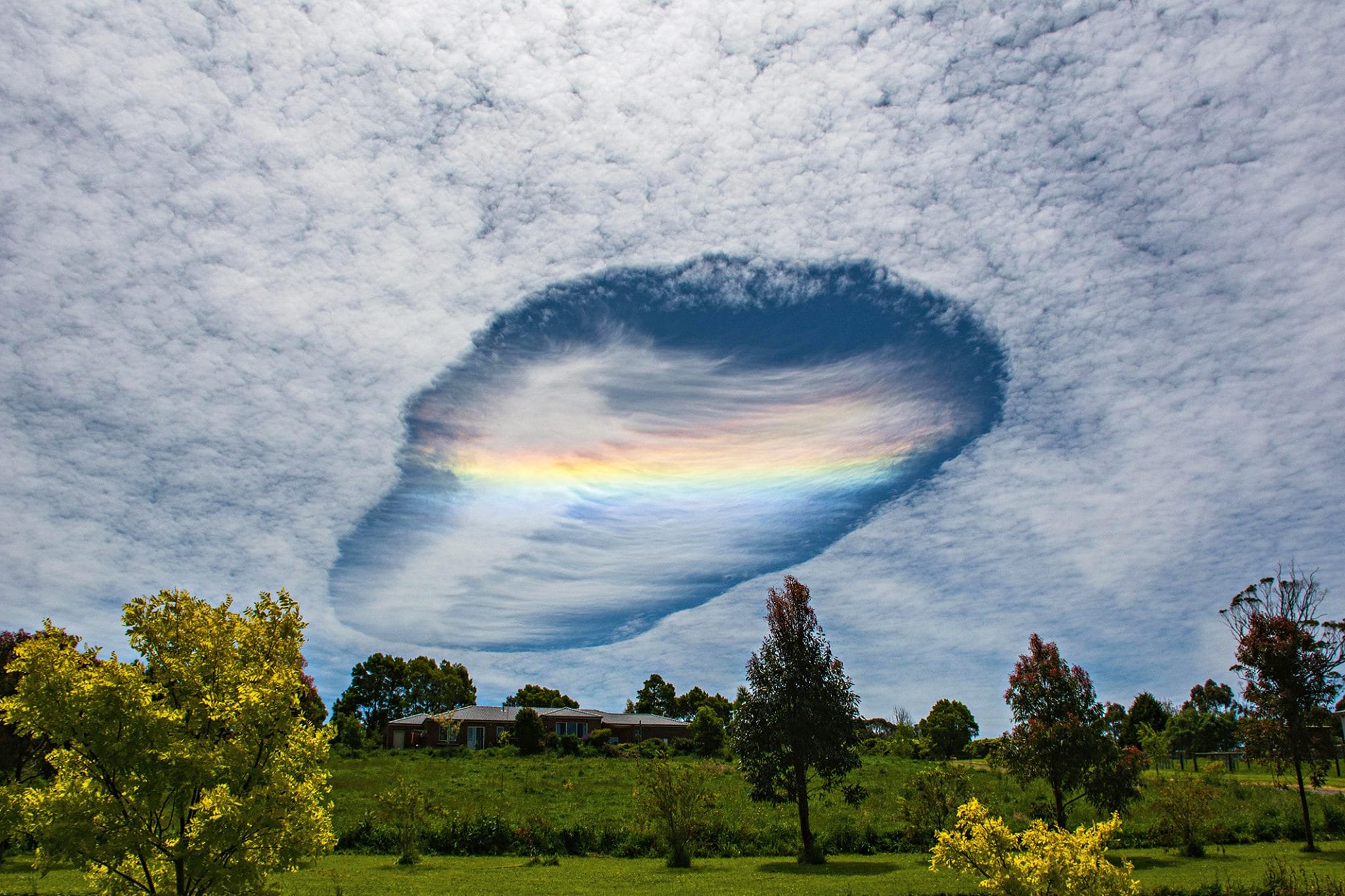
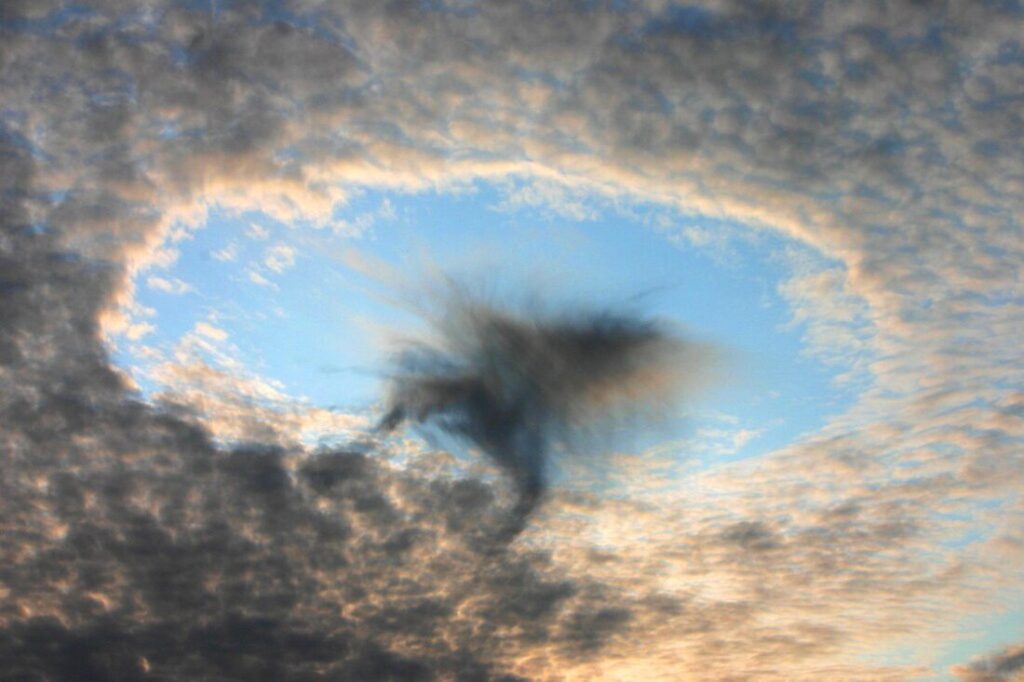
Officially known as Cavum Clouds, Fallstreak or hole-punch clouds are circular or elliptical gaps in mid-level cloud layers caused by aircraft penetration through supercooled cloud decks.
They combine natural and anthropogenic processes, creating visually striking holes fringed by ice-crystal fallout.
Fallstreak holes primarily affect cirrocumulus and altocumulus clouds, which are composed of supercooled water droplets that can suddenly freeze or evaporate.
When a disturbance, often from a passing aircraft, initiates ice crystal formation, these droplets rapidly turn into ice and fall as ice crystals, creating the distinctive circular or elliptical hole in the cloud layer
Details
Height: Typically 10,000–25,000 feet (3,000–7,500 metres).
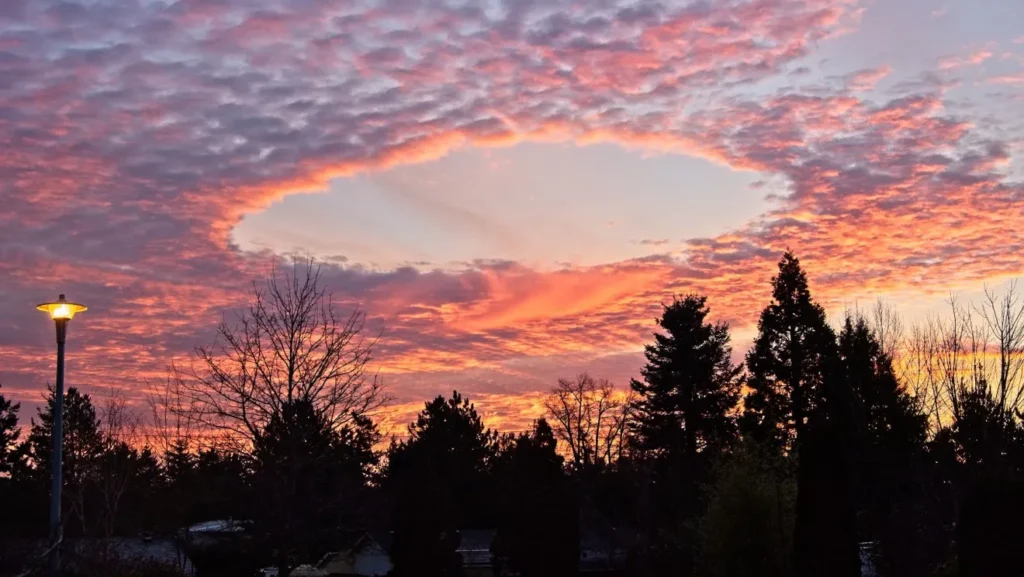
Look: Circular hole in altocumulus or cirrocumulus with streaks of virga descending.
Name meaning: “Fallstreak” refers to precipitation trails; “hole-punch” describes the appearance.
Rain: Occasionally light precipitation (virga) evaporating before reaching the ground.
What Do Fallstreak or Hole-Punch Clouds Look Like
Viewed from the ground, fallstreak holes appear as large circular clearings surrounded by smooth cloud edges.
Beneath each hole, streaks of ice crystals may descend in fibrous shafts. The size can reach several kilometres across, often expanding over minutes.
A History of Fallstreak or Hole-Punch Clouds
Though photographs date to the 1940s, systematic explanation came in the 2000s when satellite and aircraft studies linked the phenomenon to jet aircraft traversing supercooled clouds.
Observers once speculated that these holes might be explosions or weather modification experiments, but scientific consensus now attributes them to aircraft-induced ice nucleation.
Further Information
When an aircraft passes through a layer of supercooled water droplets, the pressure drop and particles in the exhaust trigger rapid freezing.
The newly formed ice crystals grow by the Bergeron–Findeisen process, drawing vapour from surrounding droplets and clearing the hole.
The Bergeron–Findeisen process describes how ice crystals grow within cold clouds at the expense of nearby supercooled water droplets.
It is the main mechanism behind precipitation in mixed-phase clouds, which contain both liquid and solid particles.
This process exemplifies microphysical interactions between natural and artificial triggers in cloud dynamics.
Fallstreak holes demonstrate how local disturbances can influence mesoscale cloud patterns visible even from satellites such as NASA’s MODIS instrument.