
Overview of Cirrus Homogenitus Clouds (Contrails)
Cirrus homogenitus, more commonly known as contrails, are artificial ice clouds formed by aircraft exhaust in the upper troposphere and lower stratosphere.
These streaks of vapour trail behind jet engines and resemble thin, fibrous cirrus clouds.
Though human-made, they are classified by the World Meteorological Organization (WMO) within the cirrus genus due to their composition and altitude.
Details
Height: Typically between 26,000 and 40,000 feet (8,000–12,000 metres), where temperatures are below −40°C.
Look: Thin, linear streaks that can remain narrow or spread into cirrus-like sheets.
Name meaning: Homogenitus is Latin for “man-made origin.”
Rain: None. Composed of ice crystals too small and dispersed to precipitate.

What Do Cirrus Homogenitus Clouds (Contrails) Look Like
Contrails appear as pencil-thin white lines following aircraft flight paths. Under stable atmospheric conditions, they fade quickly, sometimes within seconds.
When humidity is high, they persist and spread, merging into cirrostratus-type veils.
Their visual texture varies with wind shear and temperature gradients: some remain as sharp, filamented strands while others diffuse into broad, milky layers.
A History of Cirrus Homogenitus Clouds (Contrails)
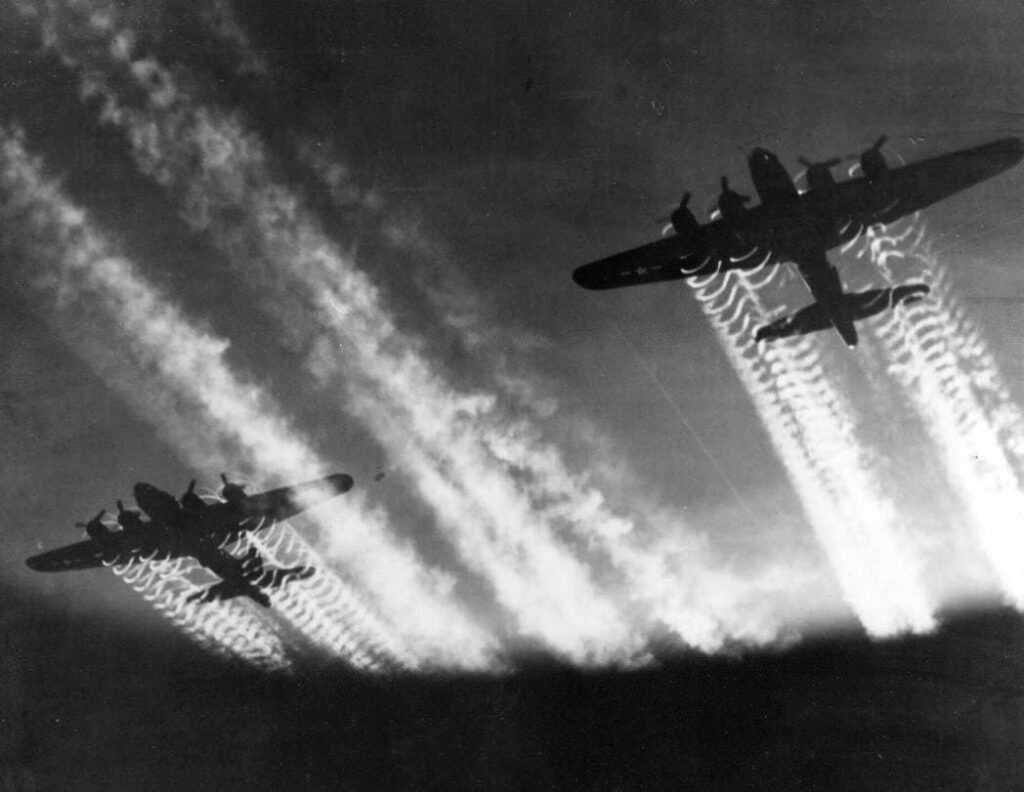
The earliest reports of persistent contrails came during World War II, when high-altitude bombers produced visible trails that occasionally lingered and spread.
Meteorologists at the time noted that these formations resembled natural cirrus and could alter sky transparency.
The term contrail, a contraction of condensation trail, entered English aviation literature in the 1940s.
In 2017, the WMO formally standardised the name cirrus homogenitus in its updated International Cloud Atlas to distinguish anthropogenic cirrus from natural types.
Further Information
Contrails form when hot, moist exhaust gases mix with the extremely cold ambient air. Water vapour condenses on soot and sulphate aerosols, rapidly freezing into ice crystals.
Contrail persistence depends on the relative humidity with respect to ice; if supersaturation exists, the crystals endure and spread.
Studies such as Schumann (2012, Atmospheric Chemistry and Physics) show that persistent contrails can slightly affect regional radiation balance by reflecting sunlight and trapping infrared radiation.
Over time, overlapping contrails may evolve into contrail cirrus, subtly influencing climate on a local scale.