
IceCube: Antarctica’s Window on the Universe and the Earthquake Conspiracy Myth
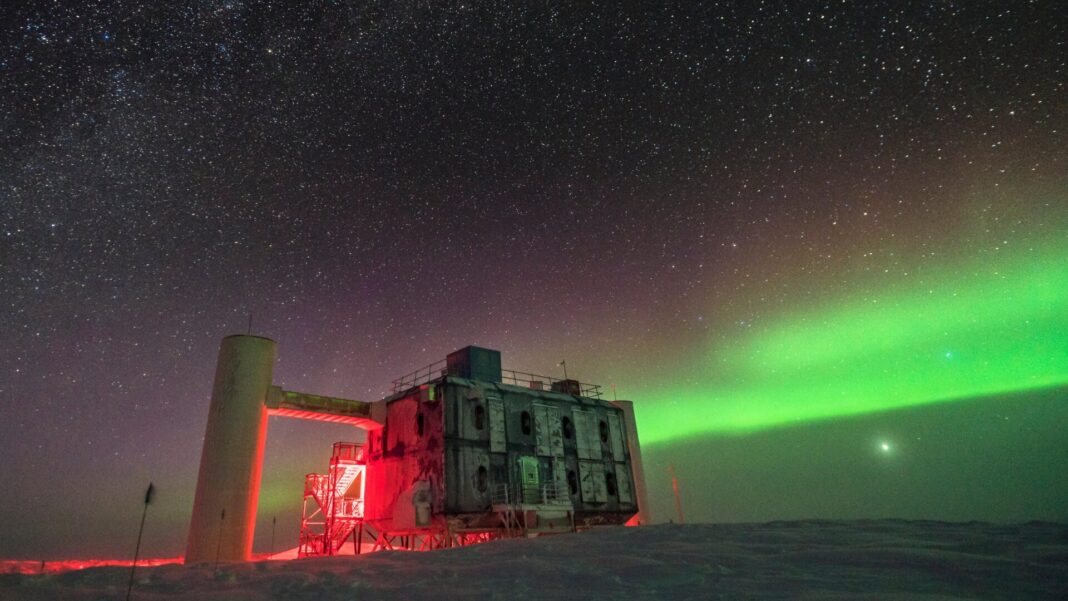
IceCube (often stylized “IceCube Neutrino Observatory”) is a scientific research observatory located at the South Pole (Amundsen–Scott Station), Antarctica.
Its purpose is to detect high-energy neutrinos originating from outer space, using a cubic-kilometer volume of Antarctic ice as its detection medium.
The basic idea is: neutrinos, which are nearly massless, electrically neutral particles, pass through matter with extremely low probability of interaction.
When a neutrino occasionally collides with a nucleus in the ice, it can produce a charged particle (e.g. a muon) that moves faster than the speed of light in ice and emits Cherenkov light.
That light is detected by photomultiplier modules arranged in strings deep below the surface. From the pattern and timing of light signals, the direction, energy, and type of neutrino can be inferred.
What IceCube actually does
IceCube is a neutrino telescope built by an international collaboration led by the University of Wisconsin–Madison.
Construction began in 2005 and was completed in December 2010 at the Amundsen–Scott South Pole Station.
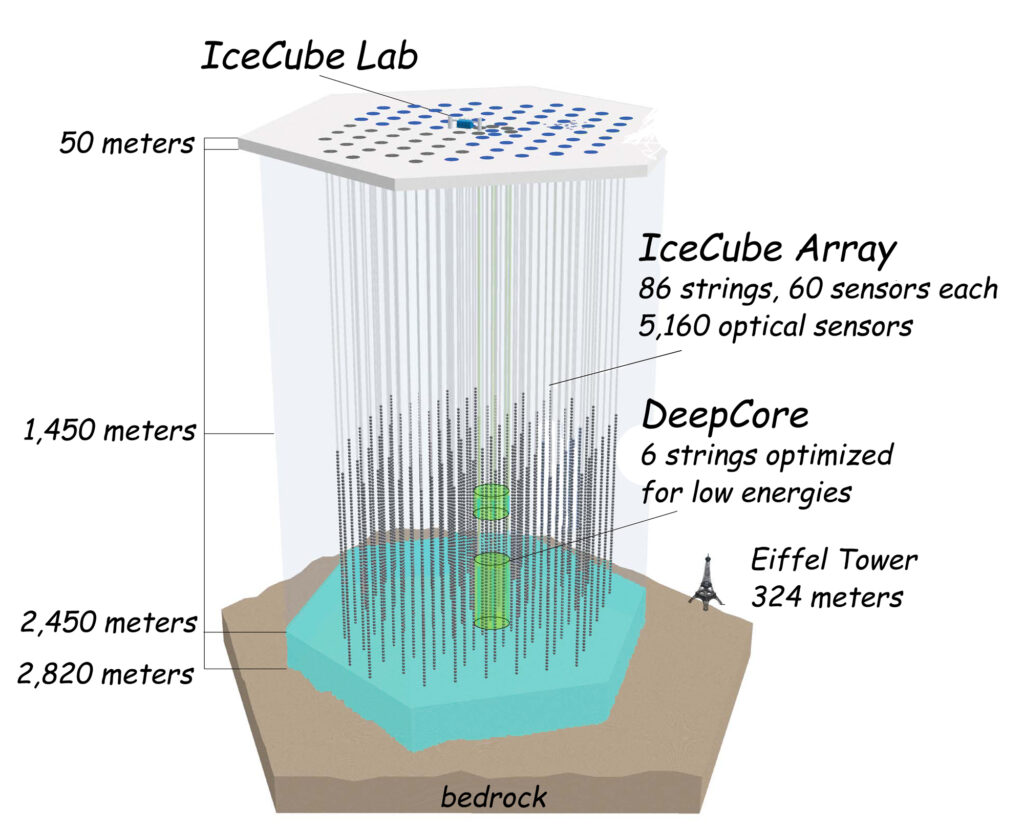
The IceCube neutrino telescope consists of 5,160 digital optical modules (DOMs) attached to 86 vertical strings, each drilled into boreholes reaching depths between 1,450 metres and 2,450 metres. The modules are frozen permanently into the transparent Antarctic ice.
Their task is to detect brief flashes of Cherenkov radiation, faint blue light emitted when a charged particle, produced by a rare neutrino collision, travels through ice faster than light can move in that medium.
By recording the timing and brightness of these flashes, scientists can reconstruct the energy, direction, and type of incoming neutrino.
IceCube’s data are transmitted via satellite to supercomputers for analysis. Roughly one terabyte of raw data is collected each day, though only about 100 gigabytes (the events of interest) are sent north for study.
The system detects around 275 atmospheric neutrinos per day, alongside hundreds of millions of background cosmic ray signals.
The detector is essentially passive. Each module consumes about 5 watts of power, roughly equivalent to a nightlight.
The entire observatory runs on electricity generated at the nearby U.S. research station, which itself is powered by diesel generators rated at a few megawatts; hardly the output of a doomsday machine.
IceCube’s achievements are substantial and uncontroversial. In 2013, it provided the first evidence of high-energy astrophysical neutrinos, confirming theories about particle acceleration in distant galaxies.
Later analyses traced some of these neutrinos back to blazars; supermassive black holes ejecting cosmic jets millions of light years away.
The observatory’s results have been published in hundreds of peer-reviewed papers and openly shared across the international physics community.
The IceCube conspiracy theory emerges
Yet online, a parallel narrative has flourished. According to several websites, podcasts, and social media channels, IceCube is not merely a scientific observatory but a directed-energy system capable of manipulating the Earth’s crust.
The claim holds that the array can beam energy deep into the planet, triggering earthquakes and possibly influencing weather patterns or communications.
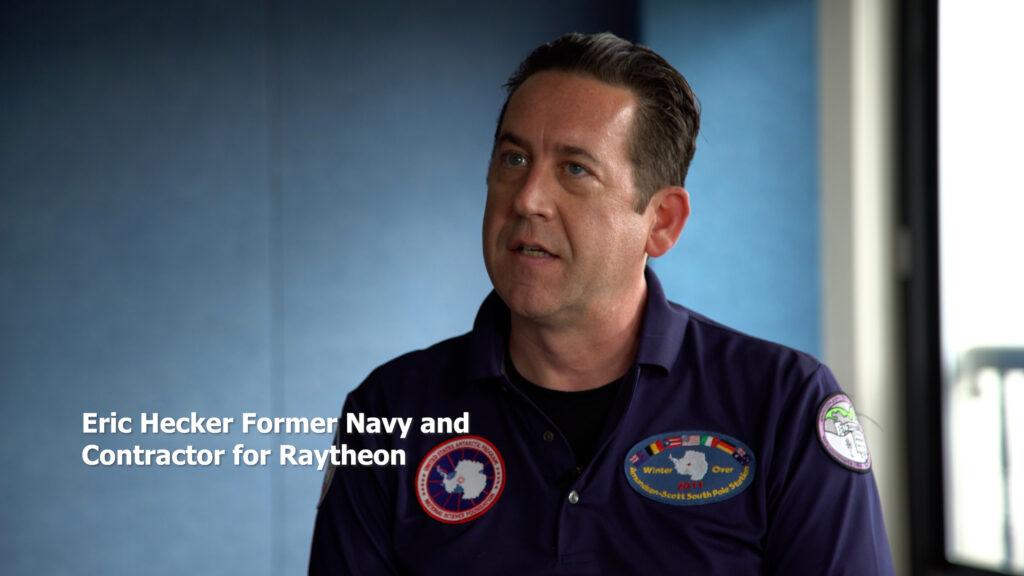
Among the most cited figures in this story is an American man named Eric (or Erick) Hecker, who describes himself as a whistle-blower.
He says he worked at the South Pole around 2010 under contract with Raytheon, the U.S. defence company that provided logistical support for the National Science Foundation’s Antarctic operations.
In interviews with fringe media outlets, Hecker claims to have witnessed advanced technologies including energy-projection systems and extremely low-frequency (ELF) transmitters supposedly capable of influencing tectonic activity.
In some online retellings, these alleged systems are said to have been used to trigger the 2011 Christchurch earthquake in New Zealand.
The notion is that IceCube or related installations discharged a burst of energy through the Earth, setting off the devastating magnitude 6.3 event that killed 185 people.
It is an interesting hypothesis. It is also physically impossible.
Why human technology cannot trigger major quakes
There are indeed circumstances in which human activity can induce small earthquakes. These include reservoir impoundment, deep-well injection, hydraulic fracturing, and underground nuclear testing.
However, the magnitudes are modest: typically less than 5, and usually far smaller.
To induce a magnitude 6 or larger event would require altering stress over a fault area of tens of square kilometres, at depths of several kilometres, and over geologic timescales.
The energy coupling efficiency between surface technology and rock at that depth is vanishingly small.
Even underground nuclear tests, which release on the order of 10¹⁴ joules (similar to the Christchurch quake), do not produce quakes of that size. The energy dissipates rapidly and does not propagate as tectonic rupture.
The suggestion that a network of photomultiplier tubes and data cables under the Antarctic ice could achieve what thermonuclear devices cannot defies both physics and common sense.
The whistle-blower: Eric Hecker
The narrative of IceCube as a secret energy weapon stems from a single individual: Eric Hecker, who claims to have worked at the Amundsen–Scott South Pole Station as a contractor for Raytheon Polar Services. His publicly verifiable role appears to have been within the plumbing and maintenance division.
In various interviews on fringe media channels and podcasts, Hecker describes seeing “powerful energy pulses”, “underground laboratories”, and “ELF transmitters” beneath the ice.
He asserts that Raytheon and U.S. government agencies are conducting classified experiments involving energy projection, advanced communications, and possibly mind-control technologies.
He further claims that he has given testimony to U.S. political bodies — though there is no record in official congressional transcripts or credible journalism confirming this.
Mainstream media organisations, including AFP Fact Check, have examined these assertions and found no evidence to support them.
IceCube’s published documentation is open; its collaborators number over 300 scientists from 53 institutions across 12 countries.
The design schematics, operational manuals, and research papers are publicly accessible. Nothing in them resembles a directed-energy weapon.
Assessing Hecker’s credibility, or lack of!
A careful evaluation of Hecker’s claims raises several inconsistencies.
- Lack of corroboration
No other employee, scientist, or contractor who worked at the South Pole has reported anything remotely similar. The research community in Antarctica is small and close-knit; leaks would be unavoidable if such weapons existed. - Technical implausibility
Hecker’s descriptions of “directed energy beams” emerging from IceCube contradict basic design principles of the detector. The modules lack emitters. The electronics are sealed within pressure-resistant glass spheres designed only to receive light, not produce it. - Security and access
Even in civilian research contexts, critical systems are compartmentalised. It is improbable that a maintenance worker would have unrestricted access to top-secret defence technology while performing plumbing duties. - Absence of documentation
A genuine whistle-blower case usually includes supporting documents, photographs, or internal communications. Hecker has presented none that can be independently verified. - NDA / secrecy gaps
It is almost certain that Raytheon / U.S. military contractors would require NDAs, classified-access procedures, and compartmentalisation. For someone in a plumbing/maintenance role to access top-secret directed-energy weapon labs would require major security breaches. That is not impossible in covert settings, but it is a heavy claim that requires evidence. - Public visibility and survival
The fact Hecker is still alive goes a long way to disprove his claims. Hecker regularly appears on podcasts, gives public talks, and maintains an active social media presence. If he were truly exposing highly classified military technology, continued freedom or the fact that he is still alive would be unlikely. This is not evidence that he is lying, but it undermines the narrative that he holds world-shattering secrets. - Incentive and platform
His claims attract attention within communities interested in hidden technologies and secret government projects. Public speaking, books, and interviews can provide both financial and psychological rewards. None of this proves deception, but it introduces possible motivation beyond truth-telling.
Could he have seen something real?
I can just see a bunch of bored scientists and engineers in Antarctica telling tall stories to the naive plumber about direct energy weapons and all sorts of non-existant things just to take the piss. Is this what happened to Hecker?
It is also possible that Hecker witnessed legitimate, but misunderstood, scientific or communications equipment.
The Amundsen–Scott Station houses numerous radio and satellite systems: weather monitoring, astrophysical telemetry, and high-frequency research. To an untrained observer, their complexity might appear mysterious.
Similarly, the Deep Space Network, cosmic microwave background instruments, and upper-atmosphere research arrays sometimes use high-frequency or extremely low-frequency antennas.
These are designed for communication, not energy projection. Misinterpreting such systems as weapons is easy without technical context.
Psychologically, extraordinary environments can also foster misperceptions. Extended isolation, circadian disruption, and the sensory monotony of Antarctic winters have measurable effects on cognition and mood.
Minor misunderstandings can grow into profound convictions.
The physics of impossibility
Even if we entertain, hypothetically, that IceCube or some secret Antarctic installation attempted to transmit energy into the Earth, the engineering challenges are insurmountable.
- Transmission loss: Rock and ice absorb and scatter electromagnetic energy rapidly. A radio wave penetrating more than a few tens of metres experiences exponential attenuation.
- Power requirement: To influence tectonic stress kilometres below ground, the energy would have to be immense — at least 10¹⁶ joules for a moderate event. Delivering that via any plausible antenna would vaporise the transmitter itself.
- Targeting precision: Fault systems are irregular and buried. Knowing precisely where and when a rupture will occur exceeds current seismological capability.
In essence, to trigger an earthquake of the claimed magnitude would require a device whose existence would be impossible to hide. An installation drawing more power than entire cities and generating electromagnetic emissions detectable worldwide.
Earthquakes by the numbers
To understand why, we need to consider the energy involved in an earthquake. On the moment-magnitude (Mw) scale used by seismologists, the energy EEE released by an earthquake is approximately: E=101.5M+4.8 joules.
A magnitude 6 quake therefore releases around 6 × 10¹³ joules of energy — roughly equivalent to fifteen kilotonnes of TNT, or one Hiroshima-sized atomic bomb.
A magnitude 7 event releases about 2 × 10¹⁵ joules; a magnitude 8, some 6 × 10¹⁶ joules.
The Christchurch earthquake, at magnitude 6.3, therefore released approximately 2 × 10¹⁴ joules.
That is the same amount of energy as the entire United Kingdom consumes in electricity over several hours.
By contrast, the entire global electrical generation capacity at any given moment is about 20 terawatts, equivalent to 2 × 10¹³ joules per second.
To inject enough energy to mimic a magnitude 7 quake, one would need to deliver the output of the entire world’s power plants for several minutes, focused coherently into the fault beneath a single city; and with almost perfect efficiency through kilometres of rock.
No technology known to science or engineering can deliver or focus that much energy through the Earth’s crust without leaving vast collateral effects.
Even the world’s most powerful lasers and particle accelerators operate at energies trillions of times smaller.
Furthermore, IceCube’s power draw is on the order of a few megawatts at most, less than that of a small hospital.
Its instruments do not emit beams of any kind; they merely detect faint light produced by natural cosmic interactions.
Suggesting that such a system could produce continental-scale seismic shifts is like claiming that a torch battery could melt a glacier.
How many earthquakes happen anyway?
Another point overlooked in conspiracy versions is that the Earth is astonishingly seismically active all the time.
According to the U.S. Geological Survey (USGS) and the National Earthquake Information Center, the planet experiences:
- About 20,000 detectable earthquakes per year, or roughly 55 per day.
- Around 1,300 magnitude 5–5.9 events annually.
- Roughly 15 magnitude 7 events per year.
- About one magnitude 8 or larger quake each year.
Most of these occur far from population centres and go unnoticed by the public. But seismologists detect them continuously through a global network of instruments.
In other words, earthquakes are common, random, and statistically predictable phenomena arising from tectonic processes.
Any large quake will inevitably coincide, by chance, with some human activity somewhere in the world, including experiments in Antarctica, rocket launches, or military tests. Correlation does not imply causation.
In the case of Christchurch, the quake was a direct result of accumulated stress along the Greendale Fault, part of the active boundary between the Australian and Pacific tectonic plates.
Geological mapping, aftershock patterns, and GPS data all confirm the event’s natural tectonic origin.
No anomalous signals, energy spikes, or electromagnetic disturbances were recorded before or during the quake.
Why these ideas persist
The persistence of such theories reflects broader social and psychological patterns. Antarctica, remote and largely inaccessible, naturally invites speculation.
Its combination of extreme secrecy (scientists only), international treaties, and harsh conditions makes it an ideal canvas for imagination.
Directed-energy weapons do exist in limited military contexts, for example, high-energy lasers for missile defence.
This kernel of truth allows conspiracy narratives to graft plausible terminology onto impossible scales.
The idea that powerful institutions hide technologies beyond public understanding also resonates in an era of mistrust, secrecy, and information overload.
In that sense, the IceCube myth functions less as a claim about physics and more as a story about power and control.
Historical echoes
The IceCube conspiracy did not arise in a vacuum. It echoes earlier myths such as those surrounding HAARP (the High-frequency Active Auroral Research Program) in Alaska, long accused of weather control or mind manipulation.
In each case, a large, publicly funded scientific facility using advanced electromagnetic or optical technology becomes the focus of suspicion.
HAARP, like IceCube, was built for legitimate research. In that instance, ionospheric physics.
Decades of open data and site tours eventually dispelled most of the rumours, but not before they had become folklore in certain online circles.
The same pattern repeats: complex science, misunderstood by the lay public, spawns imaginative extrapolation that fills informational gaps with agency and intent.
Why the Christchurch link fails
Returning to the New Zealand earthquake, geophysical data leave no room for hidden causes.
The 2010–2011 Canterbury earthquake sequence began with a magnitude 7.1 event in September 2010, months before IceCube became fully operational. The February 2011 quake was an aftershock within the same fault system.
Extensive studies by GNS Science and GeoNet identified shallow crustal ruptures consistent with local stress redistribution.
No electromagnetic or acoustic anomalies were recorded prior to the event. The rupture propagated along pre-existing faults aligned with the region’s tectonic stress field; entirely consistent with natural processes.
In contrast, if a remote energy pulse had initiated the quake, seismometers would have detected an initial unnatural impulse or wave pattern distinct from tectonic shear. None were observed.
In other words, the Christchurch disaster, while tragic, was a predictable outcome of plate tectonics, not a laboratory experiment gone wrong.
Energy comparisons that end the debate
To appreciate the vastness of geophysical energy, it helps to compare familiar scales:
| Event or source | Energy released (joules) |
|---|---|
| 1 kg of TNT | 4 × 10⁶ |
| Hiroshima bomb | ~6 × 10¹³ |
| Magnitude 6 earthquake | ~6 × 10¹³ |
| Magnitude 7 earthquake | ~2 × 10¹⁵ |
| Annual global electricity use | ~6 × 10²⁰ |
| IceCube total annual power use | ~1 × 10¹¹ |
Even if IceCube could somehow direct all its annual energy consumption into the Earth in a single burst (which it cannot), the output would be roughly one ten-millionth of a typical tectonic event. The orders of magnitude are unbridgeable.
The value of scepticism
Healthy scepticism is vital in science and society alike. Questioning official narratives is not inherently wrong.
But extraordinary claims require extraordinary evidence. The idea that a neutrino observatory doubles as an earthquake generator is extraordinary indeed, and the evidence for it is nonexistent.
The open-access nature of IceCube’s data, the visibility of its collaborators, and the transparent publication of its results stand as direct counterpoints to the secrecy such claims imply.
Anyone can review its papers, attend its conferences, or even apply to join the collaboration. There is no hidden cabal; only scientists chasing ghostly particles from the stars.
What the numbers really tell us
At its core, the IceCube story is about scal; the unimaginably small and the unimaginably large.
The neutrinos IceCube detects carry energies millions of times greater than those produced in human accelerators, yet each detection event releases only a flash of light lasting billionths of a second.
These whispers from the cosmos tell us about supernovae, black holes, and the violent engines of galaxies, not about plots to reshape the Earth.
When confronted with such extremes, the human imagination often rebels. We seek agency, pattern, and intent.
To some, the idea that humans could control earthquakes is more emotionally satisfying than the humbling truth that the planet moves on its own, indifferent to our species.
The Antarctic paradox
Antarctica occupies a unique place in the modern imagination. Its isolation evokes mystery; its international governance under the Antarctic Treaty System feeds rumours of hidden interests.
In reality, the continent is perhaps the most monitored place on Earth. Every shipment, flight, and fuel drum is logged.
Scientists live under constant communication and satellite tracking for safety. A project of IceCube’s size cannot conceal secret weaponry any more than the Eiffel Tower could hide a missile silo.
Moreover, the idea of a clandestine military base disguised as a neutrino observatory collapses under basic budgetary scrutiny.
IceCube’s funding is publicly listed through the U.S. National Science Foundation and international partners. The expenditures are audited. Contractors, including Raytheon Polar Services (later replaced by other logistical firms), operate under civilian oversight.
There is no hidden pot of money to fund an energy weapon of planetary power.
Lessons from the myth
The IceCube conspiracy offers a useful case study in how misinformation spreads. It shows that technical opacity, complex science beyond everyday experience, creates fertile ground for suspicion.
It also reveals the importance of scientific literacy: when people understand even basic principles of energy, scale, and physics, such theories quickly unravel.
Finally, it highlights a paradox of transparency: IceCube publishes everything, yet the openness itself can be misinterpreted as a smokescreen.
In the internet age, information abundance does not guarantee understanding.
Truth more remarkable than fiction
The claim that IceCube can create earthquakes collapses under scientific scrutiny.
The energy required exceeds all human capacity; the data contradict it; and the supposed whistle-blower offers no credible evidence.
The real story is more remarkable: that beneath the South Pole, a transparent block of ancient ice serves as humanity’s ear to the Universe, catching particles that have travelled unimpeded for billions of years.
IceCube is not a harbinger of destruction but a celebration of curiosity; a reminder that the deepest mysteries often lie not in secret weapons, but in the simple act of listening to the stars.