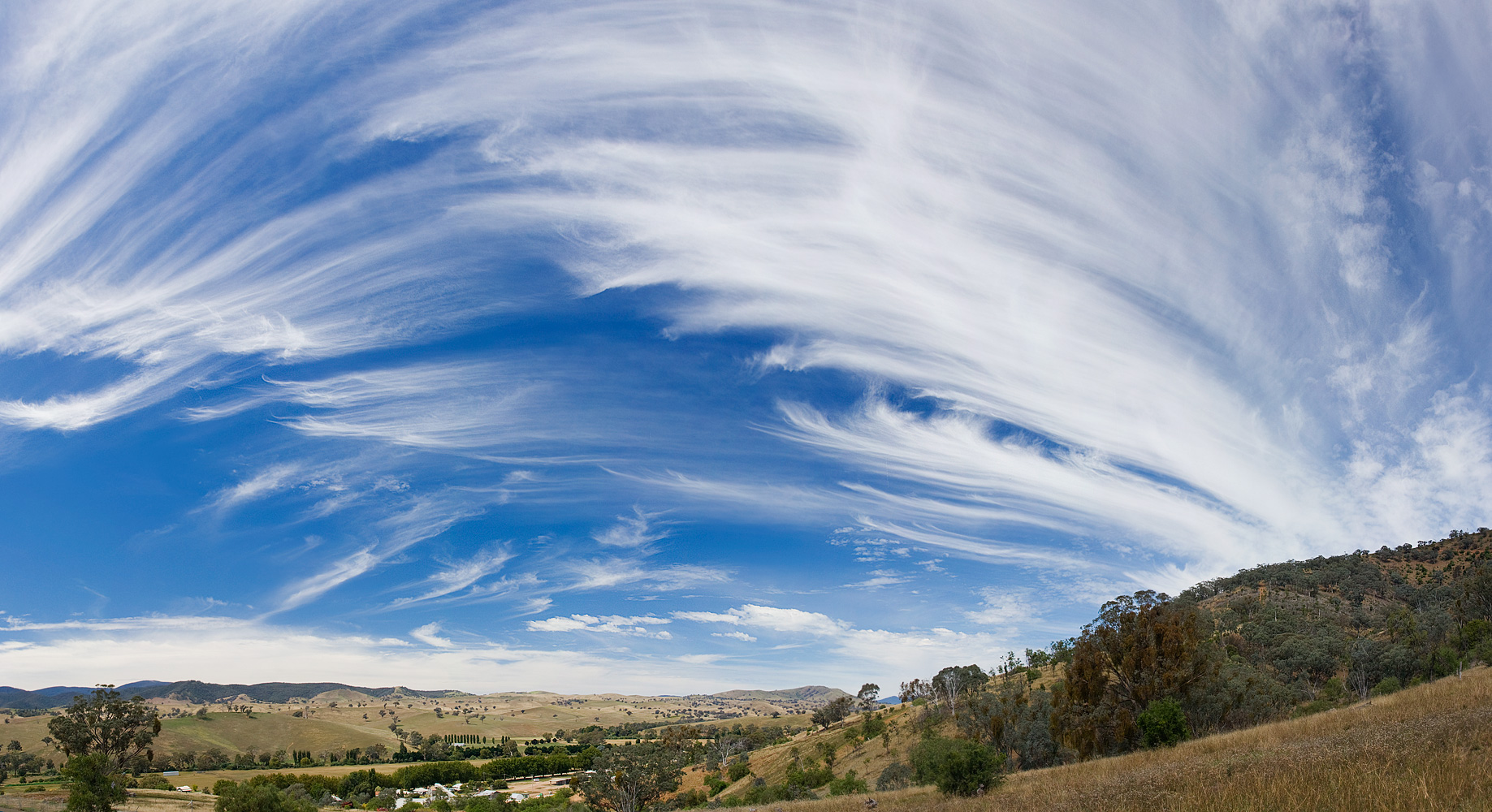
Fallstreak or Hole-Punch Clouds

Overview of Fallstreak or Hole-Punch Clouds

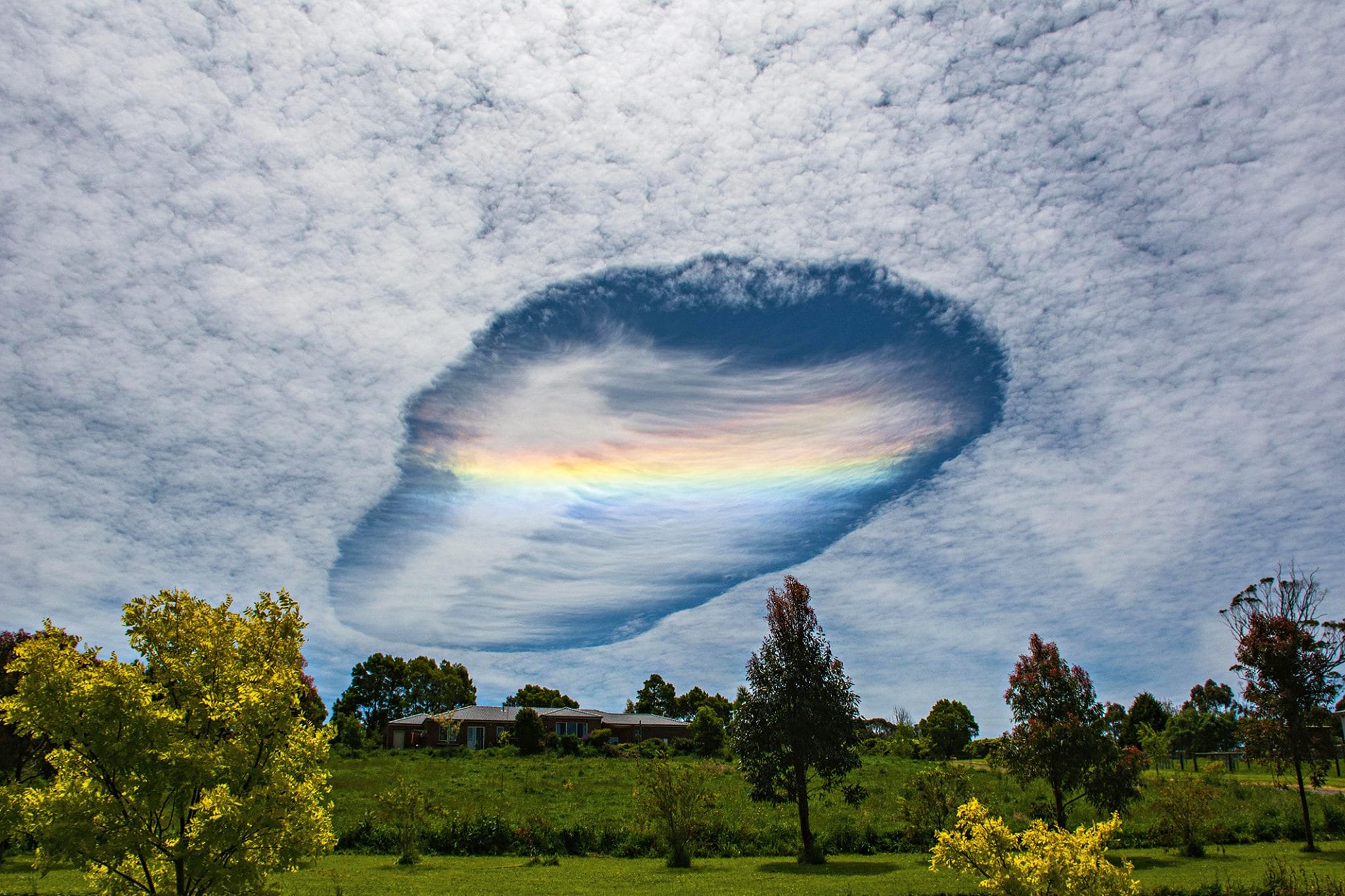
Officially known as Cavum Clouds, Fallstreak or hole-punch clouds are circular or elliptical gaps in mid-level cloud layers caused by aircraft penetration through supercooled cloud decks.

They combine natural and anthropogenic processes, creating visually striking holes fringed by ice-crystal fallout.

Fallstreak holes primarily affect cirrocumulus and altocumulus clouds, which are composed of supercooled water droplets that can suddenly freeze or evaporate.

When a disturbance, often from a passing aircraft, initiates ice crystal formation, these droplets rapidly turn into ice and fall as ice crystals, creating the distinctive circular or elliptical hole in the cloud layer
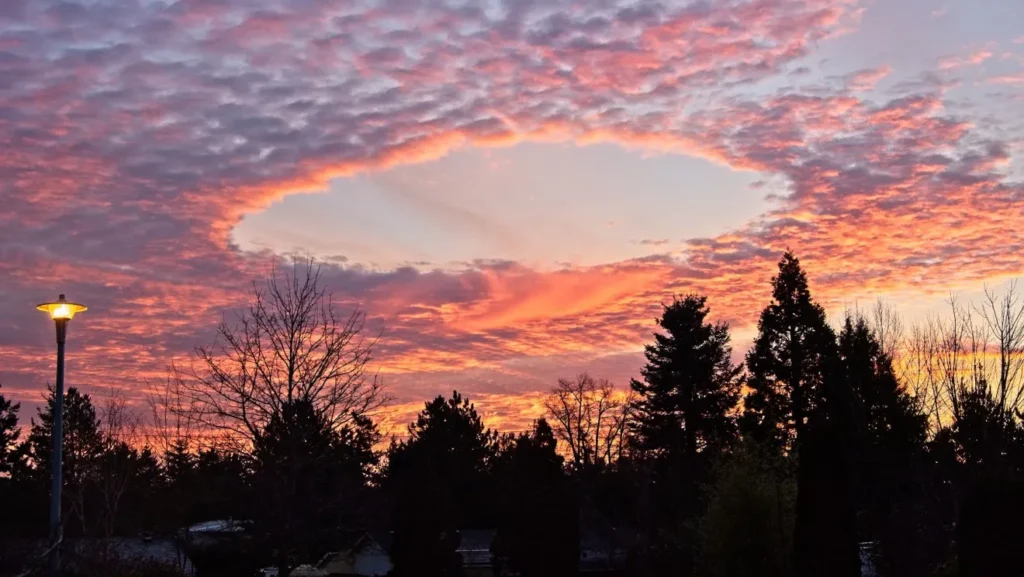
Fallstreak or Hole-punch clouds

Details

Height: Typically 10,000–25,000 feet (3,000–7,500 metres).
Look: Circular hole in altocumulus or cirrocumulus with streaks of virga descending.
Name meaning: “Fallstreak” refers to precipitation trails; “hole-punch” describes the appearance.
Rain: Occasionally light precipitation (virga) evaporating before reaching the ground.

What Do Fallstreak or Hole-Punch Clouds Look Like

Viewed from the ground, fallstreak holes appear as large circular clearings surrounded by smooth cloud edges.

Beneath each hole, streaks of ice crystals may descend in fibrous shafts. The size can reach several kilometres across, often expanding over minutes.
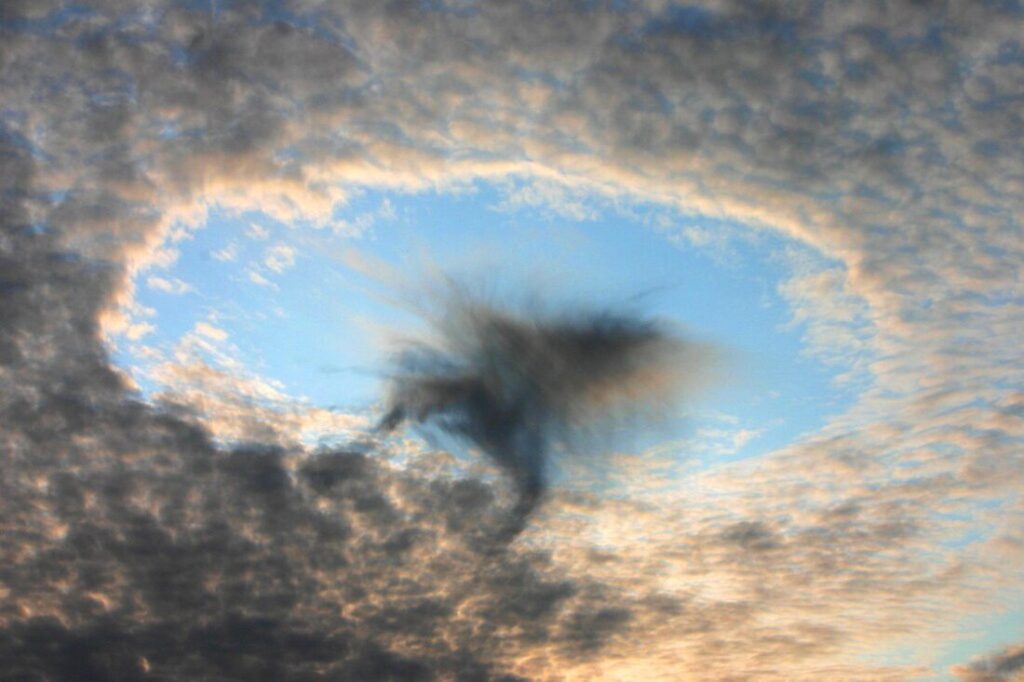
Fallstreak or Hole-punch clouds

A History of Fallstreak or Hole-Punch Clouds

Though photographs date to the 1940s, systematic explanation came in the 2000s when satellite and aircraft studies linked the phenomenon to jet aircraft traversing supercooled clouds.

Observers once speculated that these holes might be explosions or weather modification experiments, but scientific consensus now attributes them to aircraft-induced ice nucleation.

Further Information

When an aircraft passes through a layer of supercooled water droplets, the pressure drop and particles in the exhaust trigger rapid freezing.

The newly formed ice crystals grow by the Bergeron–Findeisen process, drawing vapour from surrounding droplets and clearing the hole.

The Bergeron–Findeisen process describes how ice crystals grow within cold clouds at the expense of nearby supercooled water droplets.

It is the main mechanism behind precipitation in mixed-phase clouds, which contain both liquid and solid particles.

This process exemplifies microphysical interactions between natural and artificial triggers in cloud dynamics.

Fallstreak holes demonstrate how local disturbances can influence mesoscale cloud patterns visible even from satellites such as NASA’s MODIS instrument.

Tony S.
Tony is based in Australia and focuses on how false conspiracy theories spread and harm society, with an emphasis on clear facts and critical thinking.

Related

How Clouds Form

Clouds are one of the most visible and dynamic components of Earth’s atmosphere. They influence weather, climate, and even human activities, while providing a spectacular canvas in the sky. Understanding cloud formation requires examining the physical processes that transform invisible water vapour into visible condensed droplets or ice crystals.

Cumulus Clouds

Cumulus are low, puffed, convective clouds formed by surface heating and uplift. They have flat bases and variable tops. The name was coined in the early 19th century and is widely familiar in art, and literature.

Clouds in Art

Clouds have long captivated the human imagination, not only as meteorological phenomena but as symbols, compositional elements, and expressive devices in art. Their forms, constantly shifting and ephemeral, have inspired painters, illustrators, and photographers to capture both their visual beauty and their symbolic meanings.

Fog Geoengineering, Strange Mists and the Science Behind a Modern Myth

Strange fogs and sudden illnesses spark fears of "geoengineered fog", yet science shows pollen, pollution and atmospheric physics explain these events without invoking hidden geoengineering schemes.

An Overview of Geoengineering

Geoengineering refers to deliberate, large-scale interventions in the Earth’s climate system designed to counteract the effects of global warming. It is generally divided into two main approaches: carbon dioxide removal (CDR), which aims to lower atmospheric CO₂ and solar radiation management (SRM). Neither are currently deployed at scale, and all raise significant uncertainties.

Cirrus Homogenitus Clouds (Contrails)

Cirrus homogenitus, more commonly known as contrails, are artificial ice clouds formed by aircraft exhaust in the upper troposphere and lower stratosphere. These streaks of vapour trail behind jet engines and resemble thin, fibrous cirrus clouds.

Featured

Counting the Cost of a Nationwide Chemtrail Programme

What would it actually take to run a nationwide US “chemtrail” operation? Our analysis reveals the staggering logistics — 165 aircraft, thousands of workers, and billions of dollars each year. The numbers tell their own story.

Why Contrails Can Linger and Spread

Contrails can linger and spread because they are essentially man-made cirrus clouds formed from ice crystals at high altitude. A cloud is made of water vapour, just like a contrail. Therefore if a cloud can linger, so can a contrail. When an aircraft’s hot exhaust mixes with cold, humid air, the resulting condensation freezes, creating thin white trails.

Cloud Seeding: You can’t Just Make Rain

It is impossible to manufacture rain, which depends on water vapour in the atmosphere. This is supplied by heat and evaporation from the Earth’s surface. Only when moist air cools and condenses into clouds is there potential for rain. Techniques such as cloud seeding cannot create this water; they can only encourage raindrops to form in clouds that are already primed to produce rain.

Why Humans Cannot Engineer Cyclones

Cyclones, hurricanes and typhoons are among the most powerful natural forces on Earth. Each one releases more energy in a few days than humanity consumes in years. Yet online theories claim that human technology, such as HAARP or directed electromagnetic fields (EMF), could somehow create or steer these vast systems.

The Logistics of Secrecy: The Impossible Scale of a Chemtrail Programme

This article examines the chemtrail conspiracy through physics, engineering, and economics. It shows that a nationwide spraying programme would require hundreds of aircraft, thousands of staff, and billions in funding—leaving clear evidence. The science of contrails fully explains the phenomenon without invoking any secret aerosol operation.

The chemtrail conspiracy would collapse within a few years

Physicist David Grimes’s 2016 mathematical model shows that large conspiracies such as Chemtrails inevitably unravel through leaks. His analysis demonstrates that a secret global spraying programme involving thousands of people over decades is statistically implausible.

Popular Categories

Previous article
Next article