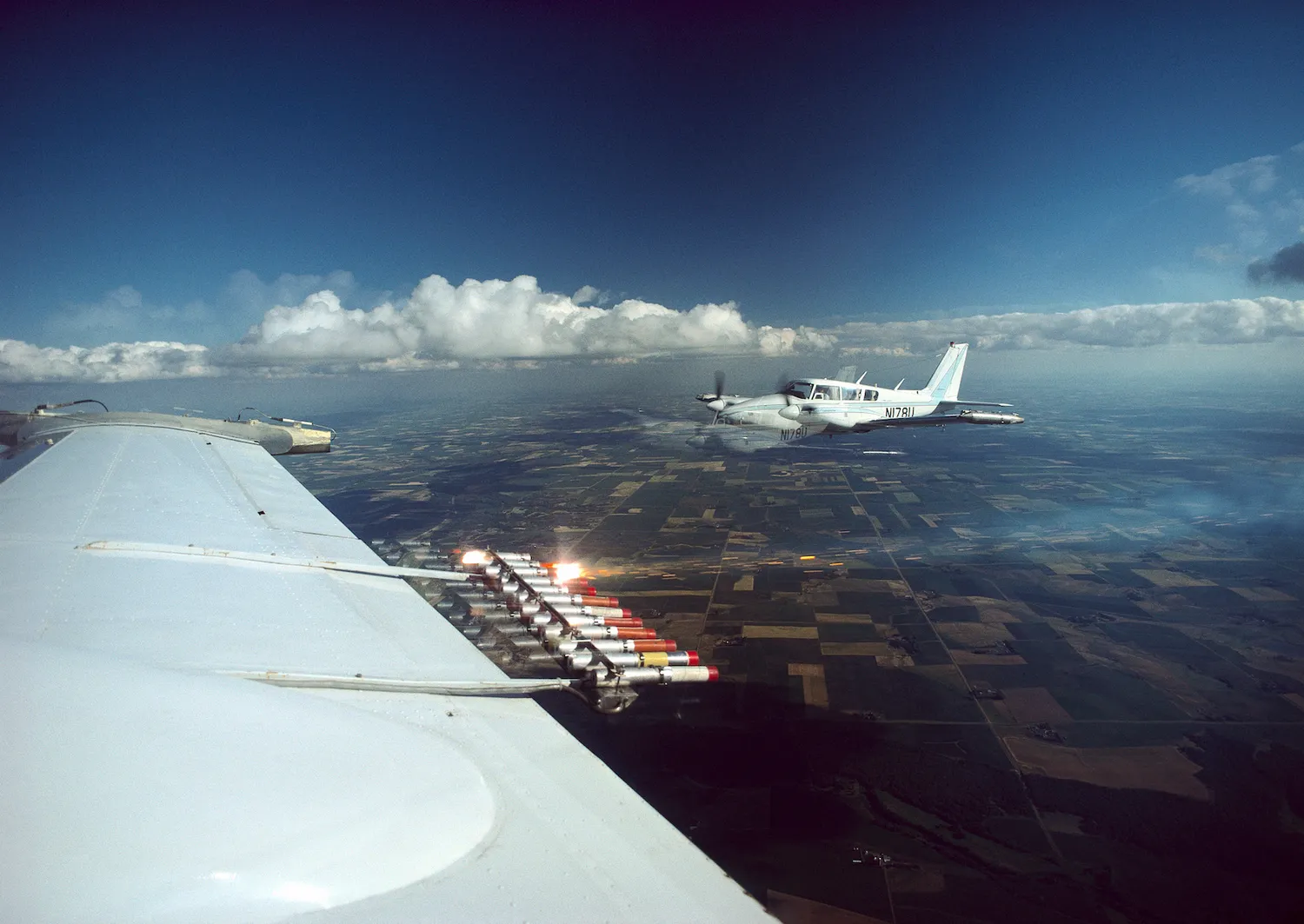
The aim is not to dim the sun:
Firstly, these small scale experiments are not aimed at “dimming the sun”, as the conventional media has wrongly reported.
The goal is not to “dim the sun” itself, nor to make sunlight visibly weaker, but to alter how much solar energy reaches or is absorbed by the lower atmosphere and surface.
Most SRM methods, such as stratospheric aerosol injection or marine cloud brightening, would reduce the total amount of incoming solar radiation by a few tenths of a percent to a few percent; far below what the human eye could perceive as a change in brightness.
You can read more about “Sun Dimming and SRM” here!
What the ARIA experiments actually are
ARIA has committed roughly £56.8 million to an array of 21 projects grouped under “Exploring Climate Cooling”. Of that pot, ARIA itself reports that around £24.5 million is allocated to a set of controlled, small-scale outdoor experiments.
These include five discrete outdoor experiments:
- re-thickening Arctic sea ice (Canada)
- two separate marine cloud brightening experiments (one centred on the UK REFLECT technology development and a related project proposed for the Great Barrier Reef in Australia)
- a UK fog/cloud experiment using controlled electric charge
- a strictly contained stratospheric balloon exposure that will not release material but will expose tiny milligram samples of mineral dust to the stratosphere and then recover them.
The tests are small, time-bound and designed so that any atmospheric effects dissipate within 24 hours; several of the teams have detailed grant pages describing methods and community engagement.
How much of the sun would the ARIA experiments block?
Two separate points must be made clearly.
First, the ARIA programme is explicitly not funding any experiment aimed at achieving a measurable, persistent global reduction in solar radiation.
The funded outdoor tests are either purely diagnostic (balloon exposures without release), technically focused and tiny (sprayer development and small plumes of seawater spray for seconds to hours), or local physical manipulations (ice thickening over areas measured in tenths to single square kilometres).
ARIA says the tests are designed so any physical effect will dissipate within 24 hours, will be very small in scale and will not be noticeable to the human eye; ARIA also states explicitly that the experiments will not reflect enough sunlight to affect plants or crops.
Second, to put this in context with mainstream SRM numbers: modelling literature and official reviews suggest that offsetting substantial warming would require a persistent, global-scale change in reflected solar radiation on the order of roughly 1 to 2 per cent of incoming solar radiation for large temperature offsets, depending on the target and the radiative calculations used.
Space-based proposals and stratospheric sulphate injection studies typically reference this order of magnitude when estimating what would be required to counter many decades of warming.
That scale is many orders of magnitude greater than what ARIA’s small tests propose to do.
In short, ARIA’s experiments are not intended to, and according to their own documentation would not, produce any measurable global percentage reduction in solar radiation, nor would they create visible “sun dimming” or crop impacts in the short, controlled tests described.
If SRM measures were implemented, would this be visible to the human eye?
In practical terms, no! To be effective, a reduction of about 1% in solar radiation reaching the earth is required. This would not be perceptible to ordinary human vision.
The human eye can only detect changes in daylight brightness once they reach roughly 3-5% under stable conditions, and natural variations caused by thin cloud, humidity, or seasonal angle of the Sun routinely exceed that threshold.
A 1% reduction in global mean solar irradiance corresponds to lowering the average energy received at the surface by about 13-14 watts per square metre, against a baseline of roughly 1,361 W/m² at the top of the atmosphere and about 1,000 W/m² at the ground under clear midday skies.
That change would be far smaller than what people already experience every few minutes as clouds pass overhead. The Sun’s apparent brightness, sky colour and overall visual intensity would therefore look exactly the same to the naked eye.
The five controlled outdoor ARIA experiments:
1. Re-Thickening Arctic Sea Ice (RASi)
Award: £9.9 million (over 42 months)
Project lead and partners: Shaun Fitzgerald, Centre for Climate Repair and a consortium that includes multiple universities and private partners.
Where: Canada; experiments across three winter seasons (2025-26 to 2027-28).
What the experiment will do: pump seawater from beneath the ice onto the ice surface, allowing very cold polar air to freeze that water rapidly and build thicker ice patches. The initial footprint per site is small, starting at roughly 0.1 km² and, if the tests and local engagement permit, growing to as much as 0.5-1 km² for later experiments. The work will be done in close collaboration with local communities and subject to independent environmental assessments.
Expected outcomes: empirical data on feasibility, the persistence of artificially thickened ice into summer, potential ecological impacts, ice dynamics and the logistical and governance issues of scaling. The project is explicitly intended to inform whether the approach could slow summer melt, not to deploy a permanent or regional climate intervention.
2. REFLECT: “A responsible innovation framework for assessing novel spray technology” (UK)
Award: £6.1 million (initial phase over 3 years)
Project lead and partners: Hugh Coe, University of Manchester, with a multi-institutional UK team.
Where: technology development and indoor testing in the UK; community engagement with an eye to future small outdoor tests in UK waters (location to be decided).
What the experiment will do: develop bespoke sprayers for marine cloud brightening (MCB) and undertake indoor and modelling work, followed by very small initial outdoor tests if governance and local co-design permit. Initial outdoor tests, if permitted, are described as very limited and should be “not noticeable to the human eye” and dissipate quickly.
Expected outcomes: instrument performance data, droplet size distributions, proof of concept for sprayer designs, and a governance and engagement framework for responsibly testing MCB at sea.
3. Marine Cloud Brightening in a Complex World (Australia / Great Barrier Reef)
Award: £1 million (potentially rising to £5 million with matched funding; additional conditional funding possibilities noted)
Project lead and partners: Daniel Harrison, Southern Cross University and an international team including CSIRO and Australian universities.
Where: planned small-scale, controlled tests over parts of the Great Barrier Reef in years 3-4 of the project, subject to community and Traditional Owner approvals and independent reviews.
What the experiment will do: combine modelling and sprayer development with prior small outdoor experience on reef cooling. If authorised, controlled spraying to brighten low marine clouds over limited areas up to 10 km × 10 km for short periods (the proposal notes possible 5-6 week operational windows, 6-8 hours per day, but only if rigorous checks and co-design succeed).
Expected outcomes: improved understanding of cloud microphysics in the reef region, whether MCB could reduce thermal stress on corals, and the socio-political processes required to run such experiments.
4. BrightSpark: cloud brightening with electric charge (UK fog/cloud experiments)
Award: £2 million (over 36 months)
Project lead and partners: Giles Harrison, University of Reading; small industrial partner participation.
Where: small UK tests focused initially on low-level fogs as an accessible test bed; experimental footprints of order 100 m × 100 m for outdoor tests.
What the experiment will do: test whether controlled electrical charge releases can influence droplet formation in fogs and clouds so as to modify droplet sizes and hence cloud reflectivity, rather than relying on seawater spraying. Tests are intended to be tiny and dissipate within 24 hours.
Expected outcomes: fundamental physics data on droplet charging and aggregation, a judgement about whether the electric-charge approach merits further study, and community engagement outputs to test acceptability.
5. Natural Materials for Stratospheric Aerosol Injection (balloon exposure of mineral dusts; contained exposures)
Award: £5.5 million (over 36 months)
Project lead and partners: Hugh Hunt, University of Cambridge with collaborators including Harvard.
Where: controlled stratospheric exposure experiments that may take place in the UK and/or the United States.
What the experiment will do: laboratory and computational work combined with weather-balloon flights that expose tiny milligram quantities of naturally occurring mineral dusts (for example limestone, dolomite, corundum) on trays in the balloon gondola to stratospheric conditions, without releasing the material into the atmosphere. After exposure, samples are retracted and recovered for analysis. This is explicitly not an injection or release experiment; materials are not dispersed.
Expected outcomes: direct observational data on how mineral particles evolve in stratospheric conditions, ageing processes, and insights into whether non-sulfate materials could ever be feasible and less hazardous alternatives for SAI.
How the experiments fit into the £56.8 million ARIA programme
ARIA’s full programme is about £56.8 million, with roughly £24.5 million earmarked for controlled outdoor experiments.
The single largest outdoor award listed on ARIA’s pages is RASi at £9.9 million. REFLECT is £6.1 million, BrightSpark about £2 million, Natural Materials for SAI £5.5 million, and the Australian Marine Cloud Brightening project is shown as £1 million initially (with conditional up-sizing if matched funding is found).
These grant values are published on ARIA’s project pages and on the ARIA programme overview.
The hazards and the systemic risks if these approaches were ever implemented at scale
ARIA’s funded projects are deliberately small and diagnostic. Nevertheless, the questions they investigate point at very substantial risks that would arise if any of the approaches were moved from experiment to sustained deployment.
- Regional climate side-effects. Models show that stratospheric aerosol injection or even strongly regionalised cloud brightening can alter precipitation patterns. For example, injecting reflective aerosols mainly in the northern hemisphere could reduce rainfall in parts of India and the Sahel. Such changes could harm farmers and water supplies in vulnerable regions.
- Ocean chemistry and ecosystems. SRM does nothing to stop ocean acidification driven by elevated CO₂. Marine cloud brightening and repeated sea-spray activities could also have local ecological effects on marine boundary layers, coral reef radiation budgets and air-sea interaction processes if scaled. ARIA’s reef project explicitly recognises these knowledge gaps and conditions further outdoor tests on rigorous local approvals.
- Ozone and chemistry risks. Stratospheric sulphate aerosols are associated with catalytic ozone depletion chemistry; replacing sulfate with “safer” minerals is the subject of ARIA’s stratospheric materials project precisely because of this hazard. Yet mineral alternatives themselves may have other chemical or radiative behaviours that are not well known.
- Termination shock and governance failures. If an SRM programme were run for decades and then stopped abruptly while CO₂ remained high, the climate would rebound rapidly, producing what researchers call a “termination shock” with very rapid warming. There are also acute geopolitical governance risks: a single actor acting unilaterally could create outcomes that harm others, creating international tensions. These governance and ethical questions are widely acknowledged as central obstacles to deployment.
- Moral hazard and political diversion. There is an argument that visible progress on cooling technologies could reduce political pressure for deep decarbonisation. Some social scientists find little evidence for automatic moral hazard in public opinion studies, but the risk remains an important policy concern and motivates a heavy emphasis on governance research alongside technical work.
What the ARIA experiments will, and will not, resolve
The ARIA experiments are explicitly designed to gather missing empirical data about mechanisms, technological feasibility and social acceptability.
If executed with the governance requirements ARIA describes, they will produce useful microphysical and process knowledge: for example, whether electrically charging droplets measurably changes droplet size distributions, whether pumped winter seawater produces ice that persists through the melt season, and how candidate mineral particles age under stratospheric conditions. That knowledge is necessary for informed policy decisions.
What the experiments will not do is prove that any of these methods are safe, scalable, or morally acceptable as a policy. Small, short tests cannot reveal all regional climate impacts, long-term ecological effects, geopolitical consequences or the social distribution of risks and benefits.
Those questions require far larger, global modelling and governance work and, crucially, sustained international political deliberation.
Why these distinctions matter
Public debate since ARIA’s announcement has tended to conflate three different things: exploratory, small-scale, tightly governed field science; speculative modelling of what would happen under sustained deployment; and the political question of whether any society should ever try to manipulate planetary radiation at scale.
ARIA’s programme sits squarely in the first category, funding carefully scoped experiments and governance research.
The experiments are small, limited in space and time, and are not intended to alter global solar radiation in any measurable way.
That said, the scientific, ethical and diplomatic questions the experiments probe remain profound, and they expose the need for transparent, international arrangements before any serious consideration of deployment could be contemplated.