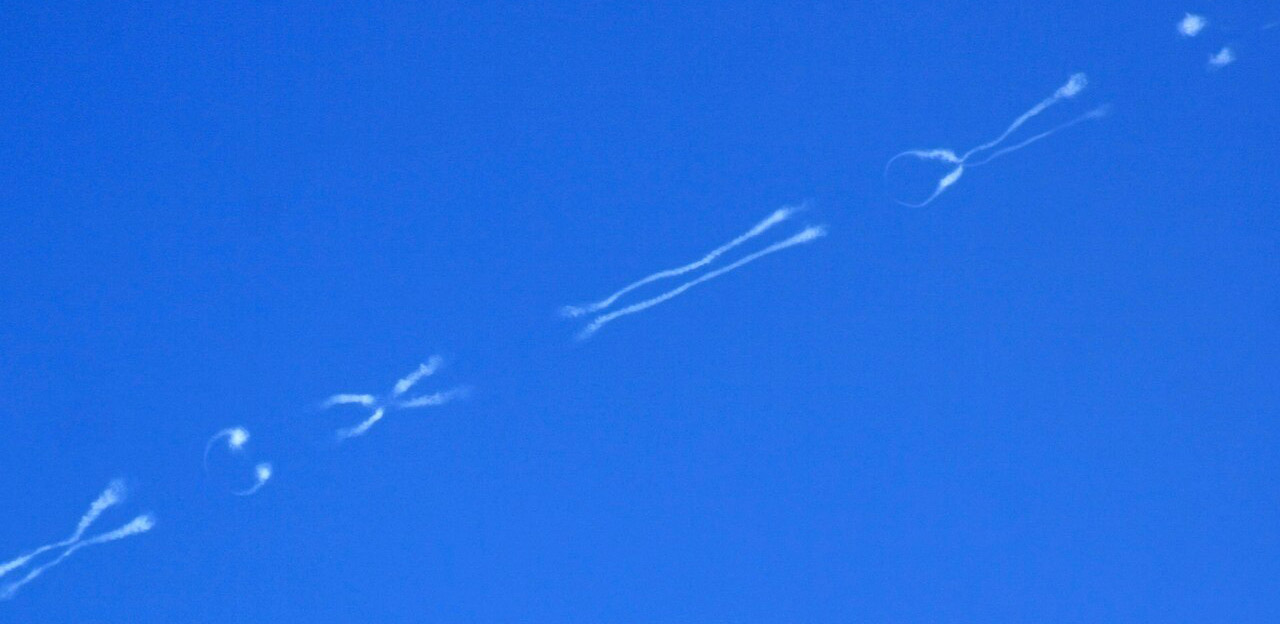

Aircraft contrails are a frequent subject of discussion among chemtrail believers, particularly when they display unusual shapes or patterns. One phenomenon commonly cited as evidence that contrails are not simply condensed water vapour is the formation of looping, braided or wave-like structures along a contrail’s length. In atmospheric science and aerodynamics, these features are generally explained by a process known as Crow instability.
Crow instability is a well-documented fluid dynamic phenomenon that affects the pair of wingtip vortices generated by an aircraft in flight.
The process has been studied experimentally, modelled mathematically and observed repeatedly in both contrails and aircraft wake research. While the resulting visual patterns can appear unusual to ground observers, they are consistent with established aerodynamic theory and do not require the presence of unusual substances within the exhaust plume.
Contrails and Aircraft Wake Vortices
To understand Crow instability, it is necessary to distinguish between a contrail and the wake generated by an aircraft.
A contrail forms when hot engine exhaust containing water vapour mixes with cold ambient air at cruising altitude. If atmospheric conditions are sufficiently cold and humid, the water vapour condenses and freezes into microscopic ice crystals. These ice crystals scatter sunlight and become visible as a white line behind the aircraft.
The contrail itself is only one component of what exists behind an aircraft. At the same time, lift generated by the wings creates a pair of counter-rotating vortices extending behind the aircraft. These vortices are a direct consequence of pressure differences between the upper and lower wing surfaces.
Air naturally moves around each wingtip from the high-pressure region beneath the wing towards the lower-pressure region above it. This process generates two rotating tubes of air that trail behind the aircraft and can persist for several minutes under suitable atmospheric conditions.
In many cases, the visible contrail becomes entrained within these vortices. As the vortices evolve, the contrail evolves with them.
Technical Overview of Crow Instability
Crow instability is a long-wavelength instability that develops within a pair of parallel counter-rotating vortices.
The phenomenon was first analysed by physicist Steven Crow in 1970. His theoretical work demonstrated that paired vortices are not perfectly stable structures. Small perturbations along their length can grow through mutual vortex interaction.
Initially, the vortex pair appears relatively straight. However, minor disturbances caused by atmospheric turbulence, wind shear or other environmental influences begin to amplify. Over time, sinusoidal oscillations develop along both vortices.
As these oscillations increase in amplitude:
- Portions of the vortices move closer together.
- Other portions move further apart.
- Induced velocity fields strengthen the deformation.
- The vortices eventually reconnect at multiple points.
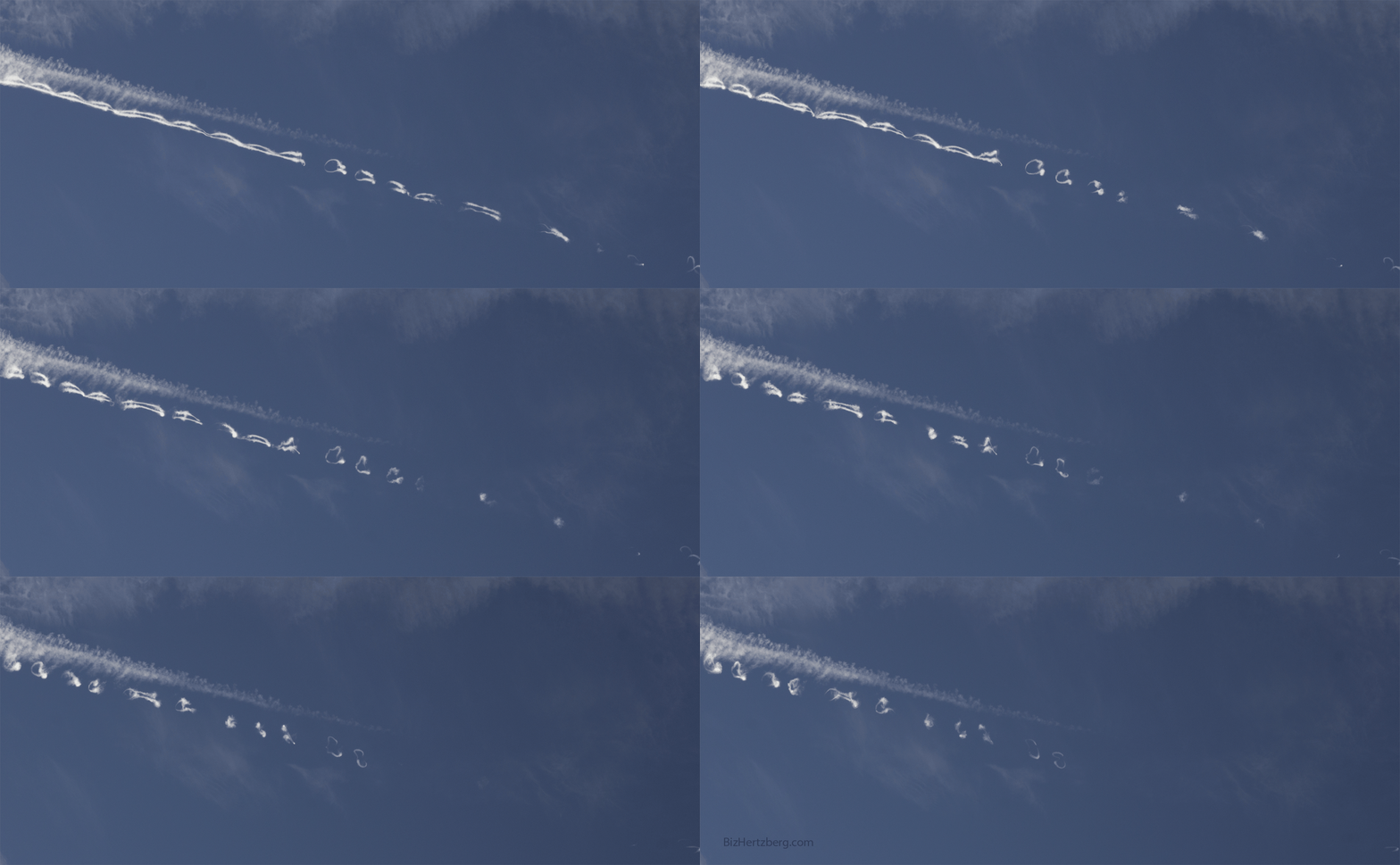
This process creates a sequence of linked loops along the wake structure.
When ice crystals from a persistent contrail are embedded within the vortices, the deformation becomes visible. The observer sees loops, braids or wave-like structures in the contrail even though the actual process is occurring within the underlying vortex pair.
The characteristic wavelength of the instability is typically several times greater than the spacing between the vortices themselves. This produces large-scale patterns that can extend for kilometres along the contrail.
Why Contrails Sometimes Appear to Twist
Many images shared online show contrails appearing to twist around themselves or form braided structures. These observations are often interpreted by chemtrail believers as evidence that the trail contains unusual materials.
In reality, the apparent twisting occurs because the visible ice crystals trace the motion of the vortices.
As the two vortices undergo Crow instability, the contrail becomes deformed into the same wave pattern. Since the observer cannot see the vortices directly, only the ice crystals are visible. The resulting geometry can give the impression that the contrail itself is behaving in an unusual or artificial manner.
The effect is comparable to releasing smoke into a rotating airflow. The smoke reveals the structure of the airflow but does not cause the structure itself.
Conditions Required for Crow Instability to Become Visible
Crow instability develops within aircraft wake vortices regardless of whether a visible contrail exists. However, the instability can only be observed directly when a sufficient number of particles or ice crystals are present to trace the vortex motion.
Several conditions increase the likelihood of observing the phenomenon:
Persistent Contrails
The contrail must remain visible long enough for the instability to develop. Short-lived contrails often dissipate before significant vortex deformation occurs.
Stable Atmospheric Conditions
Excessive turbulence can disrupt vortex structures before organised wave patterns form. Relatively stable air allows the instability to evolve more clearly.
Ice-Supersaturated Air
Persistent contrails are most common in regions where relative humidity with respect to ice exceeds approximately 100 per cent. In these environments, ice crystals can survive and grow rather than evaporate.
Limited Vertical Wind Shear
Strong wind shear can distort or destroy the wake structure before Crow instability becomes fully developed.
Because these conditions do not occur everywhere, Crow instability is relatively uncommon compared with ordinary straight contrails.
Why the Phenomenon Appears in Chemtrail Discussions
Crow instability appears frequently in chemtrail related discussions because it produces patterns that differ significantly from the straight contrails most people expect to see.
Several factors contribute to this interpretation:
First, the phenomenon is not widely known outside aerospace and atmospheric science disciplines.
Second, the loops and wave structures often develop after the aircraft has moved well beyond the observer’s field of view. The transformation therefore appears disconnected from the aircraft that created it.
Third, the resulting patterns can appear highly organised. To someone unfamiliar with fluid dynamics, the regular spacing of the loops may seem inconsistent with a natural process.
However, organised structures are common in fluid mechanics. Similar instabilities occur in rivers, smoke plumes, ocean currents, volcanic eruptions and cloud systems. Regularity alone is not evidence of artificial intervention.
Scientific Evidence Supporting the Explanation
The explanation for Crow instability does not rely solely on visual observations.
The phenomenon has been studied through:
- Analytical mathematical models
- Wind tunnel testing
- Computational fluid dynamics simulations
- Aircraft wake measurements
- Contrail observations
These independent approaches consistently produce the same behaviour predicted by Crow’s original theoretical work.
Researchers studying aircraft wake hazards have observed the instability repeatedly because vortex evolution directly affects aircraft separation requirements and aviation safety. The same vortex dynamics that influence wake turbulence also produce visible distortions in persistent contrails.
Importantly, the observed dimensions and timescales of real-world contrail distortions correspond closely with theoretical predictions derived from vortex dynamics.
This agreement between theory, modelling and observation is one of the strongest indicators that the underlying explanation is correct.
What Ground Observers Are Actually Seeing
When observers photograph a contrail displaying Crow instability, they are not directly observing the instability itself. They are observing ice crystals that have become embedded within a changing airflow pattern.
The visible contrail acts as a tracer.
The underlying vortices remain largely invisible, but the ice crystals reveal their motion. As the vortices bend, oscillate and reconnect, the contrail records those changes in a form that can be seen from the ground.
This distinction is important because many interpretations focus exclusively on the appearance of the contrail while ignoring the aerodynamic processes occurring within the aircraft wake.
Without knowledge of wake vortex dynamics, the observed shapes can appear difficult to explain. Once the behaviour of paired vortices is understood, however, the patterns become consistent with established aerodynamic principles.
What the Evidence Shows
Crow instability is a recognised aerodynamic phenomenon affecting the counter-rotating vortices generated by aircraft wings. Under suitable atmospheric conditions, persistent contrails become embedded within these vortices and reveal their evolution as visible loops, braids and wave-like structures.
Although such patterns are often presented within chemtrail discussions as evidence of unusual activity, the phenomenon has been extensively studied within fluid dynamics and aerospace engineering. Mathematical theory, laboratory experiments, numerical simulations and real-world observations all support the same explanation.
The unusual appearance of a contrail displaying Crow instability reflects the behaviour of aircraft wake vortices interacting with the atmosphere. It does not require the presence of secret spraying operations, specialised chemicals or non-standard aircraft systems. Instead, it provides a visible example of well-understood aerodynamic processes occurring at high altitude.