
The Physical Basis of Contrail Formation
Persistent contrails are among the most visible human influences on the upper troposphere. Their appearance, persistence and spread depend upon a precise combination of aircraft emissions, ambient temperature, humidity, pressure and atmospheric dynamics.
Predicting when contrails will persist involves physics, thermodynamics and microphysical modelling.
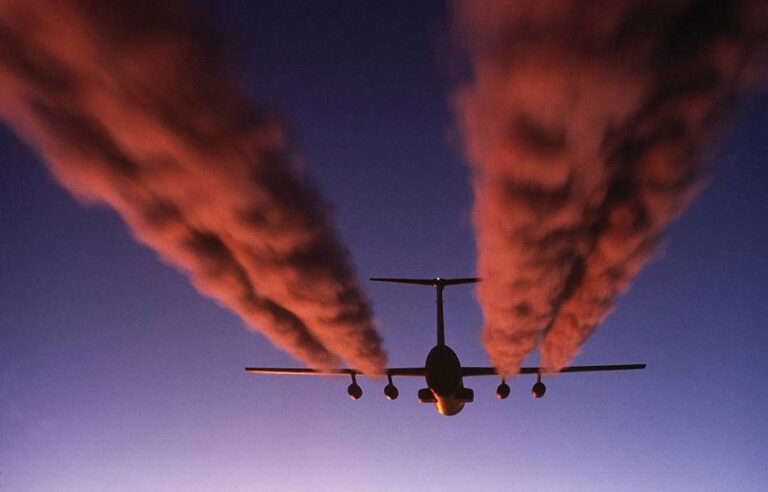
Jet engines produce exhaust gases made primarily of carbon dioxide and water vapour. At cruise altitude the ambient air is extremely cold, typically between -40 °C and -60 °C. When hot exhaust gases mix with the surrounding air, the mixture cools rapidly.
If conditions allow, the water vapour becomes supersaturated relative to liquid water and forms minute water droplets. These freeze almost immediately to form ice crystals. The resulting trail is a contrail.
The essential physical processes are:
- Mixing of hot exhaust with cold ambient air.
- Condensation of water droplets when saturation is reached.
- Freezing of droplets into ice crystals.
- Growth, persistence or sublimation depending on humidity.
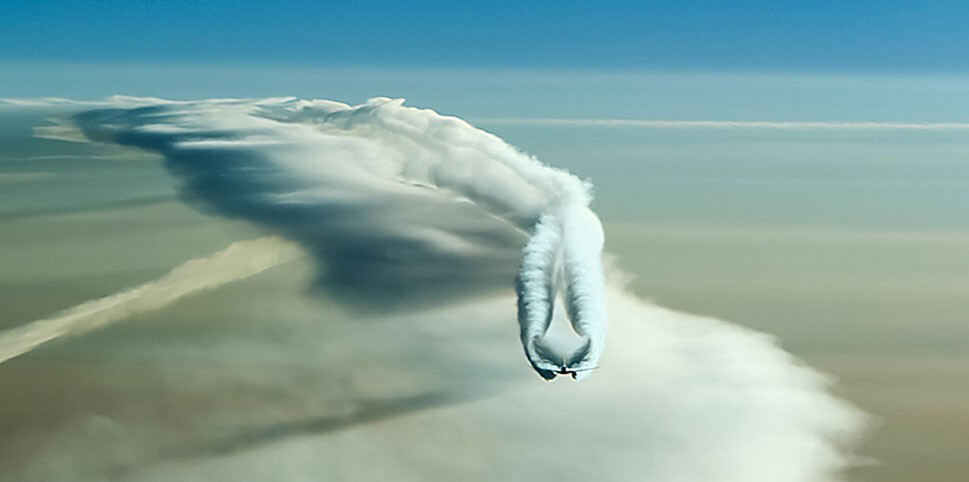
In ordinary conditions contrails dissipate quickly when the ambient air is ice subsaturated (values below 100 percent relative humidity with respect to ice). Persistent contrails occur when the air mass is ice supersaturated. This means the vapour pressure exceeds the saturation vapour pressure over ice at that temperature. The ice crystals do not sublimate. Instead they grow by deposition of additional water vapour. The result is a long lived contrail that may widen and spread into cirrus like cloud sheets.
The Schmidt Appleman Criterion
Persistent contrail prediction begins with the Schmidt Appleman Criterion. Proposed in the 1940s and refined over the following decades, it provides the thermodynamic threshold at which an aircraft will form a visible contrail. The criterion evaluates whether the exhaust plume, when mixed with ambient air, reaches saturation with respect to liquid water.
The governing equation expresses the temperature at which contrails can form:
Tcrit = ( (EIH2O x Lv) / cp ) x ( 1 / ln(1+S) )
In practice a commonly used formulation is based on the critical ambient temperature:
Tcrit = ( (EIH2O / ϵ) x (p / p0) )1/α
Where:
- EIH2O is the emission index of water vapour (kg of water per kg of fuel burnt).
- ϵ is a constant related to mixing efficiency.
- p is ambient pressure.
- p0 is standard pressure.
- α is a thermodynamic constant.
Different formulations exist, but the principle is the same. A contrail forms when the ambient temperature is below this critical temperature. For modern turbofan engines, a typical critical threshold is near -40 °C to -42 °C at cruising altitudes.
However, this alone predicts only formation of a contrail, not persistence. For persistence we must consider ice supersaturation and the saturation vapour pressure over ice.
Relative Humidity with Respect to Ice
Atmospheric scientists describe humidity in the upper troposphere using relative humidity with respect to ice (RHi). This differs from the more familiar relative humidity with respect to liquid water (RHw). Because saturation vapour pressure over ice is lower than over liquid water at the same temperature, moderately dry air in the conventional sense can still be supersaturated with respect to ice.
The saturation vapour pressure over ice is calculated using the Clausius Clapeyron equation:
esi(T) = e0 * exp( (Ls / Rv) * (1/T0 – 1/T) )
Where:
- esi is the saturation vapour pressure over ice.
- Ls is the latent heat of sublimation.
- Rv is the gas constant for water vapour.
- T0 is a reference temperature.
- e0 is the reference vapour pressure.
Relative humidity with respect to ice is:
RHi = e / esi(T) × 100
Where e is the actual vapour pressure. Persistent contrails require:
RHi > 100%
Under these conditions ice crystals grow by deposition. The contrail spreads and may persist for hours.
The Ice Supersaturated Region
Ice supersaturated regions (ISSRs) are volumes of the upper troposphere where RHi exceeds 100 percent. These regions are common. Satellite measurements show that between 10 percent and 30 percent of the upper troposphere is ice supersaturated at any moment. Their formation is governed by:
- Large scale uplift and cooling
- Jet stream dynamics
- Gravity wave activity
- Entrained moist air from lower altitudes
These regions are invisible to the naked eye until ice crystals form. This leads to an everyday misunderstanding. A clear blue sky does not guarantee that the upper air is dry. A pilot flying at 10 km may enter a large ISSR that an observer at ground level cannot detect. The moment an aircraft engine produces condensation nuclei within that region, a persistent contrail appears.
Forecasting Persistent Contrails
Forecasting persistent contrails requires different datasets and models. Meteorologists use:
- Temperature forecasts for flight levels 300 to 450 (approximately 30,000 to 45,000 ft).
- Humidity fields, especially RHi.
- Vertical velocity which influences cooling and thus humidity.
- Wind fields which control spreading of persistent contrails.
Operational prediction is based on numerical weather prediction models. The European Centre for Medium Range Weather Forecasts (ECMWF), the UK Met Office and the US National Centers for Environmental Prediction all generate upper tropospheric humidity fields.
Predicting Persistent Contrails Using Temperature Thresholds
The first step is to determine whether temperatures at cruise altitude fall below the Schmidt Appleman critical temperature. A simplified form of the critical temperature equation is often used operationally:
Tcrit ≈ -39°C – 6 * ln (EIH2O / 1.25)
Modern engines have a water vapour emission index around 1.2 to 1.3 kg per kg of fuel, giving a critical temperature near −40 °C. If forecast temperatures at 250 hPa (roughly 10 km altitude) fall below this, contrail formation is likely.
Predicting Contrail Persistence Using RHi
A second field is examined: the relative humidity with respect to ice. Models calculate this using the predicted water vapour mixing ratio and temperature. The condition for persistence is:
RHi(z,t) > 100
Where z is altitude and t is time.
If a model forecasts temperatures below the Schmidt Appleman threshold and RHi above 100 percent, persistent contrails are predicted. Regions where only the temperature threshold is met will produce short lived contrails that sublimate quickly.
Vertical Motion and Adiabatic Cooling
Vertical velocity plays an important role in forming ISSRs. Rising air cools adiabatically, reducing saturation vapour pressure and increasing relative humidity. The dry adiabatic lapse rate is approximately:
Γd = g / cp ≈ 9.8°C/km
Where:
Γd is The dry adiabatic lapse rate.
g is the acceleration due to gravity.
cp is the specific heat capacity of air at constant pressure.
For moist air the lapse rate is lower, but the principle is the same. Slow, broad scale ascent across hundreds of kilometres cools large regions into ice supersaturation.
Gravity waves also contribute. Their oscillatory vertical motion can temporarily raise RHi above 100 percent in layers tens to hundreds of metres thick. This produces narrow bands where persistent contrails form.
The Role of Fuel Composition
Aircraft fuel composition influences the water vapour emission index. Hydrogen rich fuels produce more water vapour. Future sustainable aviation fuels may slightly increase or decrease contrail likelihood. However, the dominant factor remains ambient conditions rather than variations in fuel chemistry.
Soot particle emissions affect the number of ice nuclei in the exhaust. Modern engines tend to emit fewer particulates. This means fewer but often larger ice crystals. These crystals may have a different growth pattern in ISSRs. Advanced contrail prediction models therefore incorporate both water emission index and particle emission index.
Contrail Microphysics
A contrail at the moment of formation is a dense plume of ice crystals. The microphysical processes controlling its evolution include:
- Sublimation when RHi is below 100 percent.
- Deposition when RHi is above 100 percent.
- Aggregation as crystals collide.
- Sedimentation as crystals fall slowly out of the plume.
The mass growth rate due to deposition is given by:
dm / dt = 4π r D ρv ( e/esi – 1 )
Where:
- r is crystal radius.
- D is diffusivity of water vapour.
- ρv is vapour density.
When the ambient air is strongly supersaturated, this term is positive and contrail crystals grow. The plume becomes optically thicker and spreads laterally through wind shear.
Spreading of Persistent Contrails
Wind shear stretches contrails into long filaments. A wind shear of only a few metres per second per kilometre is enough to widen a contrail into a cirrus sheet over one to two hours. Numerical models simulate this spreading using the deformation and divergence fields of the upper troposphere.
Aircraft contrails therefore act as tracers for upper air dynamics. Pilots often note that contrails occur on days of strong jet stream activity, which is consistent with widespread ISSRs associated with large scale uplift.
Satellite Detection of Ice Supersaturation
Modern satellites carry instruments capable of estimating upper tropospheric humidity. The Atmospheric Infrared Sounder (AIRS), Infrared Atmospheric Sounding Interferometer (IASI) and instruments aboard Meteosat detect humidity profiles by measuring infrared absorption at specific wavelengths.
These products show the spatial distribution of ISSRs. Typical patterns include:
- Bands along the polar jet stream
- Moist outflow ahead of frontal systems
- High altitude moist layers in subtropical jet regions
These are the same regions where observers frequently notice persistent contrails.
Why Persistent Contrails Appear and Disappear Rapidly
Ground observers often note that some aircraft leave persistent trails while others do not. This is expected. Aircraft separated by only a few nautical miles horizontally or vertically can be flying inside or outside an ISSR.
Furthermore, ISSRs are layered. An aircraft descending from flight level 380 to 340 may briefly cut through a supersaturated layer, produce a persistent contrail and then exit the layer, leaving no trail afterwards.
This behaviour is purely meteorological and fully consistent with atmospheric physics.
Predictive Models Used by Researchers
Scientists use a range of models to predict contrail formation:
- Appleman based threshold models for initial formation.
- Large Eddy Simulation models to simulate mixing and microphysics.
- Cirrus models for long term spreading.
- Climate models to quantify radiative forcing due to contrails.
One widely used parameterisation calculates contrail coverage fraction using:
C = Pform x Ppersist x ftraffic
Where:
- Pform is probability of formation based on temperature.
- Ppersist is probability of persistence based on RHi.
- ftraffic is aircraft flight density.
This allows daily global analysis of where persistent contrails are likely.
Field Studies
Aircraft campaigns have directly sampled contrails and ISSRs. Notable programmes include:
- NASA’s SUCCESS project (1996)
- The CONTRAILS experiment of DLR in Germany
- The CIRRUS 2004 and 2006 campaigns over Europe
- The MOZAIC/IAGOS long term humidity monitoring project
These studies confirm that persistent contrails occur only where the Schmidt Appleman temperature threshold is met and where RHi exceeds 100 percent.
Radiative and Climatic Impacts
Persistent contrails reflect solar radiation during the day and trap infrared radiation at night. Their overall radiative forcing is estimated as:
RF ≈ 30 to 60mWm−2
This is small compared with anthropogenic greenhouse gases but non negligible. Climate models therefore include contrail physics as part of aviation’s overall effect on climate.
This physical significance partly motivates ongoing improvements in contrail prediction, especially as airlines explore operational changes to reduce contrail formation by adjusting flight levels to avoid ISSRs.
Practical Methods for Predicting Persistent Contrails
A scientifically accurate prediction requires:
- Flight level temperature fields from weather models or aviation forecasts.
- Upper tropospheric humidity (RHi) fields from the same models.
- Knowledge of engine characteristics, though approximate values suffice.
- Assessment of vertical motion and wind shear.
A practical prediction scheme is:
- Identify flight levels below -40 °C to -42 °C.
- Overlay RHi fields from the same model.
- Highlight regions where RHi exceeds 100 percent.
- Apply flight routing or expected traffic density.
Where conditions overlap, persistent contrail formation is expected.
For real time operational forecasting, meteorologists often use the 300hPa and 250hPa layers. Aviation weather maps provided to commercial airlines include these fields as standard.
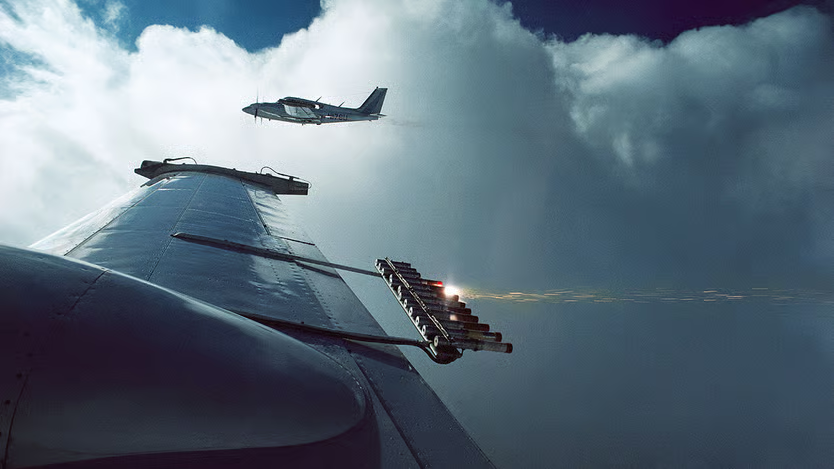
Why Persistent Contrails Do Not Indicate Spraying
Persistent contrails are a natural outcome of thermodynamics and atmospheric humidity. They require specific conditions but those conditions occur daily across much of the upper troposphere.
Everything needed to predict them uses well known physics. Numerous field studies confirm that contrails consist only of ice crystals formed from water vapour.
Contrail behaviour varies with altitude, temperature and humidity. This variability explains why contrails may appear suddenly or persist for hours.
Nothing about persistent contrails requires additional substances, deliberate release or secret spraying activity. Their properties are fully explained by standard atmospheric science.
Predicting persistent contrail formation involves:
- Temperature thresholds defined by the Schmidt Appleman Criterion.
- Humidity thresholds defined by relative humidity with respect to ice.
- Upper air dynamics influencing supersaturated regions.
- Microphysical properties governing crystal growth and spreading.
Persistent contrails occur only when the ambient air is both cold enough for initial condensation and supersaturated with respect to ice. ISSRs are widespread yet invisible until seeded by ice nuclei such as aircraft exhaust.
Numerical weather prediction models provide accurate forecasts of these regions, and researchers validate them with satellite and aircraft measurements.
Contrails are therefore predictable, measurable and scientifically well understood. Their persistence reflects the physics of the upper atmosphere, not any covert activity.