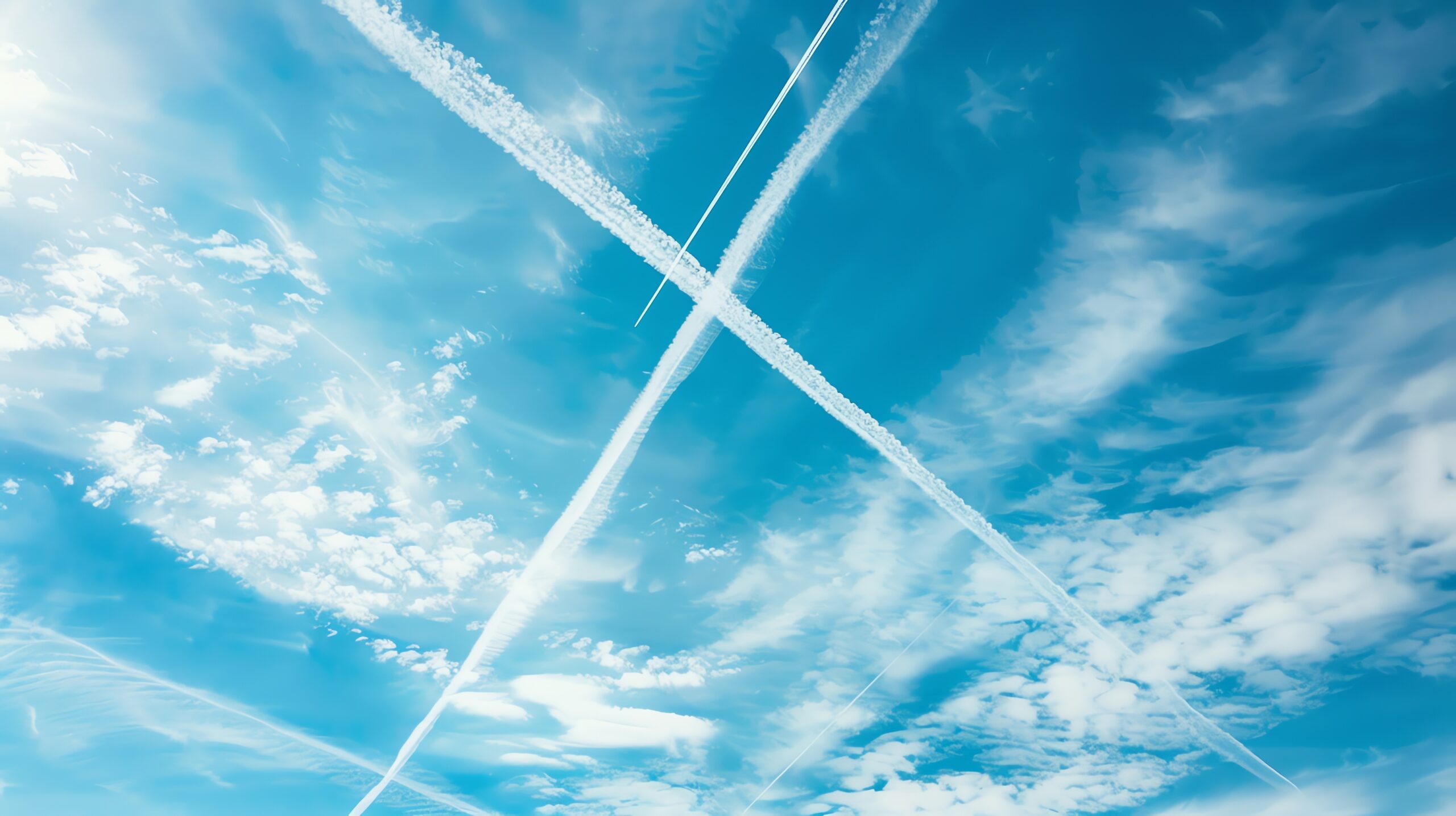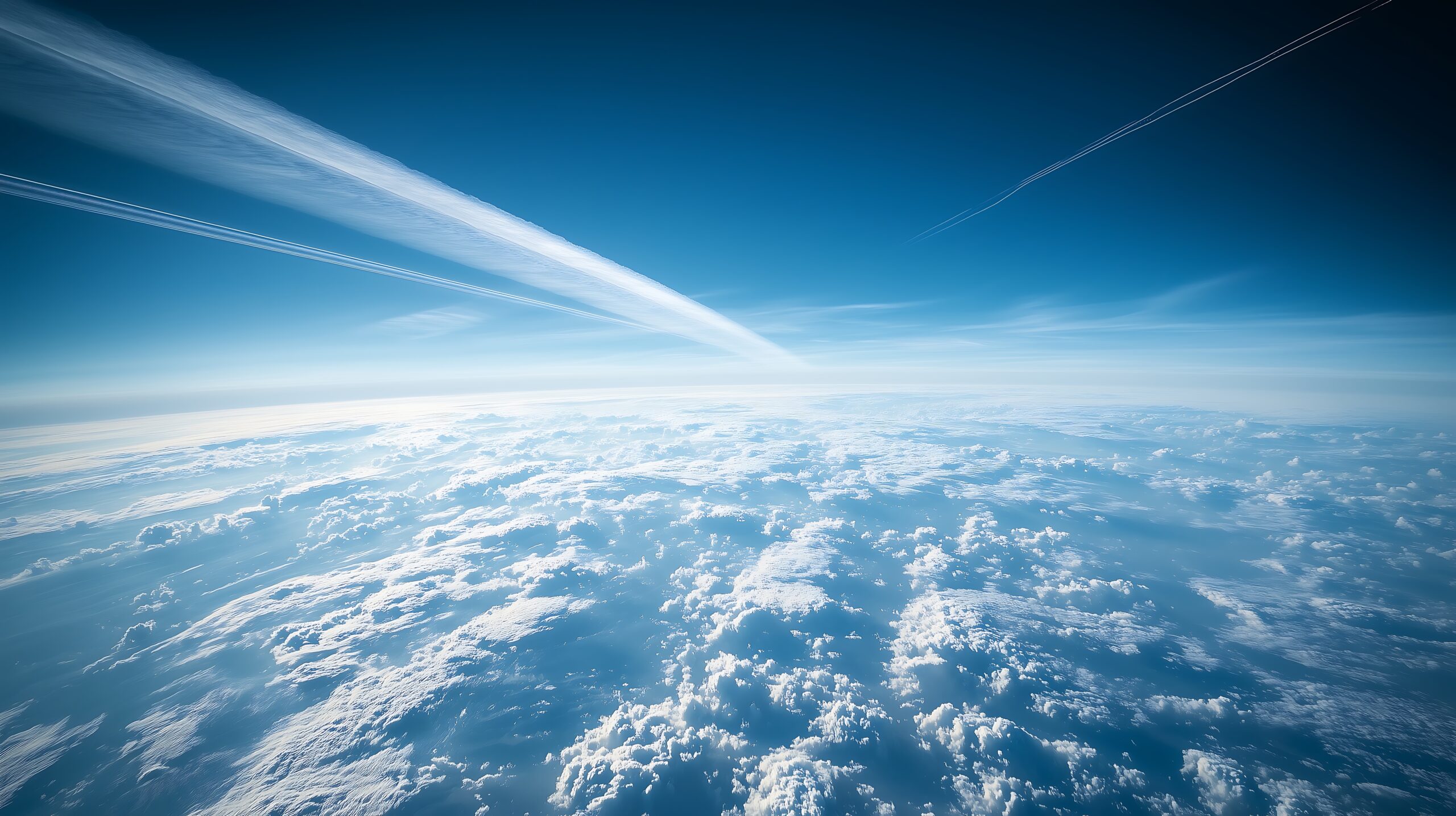

High in the sky on a clear day, one may see long, slender white streaks trailing behind an aeroplane. Recently has the belief emerged that these streaks hide a darker secret: purposeful aerial spraying of chemicals. This belief is commonly called the “chemtrails” conspiracy theory.
For decades, meteorologists have understood such lines as simple condensation-trails (or “contrails“) formed when hot, humid engine exhaust meets cold upper-troposphere air.
The emergence of the “chemtrails” narrative
While contrails have existed for decades, the chemtrail theory emerges more recently and is characterised by claims of deliberate aerosol spraying from aircraft for covert purposes.
The term “chemtrail” is a portmanteau of chemical + trail, modelled on “contrail” (condensation trail).
Origin and early articulation
The narrative began to emerge in the mid- to late-1990s.
Chemtrail conspiracy theories began to circulate after the United States Air Force (USAF) published a 1996 report about weather modification.
That 1996 document, titled “Weather as a Force Multiplier: Owning the Weather in 2025“, originated at the Air University of the USAF and mapped out hypothetical future capabilities for weather modification. Conspiracy-theorists seized on it as proof of an ongoing programme.
In 1997, appear claims that a person named Richard Finke posted an email titled “Line in the Sky Identified”, marking one of the earliest online references to alleged chemtrails.
In April 1999, journalist William Thomas published an article titled “Chemtrails – U.S. Military Continues to Spray Chemical-Laden Skytrails” for the Environmental News Service. This article helped bring the concept into wider awareness.
Meanwhile, the late-night talk-radio host Art Bell (of Coast to Coast AM) gave airtime to chemtrail topics from 1999 onward, greatly amplifying the narrative.
One archive notes: “”Seven subsequent chemtrails updates on Coast to Coast attracted such a large following.”
Thus the late 1990s mark the consolidation of the chemtrail idea into the public domain.
Key claims and themes
The claims of the chemtrail narrative are diverse, but common themes include:
- Allegation that the white lines left by aircraft are not merely condensed water vapour but intentionally sprayed chemical or biological agents.
- Purported goals of the spraying programme: weather modification, climate control (solar radiation management), population control, biological warfare, or secret geoengineering.
- The observation that persistent trails (those that linger or spread) must therefore signal something other than “normal” contrails. Proponents sometimes assert that “after 1995” the trails began to persist more than previously.
- Interpretation of crossing grid-patterns of trails, “unusual concentrations” of streaks, or unexplained clouds as evidence of spraying.
- Claims that independent “samples” (soil, rainwater) show elevated levels of aluminium, barium, strontium or polymer fibres; these findings are widely criticised for lack of chain-of-custody or peer-review.
Prominent believers and propagators of chemtrails
Several people have become identifiable for promoting the chemtrail narrative:
- William Thomas, as above, authored “Chemtrails Confirmed” (2004) and appeared on radio discussing the issue.
- Richard Finke, who early posted on internet forums and is occasionally dubbed “founder of the chemtrails hoax” by critics.
- Conspiracy-activist doctors such as Rashid Buttar (1966–2023) incorporated chemtrail claims into broader anti-vaccine and anti-government narratives.
- Visual-artist conspiracy figure David Dees (1957–2020) produced art depicting chemtrails among other conspiracies.
- On the sceptical side, science-communicator Mick West has investigated and debunked chemtrail claims. He co-authored a 2016 peer-reviewed survey that found 76 of 77 atmospheric scientists found no evidence of a secret spraying programme.
- Politically, the theory has at times surfaced in legislative debates. For example, U.S. states have introduced bills implying chemical dispersal into the atmosphere despite absence of evidence.
Institutional and governmental responses to chemtrails
As the claim spread, government and scientific bodies responded. For instance:
- In 2000, the United States Environmental Protection Agency (EPA), National Aeronautics and Space Administration (NASA), Federal Aviation Administration (FAA) and National Oceanic and Atmospheric Administration (NOAA) jointly published a factsheet stating that the visible trails were consistent with aviation-condensation phenomena and that there was no credible evidence of such a spraying programme.
- The USAF clarified that their 1996 Weather as a Force Multiplier document was a scenario-wargame exercise and was labelled “fictional representation of future situations/scenarios” not current policy.
- Fact-checkers continue to debunk images and claims tied to chemtrails (for instance, tying unusual clouds to naturally occurring roll-cloud phenomena).
The full timeline
What do conspiracy-theorists believe is happening?
Lets summarise the major strands of the chemtrail narrative, based on documented claims.
1. Weather modification / geo-engineering
Proponents argue that aircraft are dispersing reflective particles (e.g., barium, aluminium salts, polymer fibres) to reflect sunlight, modify clouds, deter rainfall or control the climate.
This view links with the idea of solar-radiation-management or stratospheric aerosol injection, though the scientists working on geoengineering stress nothing of this scale is happening covertly.
2. Population control / aerosolised health assault
Another variant claims that the chemical trails are used to introduce toxins into the population, causing illness, neurological change, fertility decline or mind-control. Some link it with big-pharma, vaccine programmes or electromagnetic experiments.
3. Military or strategic usage of atmosphere
Some believe the trails are part of secret weapons-programmes: using the atmosphere as battlefield, deploying aerosols for electromagnetic/combat or weather-weapon purposes. The 1996 USAF document is cited as potential “evidence”.
4. Cover-up of atmospheric change
A subtle version of the theory is that “we” are seeing increased atmospheric disturbance (cloud-cover, odd weather) and that the mainstream narrative of “contrails” is simply a cover-story for ongoing aerial spraying by governments or entities.
In this view, the visible grid-patterns, lingering trails and layered haze are signs of that covert programme.
These strands often overlap within individual believers. What unites them is the conviction of intent (spraying), secrecy (hidden actors), and malice (harm or manipulation).
Scientific evaluation and refutation of chemtrails
From the scientific perspective, the chemtrail theory fails the burden of credible empirical evidence.
Contrail science
As noted earlier, contrails are formed from water‐vapour and ice crystals. Atmospheric scientists have long observed that contrails can persist for minutes to hours, spread horizontally, form cirrus-type cloud layers and even contribute to local radiative forcing (i.e., reflectivity/infrared absorption).
The key point is that the persistence and spread of trails are explained by ambient humidity, temperature and wind shear rather than secret chemical programmes.
Lack of credible evidence for “spraying”
Fact-checkers and scientific reviews have concluded there is no verifiable data to support large-scale covert chemical spraying via aircraft.
The claim that airplanes intentionally release “chemtrails” as a secret program lacks credible empirical support; mainstream atmospheric science attributes persistent trail phenomena to condensation trails.
A 2016 survey of 77 atmospheric scientists found that 76 (98.7 %) reported no evidence of a ‘secret large-scale atmospheric spraying programme’ (SLAP).
Why the chemtrails belief persists
Even so, the belief persists, and scholars point to psychological, sociological and communicative factors: pattern-seeking, distrust of institutions, identity affirmation via “secret knowledge”, online echo-chambers and alignment with other conspiracies (e.g., anti-vaccine, climate denial).
Professor Timothy Tangherlini, describes the theory as a “folktale” built around contemporary fears of environmental change and government power.
Impact on policy and public understanding
The spread of the theory has implications beyond aviation: it impacts trust in atmospheric science, geo-engineering debates, public-health communication and the way social media amplifies unusual claims.
Some states’ legislation targeting “chemtrails” may divert attention from more pressing real-world issues (e.g., actual aviation emissions, climate-engineering governance).
Why did the chemtrails theory gain traction and why does it still matter?
From a journalistic perspective, the chemtrail story is interesting because it touches on multiple fronts: science-communication failure, the power of visual cues (white lines in sky), the limits of institutional trust, the rise of new media, and the way conspiracy-narratives adapt to new contexts (such as pandemic fears or climate-engineering discussion).
Visual phenomena + ambiguous science = fertile ground
White streaks in the sky are highly visible and yet their exact formation (persistence, spread) depends on meteorological subtlety.
When observers see more lines, more haze, more grid-patterns, they wonder “why now?”. The lack of immediate intuitive explanation can drive suspicion.
The internet amplified the chemtrails narrative
The late 1990s and early 2000s internet era allowed small-group forums, overnight radio shows, and image-sharing to spread the idea widely.
The chain from Finke’s email to Thomas’s article to Art Bell’s radio show to YouTube videos is indicative of how a fringe idea can become a movement.
It intersects real policy debates
Though “chemtrails” as defined by conspiracists lack credible evidence, the notion of geo-engineering (for example, injecting aerosols to reflect sunlight) is a legitimate scientific discussion.
The overlap creates confusion: when scientists talk about “stratospheric aerosol injection” (SAI) as a potential future tool, believers interpret it as proof that current “chemtrails” are real. That ambiguity gives the story continuing traction.
Trust, fear and the locus of power
At its core, the chemtrail narrative plays on a distrust of institutions: governments, the military, elites. It also taps into environmental fear (climate collapse, pandemics, toxins).
When individuals believe they are being sprayed without consent, the emotional stakes are high.
Implications for science communication
From a science journalism standpoint, the chemtrail case illustrates how explaining phenomena (contrails) is not enough: one must understand the social context, the fear-drivers, the narrative framing, and the reasons why people reject authoritative explanations in favour of alternative accounts.
Thee wrap up
The history of “chemtrails” is a rich case study in how a natural atmospheric phenomenon (contrails) became reframed, through social, technological and cultural change, into a conspiracy narrative about chemical sprays in the sky.
To summarise:
- Contrails were observed and scientifically studied long before the 1990s; persistent trails are not new.
- The perception of “more trails now” is real, but attributable to increased air-traffic, more visible skies, social-media interest, altitude/engine regimes and greater awareness, rather than proven covert spraying.
- The chemtrail narrative emerged in the late 1990s, triggered by an Air Force weather-modification scenario paper, early internet postings (Finke), journalistic articles (Thomas) and radio shows (Bell).
- Belief in chemtrails encompasses weather-modification, population-control, military-aerosol and geo-engineering themes; it is propagated by a mix of journalists, activists, alternative-health figures and conspiracy-networks.
- The scientific consensus is clear: there is no credible evidence of large-scale clandestine chemical-spraying via aircraft. The trails are explained by known contrail physics.
- Yet the narrative persists because it relates to visuals (sky lines), distrust in institutions, the interplay of climate and health fears, and the amplification of ideas via social-media.
- From a policy and communication viewpoint, the chemtrail saga underscores the challenges of bridging complex science (aeronautics + atmospheric physics) with public perception, especially when the visual cues (white streaks) seem mysterious and when trust is low.
Further reading about chemtrails
If you are curious to go further, we recommend these starting points:
- The Logistics of Secrecy: The Impossible Scale of a Chemtrail Programme
- Why Contrails Can Linger and Spread
- The peer-reviewed study by Shearer, West, Caldeira & Davis (2016) on expert consensus against a secret spraying programme.
- William Thomas’s Chemtrails Confirmed (2004) for the propagator’s side of the story.