
Sun dimming is an inaccurate term.
The phrase “sun dimming” is a misleading and scientifically inaccurate description of what is properly called Solar Radiation Management (SRM) or Solar Radiation Modification (SRM). The aim is not to dim the sun!
These terms refer to a set of theoretical climate intervention techniques aimed at slightly increasing the Earth’s reflectivity (albedo) to offset part of the warming caused by greenhouse gases.
The goal is not to “Dim the Sun”
The goal is not to “dim the sun” itself, nor to make sunlight visibly weaker, but to alter how much solar energy reaches or is absorbed by the lower atmosphere and surface. Most SRM methods, such as stratospheric aerosol injection or marine cloud brightening, would reduce the total amount of incoming solar radiation by a few tenths of a percent to a few percent — far below what the human eye could perceive as a change in brightness.
The expression “sun dimming” implies an intentional, large-scale visual or physical reduction in the Sun’s intensity, which is not what SRM entails. It also feeds into conspiracy narratives by suggesting that governments are secretly trying to obscure or block sunlight. In reality, SRM research is focused on the physics of radiative forcing and climate feedbacks, not on altering how bright the Sun appears.
Using the correct terminology is important because it reflects the scientific precision of the work: SRM is about managing radiation balance, not dimming daylight. Framing it as “sun dimming” distorts the scientific purpose, exaggerates potential visual effects, and undermines informed discussion about the ethics, risks, and feasibility of such interventions.
What is Solar Radiation Modification (SRM)
Solar Radiation Modification (SRM) refers to a group of proposed technologies intended to reflect a portion of sunlight back into space, thereby reducing global temperatures. While it is often discussed as a potential emergency measure to slow global warming, SRM carries a range of scientific, environmental, political, and ethical risks that make it highly controversial.
The two most studied approaches currently are:
- Stratospheric Aerosol Injection (SAI)
This involves injecting particles high into the stratosphere (for example sulphur dioxide, or possibly alternative solid aerosols) that reflect incoming solar radiation. The particles scatter sunlight; volcanic eruptions are natural analogues. - Marine Cloud Brightening (MCB)
Seeding low-lying marine clouds (especially over oceans) with sea salt or other particles to increase their reflectivity, so clouds reflect more sunlight. This could reduce warming (at least regionally) or affect climate variability.
Other less prominent or more speculative SRM methods being discussed include:
- Cirrus cloud thinning (reducing high-altitude cirrus to allow more heat to leave Earth)
- Surface albedo modification: increasing reflectivity of land (e.g. lighter surfaces) or snow/ice restoration (thickening sea ice)
- Alternative solid aerosol particles (other than sulphuric acid) in the stratosphere to reduce side effects such as ozone damage or unwanted warming of some layers of atmosphere.
Although these interventions might, in theory, reduce global temperatures relatively quickly, they do not address the root cause of climate change, the accumulation of greenhouse gases in the atmosphere, and could create a host of unintended consequences.
How would a solar radiation management plan effect us if it was implemented.
Would a 1% reduction in sunlight be visible to the human eye?
In practical terms, no, such a reduction would not be perceptible to ordinary human vision. The human eye can only detect changes in daylight brightness once they reach roughly 3–5% under stable conditions, and natural variations caused by thin cloud, humidity, or seasonal angle of the Sun routinely exceed that threshold.
A 1% reduction in global mean solar irradiance corresponds to lowering the average energy received at the surface by about 13–14 watts per square metre, against a baseline of roughly 1,361 W/m² at the top of the atmosphere and about 1,000 W/m² at the ground under clear midday skies.
That change would be far smaller than what people already experience every few minutes as clouds pass overhead. The Sun’s apparent brightness, sky colour and overall visual intensity would therefore look exactly the same to the naked eye.
Would it affect crops or photosynthesis?
On current model evidence, a 1% global mean reduction in solar radiation would have negligible direct impact on crop yields. Photosynthesis typically saturates well before full sunlight intensity, meaning that most plants already operate near their maximum photosynthetic efficiency under normal daylight. Reducing light by one percent is equivalent to moving a plant a few metres into partial shade for a few minutes per day — biologically trivial.
However, indirect effects could occur if SRM changed regional climate patterns that influence crop performance more strongly than light intensity itself. For instance, small shifts in rainfall, temperature or humidity arising from the way SRM alters atmospheric circulation could have meaningful agricultural consequences, particularly in monsoon-fed or marginal regions. The models suggest these changes would vary by geography: some areas might see slightly cooler, more stable growing seasons, while others could experience altered rainfall timing or cloudiness.
Could there be visible “sun dimming” or a change in sky colour?
A 1% reduction in total solar radiation is not enough to cause noticeable dimming or changes in the apparent colour of the Sun. Any visible “whitening” of the sky or reduction in direct sunlight would depend on how the reduction is achieved:
- If done by stratospheric aerosols, such as sulphate particles, the effect on the sky could be slightly more diffuse light and paler blue tones under some conditions. Even then, at 1% radiative forcing reduction, it would be very subtle — less than what most people notice during ordinary hazy summer days.
- If done by marine cloud brightening, the visual effect would simply be marginally brighter marine clouds over the ocean, not perceptible inland.
- If done via space-based or theoretical reflective technologies, there would be no visible atmospheric change at all.
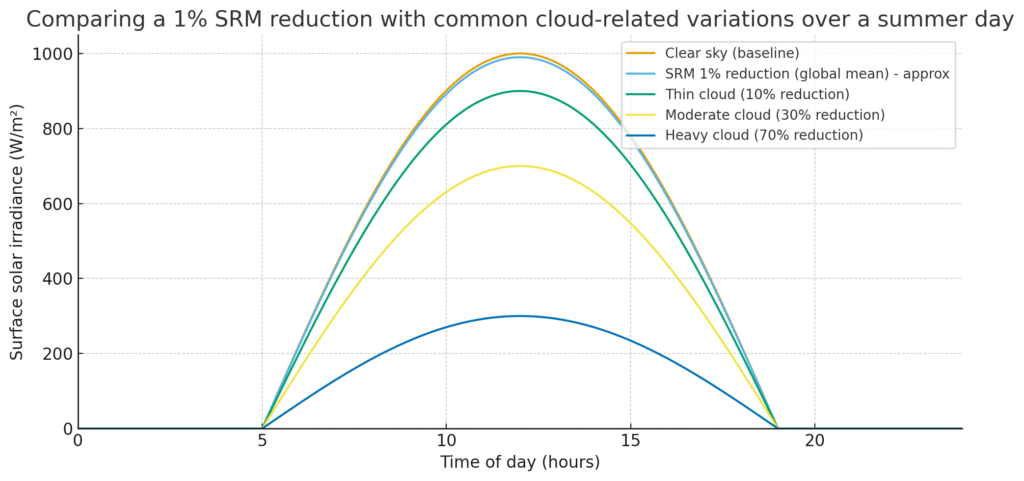
A plot of surface solar irradiance across a representative mid-latitude summer day for: clear sky baseline, a 1% SRM reduction, and three cloud scenarios (thin 10%, moderate 30%, heavy 70% reductions).
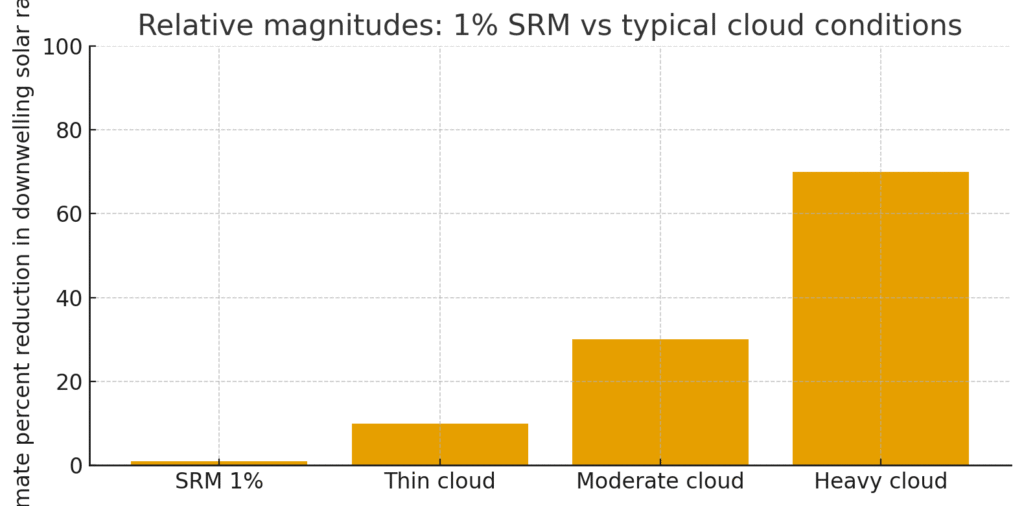
Bar chart that directly compares percent reductions: SRM 1% versus thin/moderate/heavy cloud.
Bottom line
A sustained 1% reduction in incoming solar radiation would not be visible to people on the ground and would not directly harm crops through reduced light. Its significance lies not in any perceptible dimming, but in the way it could alter global and regional energy balances, potentially shifting rainfall, temperature and circulation patterns.
In essence:
- Visual change: imperceptible.
- Photosynthetic impact: negligible.
- Climate-system impact: potentially important, depending on implementation method and location.
Governance, ethics, risk assessment
UKRI / NERC “Modelling environmental responses to SRM” programme
The UK is funding efforts (£10.5m over five years) to do independent risk-risk analyses: comparing risks of SRM vs risks of not doing SRM, looking across environmental, social, ethical dimensions. Also assessing governance, regulation, and stakeholder engagement.
Public and expert perceptions, justice, inclusivity
The recent SRM evidence review report from European scientific advice examines not only the physical science, but also public perceptions, justice (who gains/loses), ethical implications, international cooperation. There is increasing recognition that SRM research must not be done behind closed doors, but with transparency and broad inclusion of voices, especially from regions likely to be most affected.
Governance frameworks for MCB and other SRM
A recent paper identifies 12 governance challenges and 13 recommendations specific to Marine Cloud Brightening: for example, how to regulate field trials, who has consent, environmental impact assessments, reversible trials, monitoring, cross-border effects.
What are the key knowledge gaps & unresolved scientific/technical uncertainties
Research to date has uncovered many important issues; several remain especially uncertain. These are critical because they affect whether SRM can work as intended, with manageable risk, and whether it might have unintended bad outcomes.
Here are the main gaps:
Public perception and legitimacy: how communities especially in regions likely to be affected view SRM. Transparency, inclusion of stakeholders.
Aerosol particle properties and behaviour
What ideal particle types are best? SO₂ (sulphur dioxide) is well studied, but has drawbacks (ozone depletion, acid deposition, etc.). Solid particles (e.g. alkaline salts, calcite) might avoid some issues, but their interactions with atmospheric chemistry, UV, radiation, and microphysics under stratospheric conditions are imperfectly known.
How long particles persist, how they change (aging, coagulation, sedimentation) in the stratosphere. This impacts how often injections must recur, what overall burden is required.
Cloud response and saturation effects in MCB
Clouds respond in complex ways. For example, increasing cloud droplet number may increase albedo, but effects may saturate (i.e. past some point adding more particles gives diminishing returns). Also, brightened clouds might evaporate sooner, or have changes in lifetime or precipitation.
Spatial heterogeneity: effectiveness depends heavily on cloud cover, wind speed, regional meteorology. Some ocean regions may respond more than others. Injection strategies matter.
Atmospheric chemistry side effects
Ozone layer: many studies warn that aerosols (especially sulphur-based) could damage ozone, especially if particles provide surfaces for chemical reactions involving halogen species.
Effects on water vapour and stratospheric temperature (heating of stratosphere, which can feed back into climate).
Climate feedbacks, circulation, precipitation, extremes
How major atmospheric circulation patterns (monsoons, Hadley cell, jet streams) will respond. Some model results show weakening or shifting of monsoon rains under SAI or MCB. This could affect billions of people.
Influence on extremes: heatwaves, cold spells, droughts, floods. For example, regional cooling might reduce heat extremes but could also shift precipitation and produce unanticipated side-effects. Studies are now simulating how SRM might influence regional extremes.
Termination shock and long-term deployment issues
If SRM is deployed for years or decades and then abruptly halted, warming could proceed very rapidly (“termination shock”). Ecosystems and societies might struggle to adapt.
Longevity of interventions: how often injections, what scale is needed, possible cumulative side effects over many years.
Observational constraints and verification
Natural analogues (volcanoes, large aerosol emissions) help but are imperfect. Observations of clouds (e.g. ship tracks) are useful but often limited. There is a need for more field measurement, high-resolution monitoring.
Process-level understanding: how microphysical cloud processes, aerosol-cloud interactions, radiative transfer behave in real atmospheres, including turbulence, mixing, varying humidity. Many models approximate or parameterise these, which introduces uncertainty.
Governance, ethics, social, legal dimensions
Who decides deployment, trial approval, risk sharing? Many SRM effects (on climate, precipitation etc) cross national borders. Legal and political frameworks are not well developed. scientificadvice.eu+1
Ethics and justice: some regions may benefit, others may suffer. Distribution of risks and benefits; intergenerational responsibilities; potential for misuse.
Where the research might lead, and possible futures
Based on what is presently active, one can sketch possible trajectories:
- In the next few years (2025-2030), more small-scale field trials of MCB and related cloud brightening, possibly material exposure tests in the stratosphere via balloons (not releasing particles, but studying behaviour). UK’s ARIA is leading several such experiments.
- Improvement in climate models so that decision-makers can better estimate regional impacts, uncertainties, and trade-offs for SRM vs alternative interventions (mitigation, adaptation).
- Possible development of regulatory or international frameworks for governing SRM research: protocols for approval of trials, environmental impact assessments, standards for transparency.
- If results from experiments & modelling are favourable (i.e. cooling can be achieved with acceptable side effects), some governments or international bodies may begin to seriously consider SRM as a contingency measure, though deployment at scale is far off and risky.
- On the flip side, research may reveal that risks are too large, or side-effects too unpredictable, pushing consensus towards rejecting SRM beyond research, focusing instead solely on emissions reduction and carbon removal.
The potential dangers of SRM
One major concern is the potential for severe disruption of global weather patterns. Climate models suggest that SRM could alter rainfall distribution, leading to droughts in some regions and floods in others.
For instance, studies published in Nature Climate Change and Geophysical Research Letters have indicated that stratospheric aerosol injection could weaken monsoon systems in Asia and Africa, threatening food and water security for billions of people. These regional effects could emerge even if the global average temperature decreases.
Another danger lies in the so-called “termination shock.” If SRM were suddenly halted after being deployed for several years or decades, the planet could experience rapid warming as the masking effect of aerosols dissipates.
This abrupt temperature rise could be far more damaging to ecosystems and human societies than gradual warming. The Intergovernmental Panel on Climate Change (IPCC) has highlighted this as one of the most serious risks associated with large-scale SRM deployment.
There are also environmental side effects to consider. Stratospheric aerosols could accelerate ozone layer depletion, as seen after volcanic eruptions such as Mount Pinatubo in 1991. This would increase harmful ultraviolet radiation reaching Earth’s surface, with direct consequences for human health, crops, and marine ecosystems. Furthermore, aerosol injection could increase atmospheric acidification, affecting both the atmosphere and the biosphere in unpredictable ways.
The political and ethical implications are equally troubling. SRM could be relatively inexpensive compared with deep emissions cuts, raising fears that governments or private actors might deploy it unilaterally without international consensus.
Such actions could spark geopolitical tension if some nations experience adverse effects. The lack of clear governance frameworks for controlling or monitoring SRM experiments adds to the uncertainty. Scholars have warned that this “climate geopolitics” could destabilise international relations and erode trust in global climate cooperation.
Finally, reliance on SRM could reduce the political urgency to cut greenhouse gas emissions. Known as “moral hazard,” this phenomenon could undermine efforts to transition to renewable energy and sustainable economic systems. If societies come to view SRM as a technological quick fix, they might delay essential mitigation and adaptation strategies, worsening the long-term problem.
In summary, while Solar Radiation Modification may offer theoretical benefits in reducing global temperatures, its potential dangers — including altered weather patterns, termination shock, ozone depletion, geopolitical conflict, and moral hazard — make it a deeply risky proposition. Most experts agree that SRM should not replace emissions reduction but be approached, if at all, with extreme caution, transparent governance, and robust international oversight.
The Sun Dimming conspiracy theory
There is a persistent idea on social media that some actors (governments, elites, secret cabals) are or have been secretly taking action to reduce the amount of sunlight reaching Earth’s surface. The motivations alleged vary: population control, weather manipulation, slow mass poisoning, climate change mitigation disguised as something else, etc.
Often this merges with the “chemtrails” conspiracy: that contrails left by airplanes are actually chemical or particulate sprays (not just water vapour) intended to influence the atmosphere, block sunlight, modify weather, or reduce health, etc.
Supporters of the conspiracy point to:
- Persistent contrails / unusual cloud cover
- Perceived changes in sun brightness / colour over time
- Reports of government or scientific interest / research in solar geoengineering
- Patent filings or governmental documents for reflective particles or aerosol injections
Critics and fact-checkers respond that:
- Contrails are well understood scientifically as ice crystals / water vapour formed in cold, moist upper atmosphere; their persistence depends on atmospheric humidity, etc.
- There is no credible evidence in peer-reviewed literature that large-scale spraying programmes are underway.
- Many assertions rely on misinterpreted documents, mis‐labelled photos, or anecdotal observations.
When a conspiracy theory claims that “governments are already dimming the sun,” the presence of real SRM modelling work and small experiments can be misinterpreted or conflated. But the modelling evidence actually reveals:
- No consistent global pattern of “dimming everywhere” — projections always show heterogeneity in precipitation, extremes, etc.
- Trade-offs: some regions benefit in temperature but lose in rainfall or extremes. SRM is not benign or uniform.
- The uncertainty is very high; even the sign of change (wetter vs drier) is ambiguous in many zones.
- Models differ: any real deployment would likely reveal surprises outside our current maps.