
1. Analogy to Natural Clouds: “If Clouds Can Linger, So Can Contrails”
One of the simplest ways to understand persistent contrails is to compare them to ordinary cirrus clouds.
- Cirrus clouds form naturally when air at high altitude is ice‑supersaturated and an ice‑nucleating mechanism is present (dust, aerosols). They can last hours or even days.
- Contrails are the same phenomenon but triggered by aircraft exhaust instead of natural aerosols. The ice‑supersaturated environment is the same. Therefore, if natural cirrus can linger, so can contrails.
This is why meteorologists classify persistent contrails as a type of cirrus. The similarity is not rhetorical, it is literal, based on identical microphysics.
2. The Physics and Chemistry of Persistent Aircraft Trails
From ground level, the sight of long white streaks behind high‑flying aircraft is familiar. These streaks, called contrails (short for condensation trails), are visually striking and have become central to discussions about aviation’s environmental impact and, in some circles, public controversy.
While many contrails vanish quickly, others persist for tens of minutes to hours, gradually diffusing and often spreading into sheets or bands resembling natural high clouds.
This persistence is not mysterious. It follows directly from the same atmospheric physics that govern the formation and longevity of natural cirrus clouds.
This article explains, in technical depth, the mechanisms that control contrail formation, persistence, and spreading, showing why under the right conditions contrails behave exactly like cirrus clouds, because physically they are cirrus clouds seeded by aircraft exhaust.
3. Contrails are Man‑Made Cirrus Clouds
Contrails are essentially anthropogenic cirrus clouds. Their microphysical composition, radiative properties, and classification within the International Cloud Atlas are consistent with cirrus.
The World Meteorological Organization (WMO) classifies persistent contrails as a sub‑type of cirrus called cirrus homogenitus (from the Latin for “man‑made”). When these trails spread out significantly and become indistinguishable from natural cirrus, they are further designated cirrus homogenitus cumulus or cirrus homogenitus cumuliformis depending on structure.
3.1 Composition: Ice Crystals Like Those in Cirrus
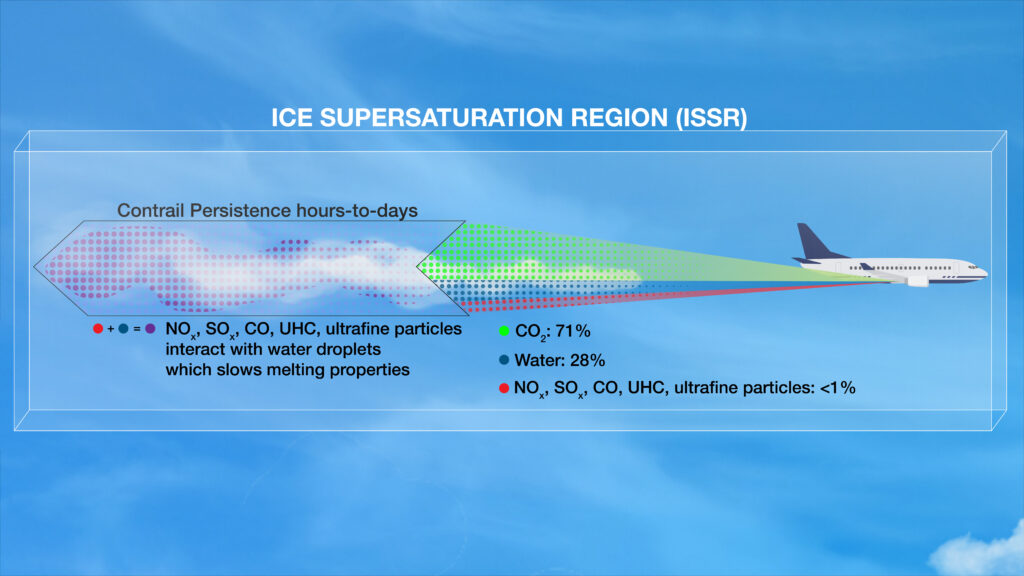
Contrails consist mainly of ice crystals, formed from water vapour emitted by the aircraft’s engines or entrained from the ambient air. Their composition (H₂O ice with trace sulfate/soot inclusions) is essentially identical to that of natural cirrus clouds.
Any differences to natural cirrus arise from the nucleation process (soot from the engines acting as condensation nuclei) and the initial crystal size distribution, but within seconds the contrail’s microphysics converge on those of high cirrus clouds.
3.2 Cloud Microphysics: Why Persistence Matters
Cloud persistence depends on the balance between sources and sinks of water vapour and the thermodynamic environment.
Relative humidity (RH) normally refers to the amount of water vapour in the air compared to the maximum it could hold before condensation, but that maximum depends on whether condensation happens onto liquid water or ice.
At very cold temperatures, like those in the upper troposphere where contrails form, ice is the relevant phase, so scientists use RHi (Relative Humidity with respect to ice) rather than the usual RH (Relative Humidity with respect to liquid water).
If the ambient air is ice‑supersaturated, that is, the relative humidity with respect to ice (RHi) exceeds 100%, then ice crystals grow by deposition of water vapour.
If RHi < 100%, crystals sublimate and the contrail dissipates. This is identical to natural cirrus formation: supersaturated conditions allow cirrus to persist for hours; undersaturated conditions cause rapid dissipation.
4. The Engine Exhaust: Source of Water and Nuclei
Aircraft engines burn hydrocarbon fuel (typically Jet A or Jet A‑1). Combustion produces carbon dioxide, water vapour, nitrogen oxides, trace unburned hydrocarbons, and particulate matter such as soot and sulfates.

4.1 Water Vapour Budget
Jet fuel combustion releases roughly 1.25 kg of water per kg of fuel burned. For a large twin‑engine airliner at cruise, fuel flow might be 2–3 tonnes per hour per engine, producing several tonnes of water vapour per hour.
At 10–12 km altitude, ambient air is extremely cold and dry by absolute humidity but may be ice‑supersaturated. When the hot, moist exhaust mixes with ambient air, the mixture can become locally saturated or supersaturated, triggering condensation and freezing.
4.2 Nucleation Sites
The exhaust also contains particles (soot, sulfates) which serve as condensation nuclei and ice nuclei.
In natural cirrus, such nuclei are provided by mineral dust, sea salt, or other aerosols.
In contrails, the aircraft effectively injects both vapour and nuclei into a conducive environment, seeding an instant ice cloud.
5. Increasing Frequency of Contrails in Modern Skies
5.1 Exponentially increasing flight numbers
The prevalence of contrails in today’s skies has increased significantly compared to several decades ago.
One major factor is the sheer scale of modern commercial aviation: more than 100,000 flights operate globally each day, compared with only a fraction of that in the mid‑20th century.
Each high‑altitude flight presents an opportunity for contrail formation under suitable atmospheric conditions, meaning that persistent trails are now much more common simply due to the density of air traffic.
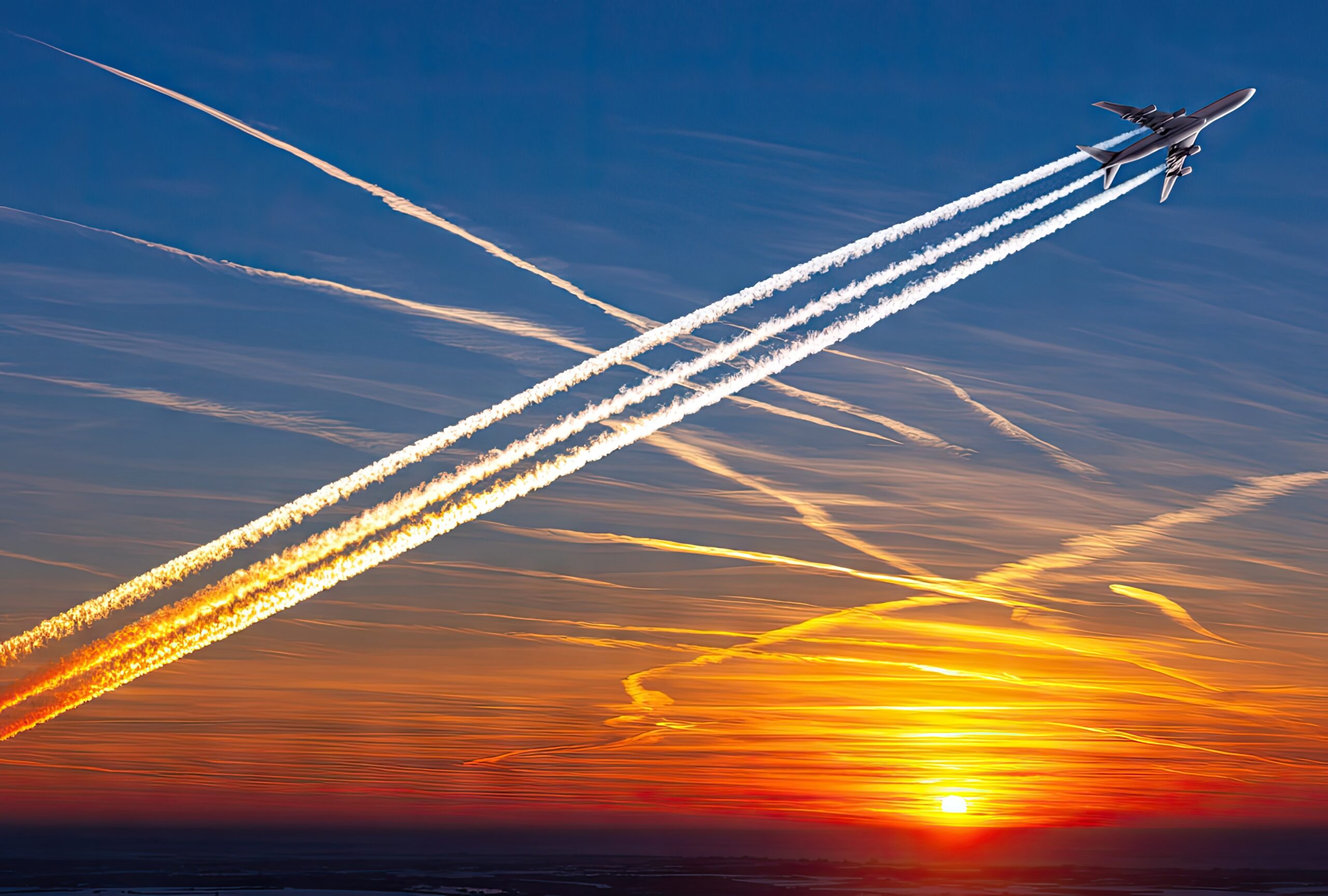
Regions with high traffic corridors, such as the North Atlantic, European airspace, and parts of the United States, regularly exhibit multiple overlapping contrails, sometimes forming extensive cirrus-like layers.
5.2 High Bypass Turbofan Engines
Another important contributor is the widespread adoption of high‑bypass turbofan engines.
Modern commercial airliners typically use engines with bypass ratios exceeding 5:1, meaning that the majority of the air moved by the engine bypasses the core combustion chamber and is accelerated by the fan.
This design increases fuel efficiency and reduces noise, but it also produces larger quantities of water vapour and cooler exhaust jets compared with older low-bypass engines.
The combination of more water vapour and lower local exhaust temperature promotes higher relative humidity in the wake, enhancing the likelihood of ice crystal formation and persistent contrails.
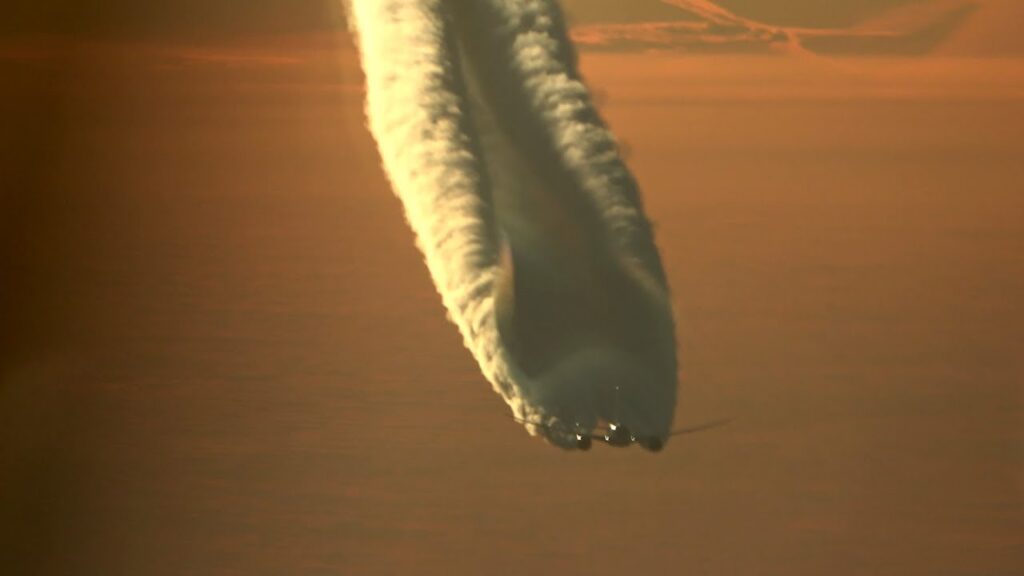
High‑bypass engines also emit more fine particulate matter in the wake, which acts as ice nuclei for contrail formation.
Even under the same atmospheric conditions, aircraft with modern high‑bypass engines are more likely to leave visible and long-lasting trails.
The increased efficiency and thrust of these engines allow larger aircraft to cruise at altitudes where the air is colder and more likely to be supersaturated with respect to ice, further promoting contrail persistence.
Consequently, both the growth of global air traffic and the shift to high‑bypass turbofans explain why we see contrails more frequently in contemporary skies.
Far from being a new or unusual phenomenon, persistent contrails are now a routine feature of the upper troposphere wherever traffic intersects supersaturated layers of cold air.
6. Thermodynamics of Contrail Formation
The formation and persistence of contrails are governed by mixing line thermodynamics in the temperature‑humidity plane. This was formalised in the Schmidt–Appleman criterion.
6.1 Schmidt–Appleman Criterion (SAC)
The criterion was first proposed by Ernst Schmidt (1941) and expanded by Herbert Appleman (1953) for use by the U.S. Air Force.
Appleman provided the practical charts and calculations that could predict contrail formation based on measurable flight and atmospheric parameters.
When a jet engine burns fuel, it produces water vapour and carbon dioxide as by-products. At high altitudes, typically between 8 km and 12 km, the air is very cold and often close to saturation with respect to ice.
The Schmidt–Appleman Criterion determines whether the mixing of hot, moist exhaust gases with the cold ambient air will cause that water vapour to condense and freeze into visible ice crystals, forming a contrail.
The SAC compares two conditions:
- The saturation vapour pressure in the engine exhaust plume, which depends on exhaust temperature, pressure, and water vapour concentration.
- The ambient atmospheric temperature and pressure at flight altitude.
Contrails form if the ambient temperature is below a critical temperature Tc given by the Schmidt–Appleman equation:
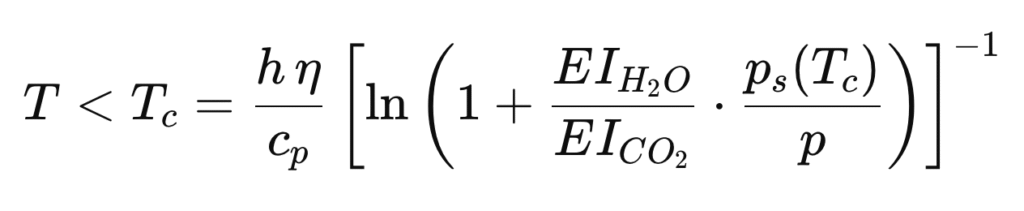
(where h is fuel combustion heat, η is engine efficiency, cp is specific heat, EI terms are emission indices, and ps(Tc) is the saturation vapour pressure).
In simpler terms, it expresses the threshold temperature below which the water vapour from exhaust cannot remain as gas, it must condense and freeze.
Meteorologists and aviation scientists use SAC with data such as:
- Ambient temperature and humidity at cruising altitude
- Engine type and efficiency
- Fuel composition
If these conditions meet the SAC threshold, a persistent contrail will likely form. If not, the exhaust simply disperses invisibly.
6.2 Persistent vs Short‑Lived Contrails
If the ambient air is ice‑subsaturated (RHi < 100%), ice crystals will sublimate and the contrail vanishes within seconds.
If the air is ice‑supersaturated (RHi > 100%), the crystals persist and grow, and the contrail may last for hours.
7. Atmospheric Conditions for Persistence
7.1 Ice‑Supersaturated Regions
Observations (Schumann 1996; Gierens et al. 1999) show that large portions of the upper troposphere, especially in the mid‑latitudes, are ice‑supersaturated.
These regions are invisible to the naked eye (clear air) but provide an environment where any ice cloud, once formed, can persist.
7.2 Temperature, Pressure and Humidity Profiles
Typical cruise altitudes (8-12 km) have pressures 200-300 hPa and temperatures -40 to -60°C. The saturation vapour pressure over ice at these temperatures is extremely low.
Small changes in mixing ratio or vertical motion can create ice‑supersaturation. Radiosonde and satellite data confirm frequent occurrences.
7.3 Wind Shear and Diffusion
Once formed, a contrail behaves like a passive tracer in the upper‑level wind field.
Wind shear spreads the contrail horizontally into filaments or sheets. Turbulent diffusion within the wake and the ambient flow further dilutes and broadens the contrail.
Over tens of minutes or hours, a narrow line can become a broad cirrus band several kilometres wide.
8. Microphysics of Contrail Evolution
8.1 Crystal Growth and Habit
Initial contrail ice crystals are typically sub‑micron to a few microns in radius. Under ice‑supersaturation they grow by vapour deposition to tens of microns within minutes.
Growth rate depends on supersaturation, temperature, and ambient pressure. Crystal habit (shape) varies with temperature: plates, columns, dendrites.
This affects optical properties but not the persistence mechanism.
8.2 Sedimentation vs Turbulence
Larger ice crystals sediment slowly (a few cm/s), but at 10 km altitude this is negligible for the timescales of contrail evolution.
Thus crystals remain suspended, advected by winds, much like natural cirrus.
8.3 Transition to Cirrus Homogenitus
As crystals grow and the wake turbulence dissipates, the contrail loses its linear shape.
At this stage it is essentially indistinguishable from natural cirrus, except for its origin.
The WMO classifies such clouds accordingly.
9. Radiative Properties and Climate Relevance
Because persistent contrails are cirrus clouds, they share similar radiative effects:
- Shortwave reflection: They reflect incoming solar radiation, producing a cooling effect.
- Longwave trapping: They absorb and re‑emit infrared radiation from the Earth, producing a warming effect.
For thin cirrus and contrails, the longwave warming effect often dominates, particularly at night.
Thus contrails contribute to aviation’s climate impact beyond CO₂ emissions.
Recent studies (e.g. Lee et al. 2021) estimate contrail cirrus accounts for more than half of aviation’s net radiative forcing.
10. Observational Evidence of Persistence
10.1 Satellite Remote Sensing
Instruments such as MODIS on NASA’s Terra and Aqua satellites can detect contrails and track their evolution.
Persistent contrails show up as thin, high‑altitude cirrus, sometimes covering large areas.
Algorithms match flight track data to contrail locations, confirming that under ice‑supersaturated conditions contrails last far longer than minutes.
10.2 In‑Situ Measurements
Research aircraft sampling contrails (Schumann et al. 2017) have measured ice crystal number concentrations, size distributions, and water vapour fields, confirming the microphysics described above.
Measurements show no anomalous chemical composition beyond expected combustion by‑products.
10.3 Ground‑Based Observations
Time‑lapse photography, lidar, and ceilometers at ground stations capture contrail lifetimes, spreading rates, and optical thickness.
These data show persistence from tens of minutes to several hours under suitable conditions, matching predictions from atmospheric models.
11. Model Simulations of Contrail Persistence
Global climate and weather models simulate contrail formation and spreading using parameterisations based on the Schmidt–Appleman criterion, RHi fields, and wind shear data.
High‑resolution large‑eddy simulations (LES) reproduce wake vortex dynamics and contrail ice crystal evolution.
These models confirm:
- Contrails form only under specific ambient conditions.
- Persistence and spreading occur under ice‑supersaturation.
- Contrails can evolve into extensive cirrus decks, affecting radiative forcing regionally.
12. Implications for Aviation and Climate Policy
Persistent contrails matter because of their radiative effects. Strategies under study include:
- Flight path optimisation: Avoiding ice‑supersaturated regions to reduce persistent contrail formation.
- Engine/airframe design: Reducing soot particle emissions to limit ice nucleation.
- Fuel changes: Using sustainable aviation fuels (SAFs) that produce fewer particulates may also reduce contrail ice crystal number concentrations.
These strategies aim to mitigate contrail climate impacts, not because contrails are mysterious, but because they are predictable and understood phenomena.
To Sum it up
Contrails are not merely transient plumes of exhaust. Under the right atmospheric conditions they are, in essence, man‑made cirrus clouds.
Their persistence and spreading follow from well‑established physics:
- They consist mainly of ice crystals, the same as natural cirrus clouds.
- Their formation and longevity depend on ambient temperature and ice supersaturation, described by the Schmidt–Appleman criterion.
- They spread and evolve due to wind shear, turbulence, and microphysical growth processes, just as natural cirrus does.
- Because of these similarities, meteorologists classify persistent contrails as cirrus homogenitus.
Therefore, if cirrus clouds can linger and spread, so can contrails, because physically, they are the same phenomenon seeded by aircraft.
Key References
- Appleman, H. (1953). The formation of exhaust condensation trails by jet aircraft. Bulletin of the American Meteorological Society, 34(1), 14–20.
- Schumann, U. (1996). On conditions for contrail formation from aircraft exhausts. Meteorologische Zeitschrift, 5(1), 4–23.
- Gierens, K., Schumann, U., Helten, M., Smit, H. G. J., & Marenco, A. (1999). A distribution law for relative humidity in the upper troposphere and lower stratosphere derived from three years of MOZAIC measurements. Journal of Geophysical Research: Atmospheres, 104(D23), 26957–26970.
- Schumann, U., et al. (2017). Properties of individual contrails: A comprehensive dataset derived from in situ and remote sensing observations. Atmospheric Chemistry and Physics, 17, 11411–11443.
- Lee, D. S., et al. (2021). The contribution of global aviation to anthropogenic climate forcing in 2018. Atmospheric Environment, 244, 117834.
- World Meteorological Organization. (2017). International Cloud Atlas: Classification of man‑made clouds (cirrus homogenitus).